Table of Contents
Introduction
How beginners lose money in trading is primarily a psychological problem, not a technical one. While new traders spend countless hours learning chart patterns and indicators, 90% of trading success comes down to controlling your emotions and avoiding mental mistakes that destroy accounts.
The harsh reality is that 80% of new traders lose money within their first year, and the culprit isn’t market crashes or bad luck—it’s their own mind working against them. Every day, millions of dollars flow from emotional, undisciplined beginners to experienced traders who understand that trading is fundamentally a psychological game.
In this comprehensive guide on how beginners lose money, you’ll discover the exact psychology mistakes that cause beginners to lose money, real-world examples of these costly errors, and proven strategies to develop the mental discipline needed for consistent profitability. Whether you’re trading stocks, forex, or cryptocurrency, understanding these psychological traps could save your account from joining the 80% failure rate.
The Shocking Reality: Why 90% of Beginners Fail
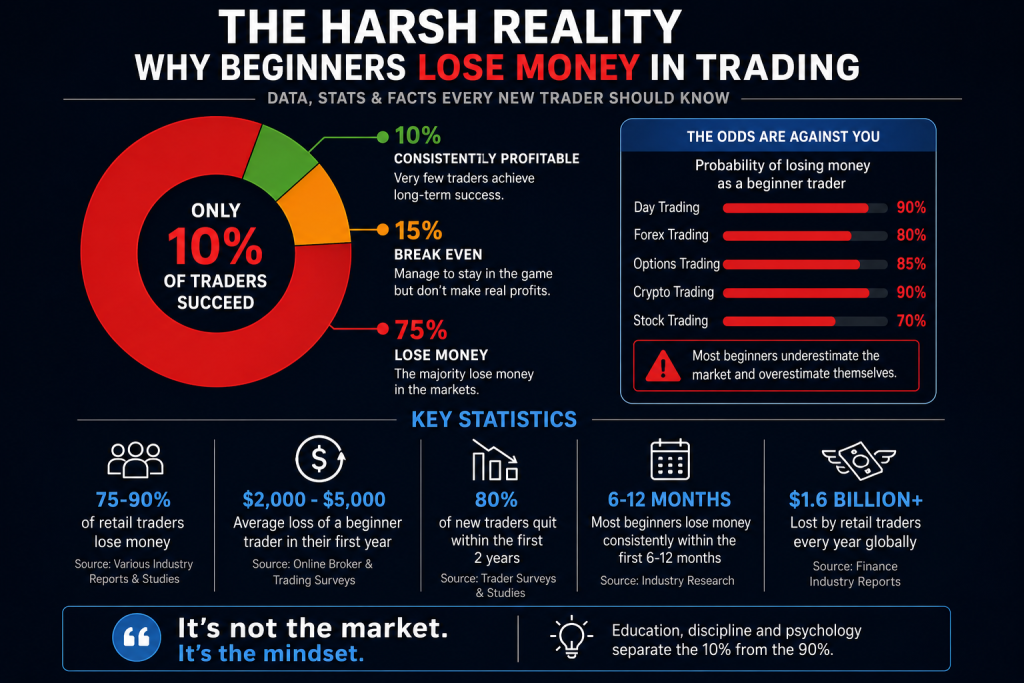
Understanding how beginners lose money starts with acknowledging the brutal statistics. According to data from major brokers and regulatory bodies:
- 80-90% of day traders lose money consistently
- 75% of new traders lose their entire account within 6 months
- Only 5-10% achieve consistent profitability
- The average beginner loses $15,000-$25,000 before quitting
These numbers aren’t caused by market complexity or lack of information. In today’s digital age, trading education is more accessible than ever. The real culprit is human psychology—our brains are simply not wired for successful trading.
The Evolutionary Problem
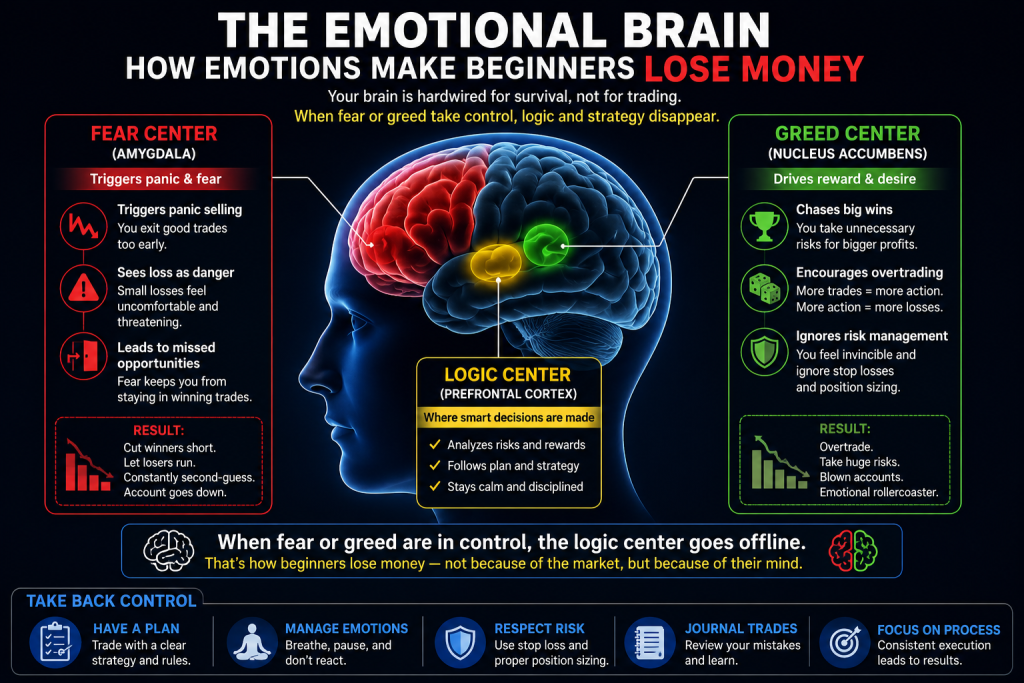
Our brains evolved for survival in hostile environments, not for making rational financial decisions. The same fight-or-flight responses that helped our ancestors survive now work against modern traders:
| Evolutionary Response | Trading Impact |
|---|---|
| Fear of predators | Panic selling during volatility |
| Seeking immediate rewards | Overtrading for quick profits |
| Following the herd | FOMO and crowd following |
| Avoiding losses | Holding losing trades too long |
The 7 Fatal Psychology Mistakes That Destroy Trading Accounts
1. Revenge Trading: The Account Killer
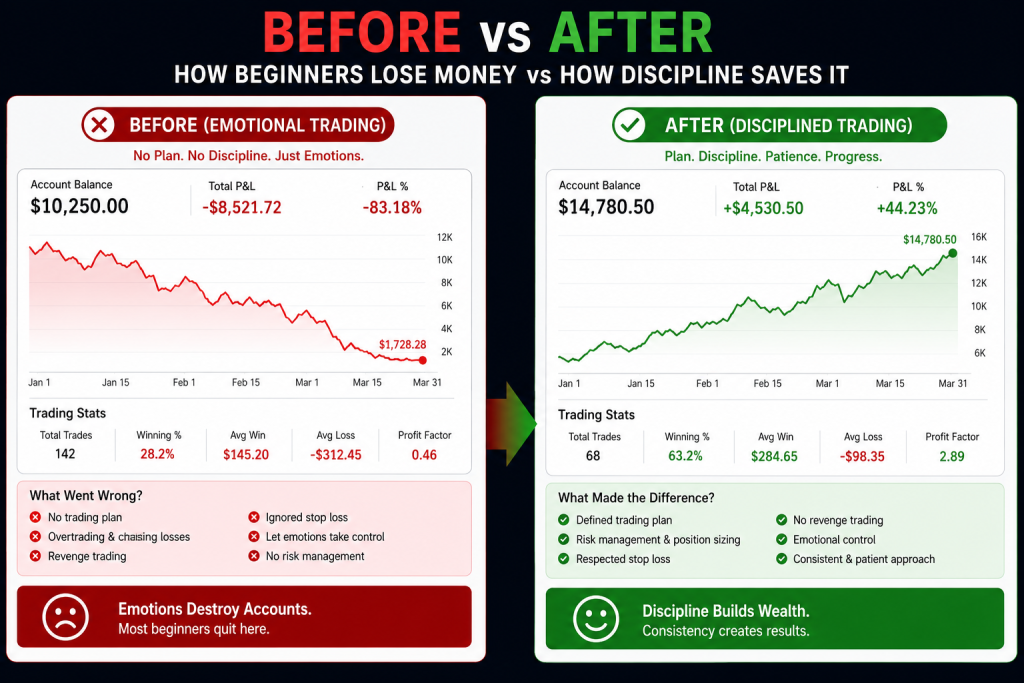
Revenge trading occurs when beginners try to “get back” at the market after losses. This emotional response transforms small setbacks into account-destroying disasters.
How It Manifests:
- Doubling position sizes after losses
- Abandoning risk management rules
- Trading outside your strategy
- Making impulsive decisions driven by anger
Real Example: Sarah, a new forex trader, lost $200 on EUR/USD. Feeling frustrated, she immediately opened a position twice as large to “win back” her money. When that trade also failed, she quadrupled her next position size, ultimately losing $3,200 in one session.
2. Fear of Missing Out (FOMO)
FOMO trading drives beginners to chase price movements that have already occurred, consistently buying high and selling low.
Warning Signs:
- Entering trades after significant moves
- Following social media “tips” without analysis
- Jumping between strategies constantly
- Trading during high-emotion market events
3. Overconfidence Bias
A few lucky wins create dangerous overconfidence, leading beginners to believe they’ve “figured out” the market.
Dangerous Behaviors:
- Increasing position sizes too quickly
- Ignoring risk management
- Skipping trade analysis
- Dismissing market warnings
4. Analysis Paralysis
Some beginners swing to the opposite extreme, analyzing every detail until perfect trading opportunities pass by.
Symptoms Include:
- Waiting for “perfect” setups that never come
- Over-researching trades
- Second-guessing every decision
- Missing obvious opportunities
5. Loss Aversion
The psychological pain of losses feels twice as strong as the pleasure of equal gains, causing beginners to hold losers too long while selling winners too early.
6. Confirmation Bias
Seeking only information that supports existing positions while ignoring contradictory evidence prevents objective decision-making.
7. Gambler’s Fallacy
Believing that past results affect future probabilities leads to poor position sizing and timing decisions.
Fear and Greed: The Twin Account Destroyers
Understanding how beginners lose money requires examining fear and greed—the two primary emotions that override logical thinking.
Fear Manifestations in Trading
1. Fear of Loss
- Exiting winning positions too early
- Holding losing trades hoping for recovery
- Reducing position sizes after wins
- Avoiding trades after losses
2. Fear of Being Wrong
- Refusing to admit mistakes
- Not using stop losses
- Adding to losing positions
- Ignoring technical signals
3. Panic Selling
During market volatility, fear-driven decisions include:
- Selling at market bottoms
- Closing all positions during downturns
- Abandoning long-term strategies
- Following crowd panic
Greed’s Destructive Impact
1. Overtrading
- Trading for entertainment rather than profit
- Ignoring quality trade setups
- Excessive position sizes
- Constant market monitoring
2. Profit Maximization Obsession
- Holding winners too long
- Ignoring exit signals
- Adding to winning positions at poor prices
- Risking profits for marginal gains
Real-World Case Studies of Psychology-Driven Losses
Case Study 1: The Crypto FOMO Disaster
Background: Mike, a 28-year-old software developer, entered crypto trading during the 2021 bull market with $10,000.
The Mistake: Driven by social media hype, Mike consistently bought cryptocurrencies after 50-100% moves, convinced he was “still early.”
Psychology Errors:
- FOMO-driven entries
- Confirmation bias (following only bullish news)
- Overconfidence from early lucky trades
Result: Lost 90% of his account ($9,000) within 3 months when markets corrected.
Lesson: FOMO entries consistently result in buying peaks and selling bottoms.
Case Study 2: The Forex Revenge Spiral
Background: Jennifer, a nurse, started forex trading with $5,000 hoping to supplement her income.
The Mistake: After losing $300 on her first trade, Jennifer doubled her next position size to recover quickly.
Psychology Errors:
- Revenge trading
- Poor risk management
- Emotional decision-making
Result: A series of larger losing trades depleted her entire account within 2 weeks.
Lesson: Emotional trading decisions compound losses exponentially.
Also Read: What is Trading Psychology? The Complete Guide to Mastering Your Mind in Trading
The Hidden Costs of Emotional Trading
How beginners lose money extends beyond obvious trading losses to include hidden costs that drain accounts:
Direct Financial Costs
| Cost Type | Annual Impact |
|---|---|
| Excessive commissions | $2,000-$5,000 |
| Spread costs from overtrading | $1,500-$3,000 |
| Slippage from emotional entries | $1,000-$2,500 |
| Opportunity costs | $5,000-$10,000 |
Psychological Costs
- Stress and anxiety affecting personal relationships
- Sleep disruption from constant market monitoring
- Confidence erosion leading to missed opportunities
- Decision fatigue reducing overall judgment quality
Building Unshakeable Trading Discipline
Successful traders develop specific habits and systems to overcome psychological obstacles.
Core Principles of Trading Psychology
1. Process Over Profits
Focus on executing your strategy correctly rather than on individual trade outcomes.
2. Probability Thinking
Understand that each trade is just one in a series of hundreds you’ll make over time.
3. Emotional Regulation
Develop techniques to recognize and manage emotional states before they affect decisions.
4. Systematic Approach
Create and follow detailed rules for every aspect of trading.
Practical Discipline-Building Techniques
Pre-Market Routine
- Review trading plan
- Set daily risk limits
- Identify key market levels
- Prepare for different scenarios
In-Market Execution
- Follow predetermined entry/exit rules
- Use mechanical stop losses
- Avoid news during trading hours
- Take breaks between trades
Post-Market Analysis
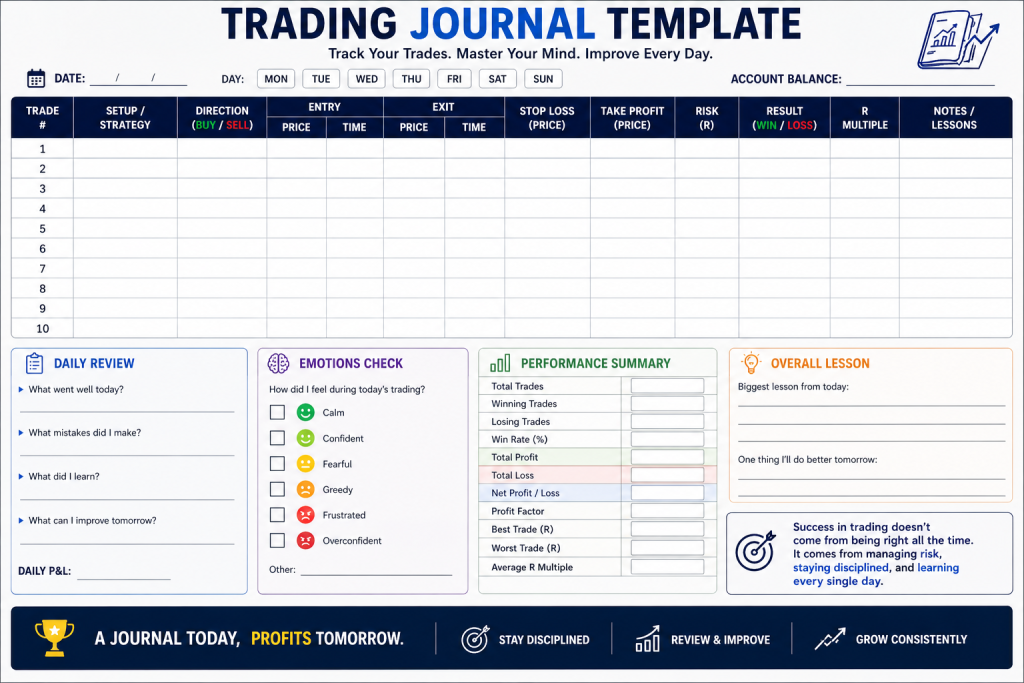
- Journal all trades
- Review emotional states
- Identify improvement areas
- Plan next day’s approach
Step-by-Step Guide to Psychological Trading Mastery
Phase 1: Foundation Building (Weeks 1-4)
Week 1: Self-Assessment
- Complete trading personality questionnaire
- Identify emotional triggers
- Set realistic expectations
- Define risk tolerance
Week 2: Rule Creation
- Develop detailed trading plan
- Create position sizing rules
- Establish risk management guidelines
- Design exit strategies
Week 3: Simulation Practice
- Practice on demo account
- Focus on rule-following, not profits
- Track emotional responses
- Refine trading plan
Week 4: Small Capital Deployment
- Start with minimal position sizes
- Continue emotional tracking
- Build confidence through consistency
- Document all trades
Phase 2: Skill Development (Weeks 5-12)
Weeks 5-8: Pattern Recognition
- Identify personal bias patterns
- Develop counter-strategies
- Practice emotional regulation
- Gradually increase position sizes
Weeks 9-12: Advanced Psychology
- Study market psychology
- Learn from trading legends
- Join trader communities
- Seek mentorship opportunities
Phase 3: Mastery (Weeks 13+)
Ongoing Development
- Continuous self-analysis
- Strategy refinement
- Psychological skill building
- Performance optimization
Expert Tips from Professional Traders
Tip 1: Treat Trading Like a Business
“Most beginners lose money because they treat trading like gambling instead of a business.” – Mark Douglas, Trading Psychology Expert
- Keep detailed records
- Separate emotions from decisions
- Focus on long-term profitability
- Continuously improve processes
Tip 2: Risk Management is Everything
“It’s not about being right or wrong, it’s about how much you make when you’re right and how much you lose when you’re wrong.” – George Soros
- Never risk more than 1-2% per trade
- Use position sizing calculators
- Diversify across strategies
- Plan for worst-case scenarios
Tip 3: Master Your Emotions
“The market is a device for transferring money from the impatient to the patient.” – Warren Buffett
- Develop emotional intelligence
- Practice meditation or mindfulness
- Take regular breaks from trading
- Maintain work-life balance
Common Mistakes to Avoid
Mistake 1: Ignoring Psychology Education
Many beginners focus solely on technical analysis while ignoring the psychological aspects that cause 90% of failures.
Solution: Dedicate at least 50% of your education time to trading psychology.
Mistake 2: Starting with Real Money Too Soon
Jumping into live trading without sufficient psychological preparation leads to emotional decision-making.
Solution: Practice on demo accounts until you can follow your rules consistently for at least 3 months.
Mistake 3: Not Keeping a Trading Journal
Without detailed records, you can’t identify psychological patterns that cause losses.
Solution: Document every trade including emotional state, reasoning, and lessons learned.
Mistake 4: Following Others’ Trades
Copying other traders prevents you from developing personal discipline and understanding.
Solution: Learn from others but develop and trade your own strategy.
Mistake 5: Perfectionism Paralysis
Waiting for perfect setups or trying to time the market perfectly prevents taking good trades.
Solution: Accept that trading involves probabilities, not certainties.
Frequently Asked Questions
What is the main reason beginners lose money in trading?
How beginners lose money primarily stems from psychological mistakes rather than lack of market knowledge. The top reasons include emotional decision-making, poor risk management, overtrading, and letting fear and greed drive trading decisions instead of following a systematic approach.
How can I control my emotions while trading?
Controlling emotions requires developing specific habits: create and follow a detailed trading plan, use predetermined position sizes, set mechanical stop losses, take regular breaks from screens, practice mindfulness, and maintain a trading journal to track emotional patterns.
What percentage of beginner traders actually lose money?
Studies consistently show that 80-90% of beginner traders lose money. According to brokers’ reports and regulatory data, approximately 75% lose their entire account within 6 months, and only 5-10% achieve consistent long-term profitability.
How much money should beginners start with?
Beginners should start with an amount they can afford to lose completely—typically $1,000-$5,000. More importantly, position sizes should never exceed 1-2% of total account value per trade, regardless of account size.
Is it normal to lose money when starting trading?
Yes, losing money initially is extremely common and often necessary for learning proper risk management and emotional control. However, these losses should be small, controlled, and part of a structured learning process rather than large emotional mistakes.
How long does it take to become consistently profitable?
Most successful traders report it takes 2-5 years to achieve consistent profitability. This includes time to develop proper psychology, refine strategies, and build the discipline necessary for long-term success.
Also Read: Why Emotions Control Your Trades: Master Your Trading Psychology for Better Results
Conclusion
Understanding how beginners lose money through psychological mistakes is crucial for anyone serious about trading success. The 7 fatal mistakes we’ve covered—revenge trading, FOMO, overconfidence, analysis paralysis, loss aversion, confirmation bias, and gambler’s fallacy—destroy more accounts than market crashes or poor strategies combined.
The path to trading profitability isn’t about finding the perfect system or predicting market movements. It’s about developing the psychological discipline to follow proven processes consistently, even when emotions suggest otherwise.
Remember these key takeaways:
- 90% of trading success comes from psychology, not technical analysis
- Emotional decisions consistently lead to buying high and selling low
- Small position sizes and strict rules prevent catastrophic losses
- Continuous self-analysis helps identify and correct destructive patterns
- Patience and discipline separate winners from the 90% who fail
Your journey to consistent profitability starts with mastering the trader in the mirror. Focus on building proper habits, managing emotions, and following systematic approaches rather than chasing quick profits.
Ready to transform your trading psychology and join the successful minority? Explore more trading education resources at Zyqorr.com and take the first step toward consistent profitability.
Financial Disclaimer
This content is for educational purposes only and should not be considered financial advice. Trading involves substantial risk of loss and may not be suitable for all investors. Always conduct your own research and consider consulting with a qualified financial advisor before making trading decisions. Past performance does not guarantee future results.
Sources and References
- Securities and Exchange Commission – Day Trading
- Investopedia – Trading Psychology
- Federal Reserve – Financial Stability Report
- TradingView – Market Psychology Analysis
- Behavioral Finance Research Studies – Journal of Finance
- Mark Douglas – “Trading in the Zone” – Trading Psychology Classic