Table of Contents
Introduction
Cryptocurrency has continued to move into the mainstream in 2026, with millions of new investors entering the market through user-friendly apps and regulated trading platforms. What was once considered a niche asset class is now widely accessible to everyday investors who want exposure to digital assets such as Bitcoin, Ethereum, and other cryptocurrencies. As adoption grows, choosing the right crypto exchange has become one of the most important decisions for anyone starting their crypto journey.
A crypto exchange is the platform where you buy, sell, and store digital assets. For beginners, the quality of the exchange can significantly impact the overall experience. A well-designed platform can make it easy to fund your account, place your first trade, and manage your portfolio with confidence. On the other hand, an exchange with weak security, confusing navigation, or hidden fees can lead to unnecessary risks and costly mistakes.
Security should be a top priority when selecting a crypto exchange. Reputable platforms typically offer features such as two-factor authentication (2FA), cold storage for customer assets, and proof-of-reserves reporting. Ease of use is equally important, especially for first-time investors who may not be familiar with trading interfaces, order types, or blockchain terminology.
This guide is designed specifically for beginners who want to start investing in cryptocurrency safely and confidently in 2026. Whether you are buying your first Bitcoin or comparing platforms with low fees and strong security, this article will help you identify the best crypto exchanges based on your needs.
To provide balanced and trustworthy recommendations, we evaluated each exchange using the following criteria:
- User Experience: Intuitive interface, mobile app quality, and educational tools.
- Fees: Trading fees, spreads, and deposit or withdrawal charges.
- Regulation: Compliance with financial regulations and licensing standards.
- Security: Account protection, asset custody practices, and transparency.
By the end of this guide, you will have a clear understanding of which crypto exchanges are best suited for beginners and what factors matter most when choosing a platform to start your cryptocurrency journey.
What Is a Crypto Exchange?

A cryptocurrency exchange is an online platform that allows users to buy, sell, and trade digital assets such as Bitcoin, Ethereum, and thousands of other cryptocurrencies. In simple terms, it functions much like a stock brokerage account, but instead of trading shares of companies, you trade cryptocurrencies.
Crypto exchanges also provide additional services such as account funding through bank transfers or cards, portfolio tracking, recurring purchases, staking, and secure custody options. For most people, a crypto exchange is the starting point for entering the digital asset market.
How Crypto Exchanges Work
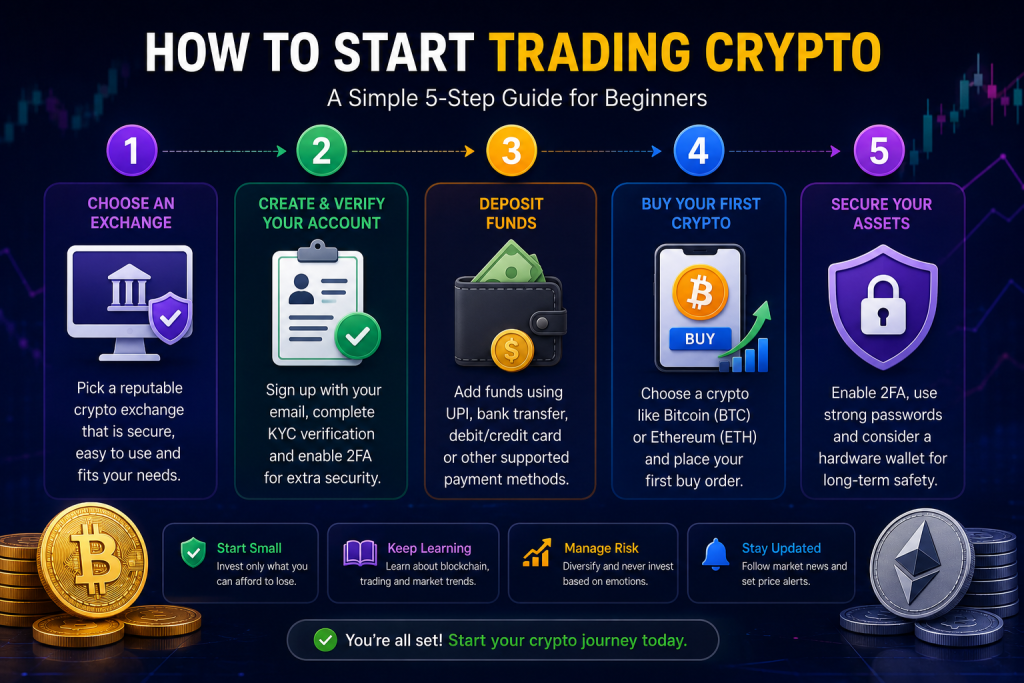
When you open an account with a crypto exchange, you can deposit funds using supported payment methods such as bank transfer, debit card, credit card, or regional payment systems like UPI where available. Once your account is funded, you can place an order to buy cryptocurrency.
Some exchanges offer a simplified “Buy Now” feature for beginners, while others include advanced trading interfaces with charts, order books, and multiple order types.
Centralized Exchanges (CEXs) vs. Decentralized Exchanges (DEXs)
Crypto exchanges generally fall into two main categories: centralized exchanges and decentralized exchanges.
Centralized Exchanges (CEXs)
Centralized exchanges are operated by companies that manage the platform and facilitate transactions between buyers and sellers.
Popular examples include Coinbase, Binance, and Kraken.
Key Characteristics of CEXs:
- User-friendly interfaces
- Account registration with identity verification (KYC)
- Customer support
- Fiat currency deposits and withdrawals
- Security features such as two-factor authentication and cold storage
Decentralized Exchanges (DEXs)
Decentralized exchanges operate using smart contracts on blockchain networks. Instead of creating an account with a company, users connect their own crypto wallets and trade directly on-chain.
Popular examples include Uniswap and PancakeSwap.
Key Characteristics of DEXs:
- No centralized intermediary
- Users maintain custody of their assets
- No standard KYC in most cases
- Requires a crypto wallet
- Can be more complex for beginners
Centralized vs. Decentralized Exchanges: Quick Comparison
| Feature | Centralized Exchanges (CEXs) | Decentralized Exchanges (DEXs) |
| Ease of Use | Excellent for beginners | More technical |
| Fiat Deposits | Yes | Usually not supported |
| Customer Support | Available | Limited or none |
| Identity Verification | Usually required | Often not required |
| Asset Custody | Exchange holds assets | User controls assets |
| Trading Fees | Competitive | Network fees can vary |
| Security Responsibility | Shared with platform | Entirely on the user |
Why Beginners Usually Start with Centralized Exchanges
For most first-time investors, centralized exchanges offer the safest and easiest way to buy cryptocurrency.
Simpler User Experience
Platforms like Coinbase and Kraken are designed for non-technical users, with clean interfaces and step-by-step onboarding.
Easy Fiat On-Ramps
Beginners can deposit local currency directly from a bank account or card without needing an external wallet first.
Built-In Security Features
Reputable exchanges provide 2FA, withdrawal protection, device management, and cold storage.
Educational Resources
Many beginner-focused platforms offer tutorials, glossaries, and market insights.
Customer Support
If you encounter issues with verification, deposits, or withdrawals, centralized exchanges generally provide help centers and support teams.
When You Might Consider a DEX
As you gain experience, you may want to explore decentralized exchanges to access newer tokens, maintain direct control over your assets, and interact with decentralized finance (DeFi) applications. However, DEXs require a stronger understanding of wallets, private keys, and blockchain transaction fees.
Bottom Line
A crypto exchange is the platform that enables you to buy and sell digital assets. While both centralized and decentralized exchanges serve important roles in the crypto ecosystem, beginners typically benefit most from starting with a reputable centralized exchange due to its ease of use, stronger support, and simpler funding options. Once you are comfortable with the basics, you can explore more advanced tools and platforms as your experience grows.
How Beginners Should Choose a Crypto Exchange
Choosing the right crypto exchange is one of the most important decisions a new investor will make. The platform you select will determine how easily you can buy cryptocurrency, how much you pay in fees, and how securely your funds are protected.
For beginners, the best crypto exchanges combine strong security, simple interfaces, transparent pricing, and responsive customer support. Rather than focusing only on the lowest fees or the largest number of listed coins, new investors should evaluate each platform using a few essential criteria.
Security
Security should be your top priority when selecting a cryptocurrency exchange. While no platform is completely risk-free, reputable exchanges invest heavily in protecting customer accounts and digital assets.
Two-Factor Authentication (2FA)
Two-factor authentication adds an extra layer of security by requiring a one-time verification code in addition to your password. This makes it much harder for unauthorized users to access your account.
For maximum protection, use an authenticator app instead of SMS-based verification whenever possible.
Cold Storage
Leading exchanges store the majority of customer assets in offline wallets, known as cold storage. Because these wallets are disconnected from the internet, they are less vulnerable to hacking attempts.
Proof of Reserves
Some exchanges publish proof-of-reserves reports to demonstrate that they hold sufficient assets to cover customer balances. While this does not eliminate all risks, it adds an important layer of transparency.
Regulation
Regulatory oversight can provide additional confidence that an exchange follows industry standards and legal requirements.
Licensing and Compliance
Well-established exchanges typically comply with Know Your Customer (KYC) and Anti-Money Laundering (AML) regulations. They may also hold licenses or registrations in the jurisdictions where they operate.
Beginners may prefer exchanges with a strong compliance record, as these platforms are generally more transparent and accountable.
Ease of Use
A beginner-friendly exchange should make it easy to deposit funds, buy cryptocurrency, and monitor your portfolio.
Simple Interface
Look for platforms with intuitive navigation, straightforward order forms, and educational prompts that guide new users through the buying process.
Mobile App Quality
Many investors manage their portfolios primarily through mobile devices. A well-designed app should offer smooth navigation, secure login options, and access to essential features such as deposits, trading, and withdrawals.
Fees
Even small differences in fees can affect your long-term returns, especially if you invest regularly.
Trading Fees
Most exchanges charge a percentage-based fee when you buy or sell cryptocurrency. Some platforms offer lower fees for higher trading volumes or when using native tokens.
Deposit and Withdrawal Charges
In addition to trading fees, review any charges for funding your account or withdrawing money and crypto assets. Bank transfers are often less expensive than card purchases.
Supported Payment Methods
The more convenient the funding options, the easier it is to begin investing.
Bank Transfer
Bank transfers are typically the most cost-effective way to deposit funds into your exchange account.
Debit and Credit Cards
Card payments allow for instant purchases but often carry higher fees.
UPI (Where Available)
For users in India, UPI support can make deposits faster and more convenient, although availability may vary based on exchange policies and local regulations.
Customer Support
Reliable customer support is especially important for beginners who may need help with verification, deposits, or account security.
Live Chat
Real-time support can be extremely valuable when urgent issues arise.
Help Center
A comprehensive knowledge base with tutorials, FAQs, and troubleshooting guides can help you solve common problems quickly.
Quick Checklist for Beginners
Before choosing a crypto exchange, ask yourself the following questions:
- Does the platform offer two-factor authentication and cold storage?
- Is the exchange regulated and compliant in relevant jurisdictions?
- Is the interface easy to understand for first-time users?
- Are the fees clearly disclosed?
- Does it support your preferred payment method?
- Is customer support responsive and accessible?
Bottom Line
The best crypto exchange for beginners is not necessarily the one with the most features or the lowest advertised fees. Instead, it is the platform that offers a secure environment, transparent pricing, a beginner-friendly experience, and dependable support.
By focusing on security, regulation, ease of use, fees, payment methods, and customer service, you can choose a platform that helps you start your cryptocurrency journey with greater confidence and lower risk.
Key Features to Look For
Beyond security, fees, and ease of use, many crypto exchanges offer additional features that can make the investing experience smoother and more educational for beginners. These tools can help you build confidence, automate your investing strategy, and monitor your portfolio more effectively.
When comparing beginner-friendly crypto exchanges, consider whether the platform includes the following features.
Educational Resources
Cryptocurrency can feel overwhelming when you are just getting started. Exchanges that provide educational content can help you understand key concepts such as blockchain technology, wallets, trading basics, and risk management.
Many leading platforms, including Coinbase and Kraken, offer beginner guides, articles, videos, and market explainers.
Why Educational Resources Matter
- Help new investors understand how cryptocurrency works
- Explain market terminology and order types
- Improve confidence before making your first purchase
- Promote informed decision-making rather than speculation
If you are new to digital assets, an exchange with a strong educational library can significantly shorten your learning curve.
Demo Mode or Paper Trading
Some exchanges provide demo accounts or paper trading tools that allow you to practice buying and selling crypto using virtual funds.
This feature lets you explore the platform and test strategies without risking real money.
Benefits of Paper Trading
- Learn how orders work
- Understand market movements
- Build confidence in a risk-free environment
- Practice before committing capital
While not every exchange offers a demo mode, it can be a valuable feature for beginners who want hands-on experience.
Recurring Buy Options
Recurring buy features allow you to automate cryptocurrency purchases on a daily, weekly, or monthly schedule.
This approach supports dollar-cost averaging (DCA), a strategy where you invest fixed amounts over time rather than trying to time the market.
Benefits of Recurring Buys
- Encourages disciplined investing
- Reduces emotional decision-making
- Smooths out price volatility over time
- Saves time through automation
For long-term investors, recurring buys are one of the simplest ways to build exposure gradually.
Staking Opportunities
Some exchanges allow users to earn rewards by staking supported cryptocurrencies. Staking involves helping secure certain blockchain networks in exchange for yield.
Popular staking assets may include Ethereum, Solana, Cardano, and others, depending on platform availability and regional restrictions.
Things Beginners Should Know About Staking
- Rewards are not guaranteed
- Lock-up periods may apply
- Asset prices can still fluctuate significantly
- Availability varies by jurisdiction
Staking can be an attractive feature, but beginners should understand both the potential rewards and the associated risks.
Portfolio Tracking Tools
Built-in portfolio dashboards help users monitor account balances, profit and loss, and asset allocation from one place.
Useful Portfolio Features
- Real-time balance updates
- Historical performance charts
- Cost basis tracking
- Profit and loss summaries
- Allocation breakdowns
These tools make it easier to understand how your investments are performing and can help you make more informed decisions.
Additional Features Worth Considering
Depending on your goals, you may also value:
- Price alerts
- Watchlists
- Tax reporting tools
- Crypto wallets
- Advanced charting features
These features may not be essential for beginners, but they can become useful as your experience grows.
Bottom Line
The best crypto exchanges for beginners do more than simply process trades. They provide educational resources, practice tools, automated investing options, staking opportunities, and portfolio tracking features that help new investors learn and grow with confidence.
When comparing exchanges, consider which features align with your investing style and long-term goals. A platform that supports both your current needs and future development can make your cryptocurrency journey significantly easier and more rewarding.
Best Crypto Exchanges for Beginners in 2026
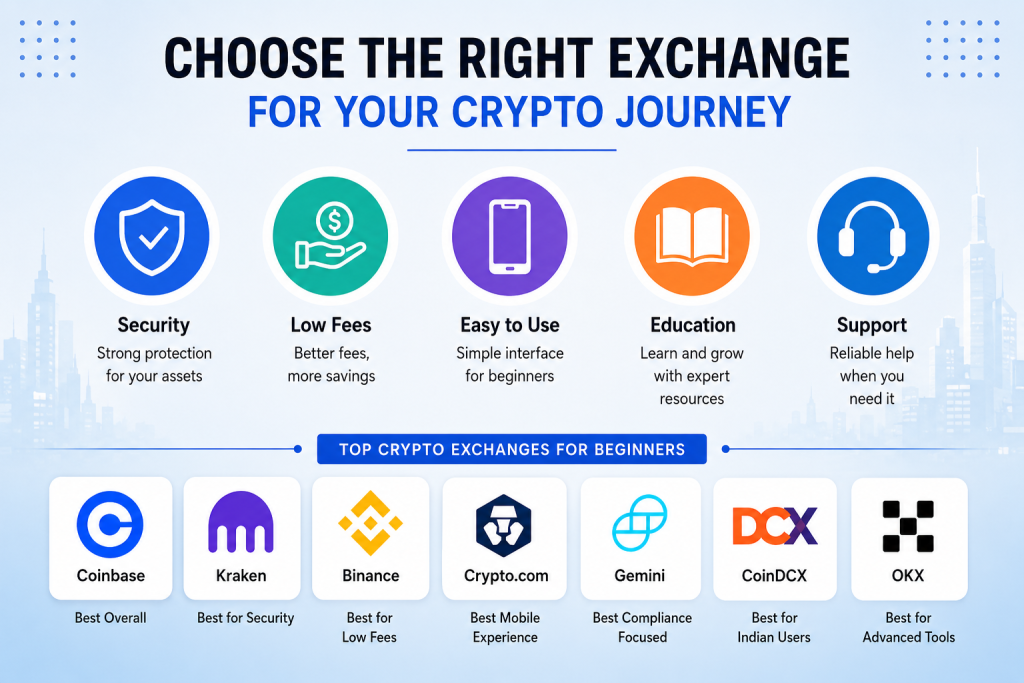
Choosing the right crypto exchange can make a significant difference in your investing experience. Some platforms are designed for simplicity, while others focus on low fees, security, or advanced tools that you can grow into over time.
Below are seven of the best crypto exchanges for beginners in 2026, selected based on ease of use, security, fee transparency, educational resources, and overall reputation.
1. Coinbase
Best For: Simplicity and education
Coinbase remains one of the most beginner-friendly cryptocurrency exchanges in the world. Its clean interface, step-by-step onboarding, and extensive educational content make it an excellent starting point for first-time investors.
Pros
- Extremely easy-to-use interface
- Strong educational resources for beginners
- Supports recurring purchases
- Well-established and publicly traded company
- Robust security features
Cons
- Trading fees and spreads can be higher than some competitors
- Limited advanced features on the basic interface
Ideal User Profile
Coinbase is ideal for beginners who want a simple, trusted platform to buy their first cryptocurrency without dealing with complex trading tools.
In my own testing, Coinbase provided the smoothest onboarding experience. From downloading the app to purchasing my first small amount of crypto, the entire process was straightforward and beginner-friendly.
2. Kraken
Best For: Security-focused beginners
Kraken has built a strong reputation for security, transparency, and reliable customer support. It offers both beginner-friendly purchase options and more advanced trading tools.
Pros
- Excellent security track record
- Competitive fees
- Strong customer support
- Wide range of supported cryptocurrencies
- Transparent fee structure
Cons
- Interface may feel slightly more technical than Coinbase
- Some features may vary by region
Ideal User Profile
Kraken is a strong choice for beginners who prioritize security and want a platform they can continue using as they become more experienced.
Kraken stood out for its transparent fee structure and security-focused design. The platform felt more professional while still remaining accessible to newer users.
3. Binance
Best For: Low fees and broad coin selection
Binance is one of the largest crypto exchanges globally and offers access to a large selection of cryptocurrencies with competitive trading fees.
Pros
- Very low trading fees
- Extensive selection of cryptocurrencies
- Advanced trading and earning features
- High liquidity
Cons
- Interface can be overwhelming for beginners
- Regulatory availability varies by country
Ideal User Profile
Binance is suitable for cost-conscious beginners who want low fees and a platform that offers advanced features as their knowledge grows.
Kraken stood out for its transparent fee structure and security-focused design. The platform felt more professional while still remaining accessible to newer users.
4. Crypto.com
Best For: Mobile app experience
Crypto.com is known for its polished mobile app, making it appealing to users who prefer managing investments from their smartphones.
Pros
- Intuitive mobile-first design
- Supports staking and reward programs
- Broad ecosystem of products and services
- Recurring buy options
Cons
- Fee structure can be less transparent for some services
- Rewards and benefits may change over time
Ideal User Profile
Best for beginners who want a feature-rich mobile app with integrated investing and earning options.
5. Gemini
Best For: Regulatory compliance
Gemini emphasizes regulatory standards, security, and straightforward investing tools.
Pros
- Strong compliance and security focus
- Simple interface
- Good educational resources
- Insurance protections for certain assets
Cons
- Fees may be higher than lower-cost competitors
- Smaller coin selection than some global exchanges
Ideal User Profile
Gemini is well suited for conservative beginners who value regulatory oversight and a straightforward user experience.
6. Bitget
Best For: Beginner promotions and copy trading
Bitget has gained popularity by offering user incentives and copy trading tools that allow beginners to observe or mirror experienced traders.
Pros
- Attractive promotions for new users
- Copy trading features
- Competitive fees
- Growing ecosystem
Cons
- Copy trading carries significant risk
- May be less familiar to some new investors
Ideal User Profile
Bitget may appeal to beginners interested in learning from experienced traders, but users should approach copy trading cautiously
Instead of highlighting Bitget for copy trading, a more beginner-friendly option for Indian readers is CoinDCX, which offers:
- INR deposits
- Compliance-focused onboarding
- Educational resources
- User-friendly interface
If you prefer to keep Bitget, clearly state that copy trading carries substantial risk and is not suitable for most beginners..
7. OKX
Best For: Advanced tools as you grow
OKX combines beginner-friendly buying tools with advanced trading, staking, and Web3 features.
Pros
- Competitive fees
- Broad range of trading and earning tools
- Supports many cryptocurrencies
- Suitable for long-term growth
Cons
- Large feature set can feel overwhelming at first
- Availability may depend on your jurisdiction
Ideal User Profile
OKX is a good option for beginners who want a simple starting experience while retaining access to advanced tools as their skills develop.
Our Overall Picks for Beginners in 2026
- Best Overall for Beginners: Coinbase
- Best for Security: Kraken
- Best for Low Fees: Binance
- Best Mobile App: Crypto.com
- Best for Compliance: Gemini
- Best for Copy Trading: Bitget
- Best for Long-Term Growth: OKX
Important Note for New Investors
No crypto exchange is perfect for everyone. The right platform depends on your priorities, including security, fees, available payment methods, and regulatory comfort level. Cryptocurrency remains a high-risk asset class, so it is wise to start with small amounts and invest only money you can afford to lose.
Detailed Comparison Table
The table below summarizes the key features of the best crypto exchanges for beginners in 2026. Keep in mind that fees, supported coins, and available features may vary by country and can change over time. Always review the latest details on each exchange’s official website before opening an account.
| Exchange | Best For | Trading Fees* | Minimum Deposit | Supported Coins | Security Features | Mobile App Rating** | Beginner Rating (5/5) |
| Coinbase | Simplicity and education | Moderate | Low (varies by payment method) | 200+ | 2FA, cold storage, proof-of-reserves reporting, insurance protections for certain assets | 4.7/5 | ⭐⭐⭐⭐⭐ |
| Kraken | Security-focused beginners | Low to moderate | Low | 300+ | 2FA, cold storage, strong security reputation | 4.7/5 | ⭐⭐⭐⭐⭐ |
| Binance | Low fees and broad coin selection | Low | Low | 350+ | 2FA, SAFU fund, cold storage | 4.5/5 | ⭐⭐⭐⭐☆ |
| Crypto.com | Mobile app experience | Moderate | Low | 250+ | 2FA, cold storage, insurance program | 4.6/5 | ⭐⭐⭐⭐☆ |
| Gemini | Regulatory compliance | Moderate to high | Low | 70+ | 2FA, cold storage, compliance-focused controls | 4.6/5 | ⭐⭐⭐⭐☆ |
| Bitget | Promotions and copy trading | Low | Low | 600+ | 2FA, protection fund, proof-of-reserves | 4.5/5 | ⭐⭐⭐⭐☆ |
| OKX | Advanced tools as you grow | Low | Low | 300+ | 2FA, proof-of-reserves, cold storage | 4.5/5 | ⭐⭐⭐⭐☆ |
* Trading fees vary based on account tier, trading volume, and payment method used.
** Mobile app ratings are approximate and may differ between the Apple App Store and Google Play Store over time.
4.7/5 (Google Play Store, May 2026)
4.8/5 (Apple App Store, May 2026)
How to Use This Comparison Table
If you are unsure which exchange to choose, use the following guidance:
- Choose Coinbase if you want the simplest experience and beginner education.
- Choose Kraken if security and transparency are your top priorities.
- Choose Binance if you want lower fees and access to a wide range of cryptocurrencies.
- Choose Crypto.com if you primarily invest using your smartphone.
- Choose Gemini if you value regulatory oversight and a conservative approach.
- Choose Bitget if you are interested in copy trading and promotional incentives.
- Choose OKX if you want room to grow into more advanced trading and Web3 tools.
Our Beginner Recommendation
For most new investors, Coinbase and Kraken offer the best balance of ease of use, security, and trustworthiness. If keeping costs low is your primary concern, Binance is often the most fee-efficient option, provided it is available and suitable in your region.
Ultimately, the best crypto exchange for beginners is the one that matches your goals, risk tolerance, and preferred investing experience.
How to Open Your First Crypto Exchange Account
Opening a cryptocurrency exchange account is a straightforward process, but taking the right steps can significantly improve your security and overall experience. Below is a beginner-friendly walkthrough to help you set up your first crypto account safely and confidently.
1. Choose a Reputable Crypto Exchange
Start by selecting a trusted platform that matches your priorities, such as ease of use, low fees, or strong security.
For example:
- Coinbase — Best for simplicity and educational resources
- Kraken — Best for security-conscious beginners
- Binance — Best for low fees
Before signing up, confirm that the exchange is available in your country and supports your preferred payment method.
2. Register With Your Email Address
Visit the exchange’s official website or mobile app and create an account using your email address.
You will typically need to:
- Enter your email address
- Create a strong, unique password
- Verify your email address
- Accept the platform’s terms of service
Use a password manager if possible to generate and store secure credentials.
3. Complete KYC Verification
Most reputable exchanges require identity verification, commonly known as Know Your Customer (KYC).
You may be asked to provide:
- Full legal name
- Date of birth
- Residential address
- Government-issued photo ID
- Selfie or live photo verification
KYC helps exchanges comply with regulations and reduces fraud risk.
4. Enable Two-Factor Authentication (2FA)
Before depositing funds, activate two-factor authentication.
This adds a second verification step during login and withdrawals, significantly improving account security.
Best practice:
- Use an authenticator app such as Google Authenticator or Authy
- Save your backup codes securely offline
5. Deposit Funds
Once your account is verified, you can fund it using available payment methods.
Common options include:
- Bank transfer
- Debit card
- Credit card
- UPI (where supported)
- Cryptocurrency transfer from another wallet
Bank transfers often offer lower fees than card purchases.
6. Buy Your First Cryptocurrency
After funding your account, choose the cryptocurrency you want to purchase.
Many beginners start with larger, more established assets such as:
- Bitcoin
- Ethereum
You can usually select a simple “Buy” option, enter the amount you want to invest, and confirm the transaction.
Consider starting with a small amount while you become familiar with the platform.
7. Consider Moving Long-Term Holdings to a Personal Wallet
If you plan to hold cryptocurrency for an extended period, you may want to transfer your assets to a personal wallet for greater control.
Wallet types include:
- Software wallets (mobile or desktop apps)
- Hardware wallets (physical devices that store private keys offline)
A common principle in crypto is:
“Not your keys, not your coins.”
While reputable exchanges invest heavily in security, self-custody can reduce reliance on third parties if you are comfortable managing private keys responsibly.
Quick Setup Checklist
Before you make your first crypto purchase, ensure that you have:
- Chosen a reputable exchange
- Verified your email address
- Completed KYC verification
- Enabled two-factor authentication
- Deposited funds securely
- Purchased your first cryptocurrency
- Evaluated whether to use a personal wallet
Bottom Line
Opening your first crypto exchange account is easier than ever in 2026, but security and due diligence remain essential. By choosing a trusted platform, enabling 2FA, and understanding how to store your assets, you can begin your cryptocurrency journey with greater confidence and lower risk.
Common Mistakes Beginners Should Avoid
Starting your cryptocurrency journey can be exciting, but it also comes with risks. Many beginners make avoidable mistakes that can lead to unnecessary losses, security issues, or poor investment decisions.
Understanding these common pitfalls can help you build better habits and approach crypto investing more responsibly.
1. Choosing an Exchange Based Only on Low Fees
Low trading fees can be attractive, but they should not be the only factor in your decision.
Some exchanges may offer competitive pricing while falling short in areas such as security, customer support, regulatory compliance, or ease of use.
What to Consider Instead
Evaluate the platform based on:
- Security features
- Reputation and regulatory standing
- User experience
- Payment methods
- Customer support
Paying slightly higher fees may be worthwhile if the exchange offers stronger protection and a better overall experience.
2. Ignoring Security Settings
Many account compromises occur because users fail to activate basic security features.
If you skip two-factor authentication, use weak passwords, or click suspicious links, your account may be vulnerable.
Essential Security Steps
- Enable two-factor authentication (2FA)
- Use a strong, unique password
- Store backup codes securely
- Verify website URLs before logging in
- Avoid sharing account credentials
Security is your first line of defense.
3. Buying Too Many Unknown Altcoins
Beginners are often tempted by lesser-known cryptocurrencies that promise rapid gains. While some projects may have potential, many are highly speculative and carry significant risk.
A More Conservative Approach
Consider starting with more established cryptocurrencies such as:
- Bitcoin
- Ethereum
As you gain experience, you can research other projects more thoroughly.
4. Keeping Large Balances on Exchanges
Crypto exchanges are convenient for buying and selling, but they are custodial platforms. This means the exchange controls the private keys to your assets.
If you plan to hold cryptocurrency for the long term, storing large balances on an exchange may expose you to additional counterparty risk.
Consider Self-Custody
For long-term holdings, some investors transfer assets to personal wallets, especially hardware wallets, where they control their own private keys.
Self-custody offers more control but also requires careful management of wallet backups and recovery phrases.
5. Investing Money Needed for Essential Expenses
Cryptocurrency is highly volatile. Prices can rise or fall sharply over short periods.
Never invest funds that you may need for:
- Rent or mortgage payments
- Utility bills
- Loan repayments
- Emergency expenses
- Daily living costs
A prudent approach is to invest only money you can afford to lose without affecting your financial stability.
Bonus Mistakes to Avoid
Other common beginner errors include:
- Trading based on hype or social media trends
- Panic selling during market declines
- Failing to research projects independently
- Overlooking tax implications
- Expecting guaranteed returns
Beginner Best Practices
To reduce risk:
- Start with small investments
- Focus on education before speculation
- Diversify thoughtfully
- Use secure exchanges
- Maintain realistic expectations
Bottom Line
Most beginner mistakes stem from rushing into the market without fully understanding the risks. By prioritizing security, avoiding speculative behavior, and investing responsibly, you can build a stronger foundation for long-term success in cryptocurrency.
The goal is not to avoid all mistakes, but to make informed decisions that protect your capital and support steady learning over time.
Security Tips for New Crypto Investors
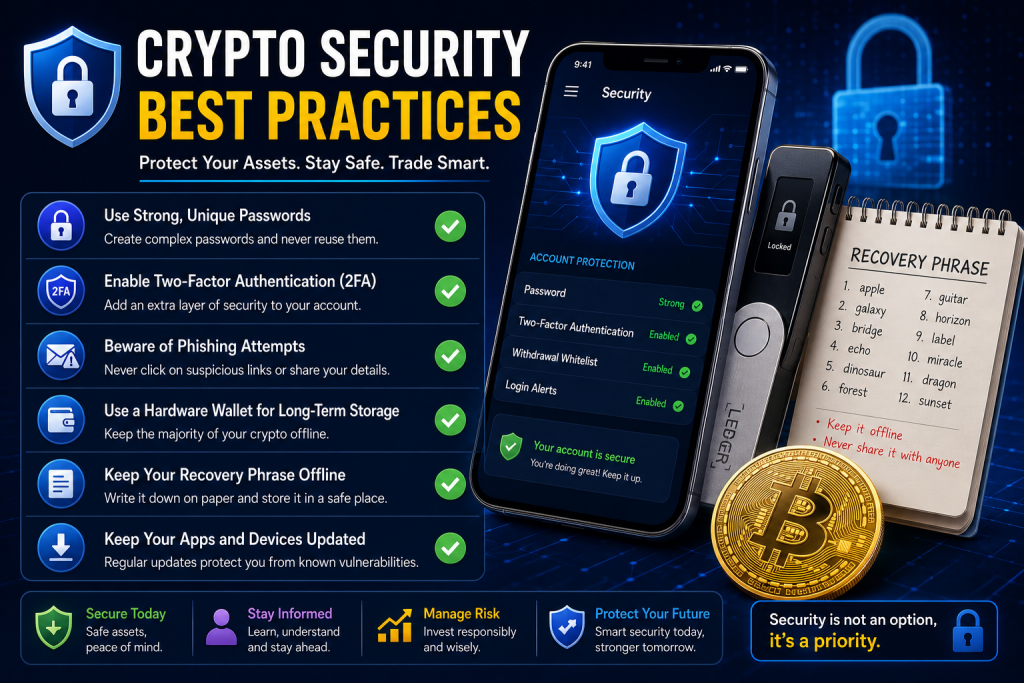
Security is one of the most important aspects of cryptocurrency investing. Unlike traditional bank accounts, cryptocurrency transactions are generally irreversible, and if your account is compromised, recovering lost funds can be difficult or impossible.
The good news is that most security breaches can be prevented by following a few simple best practices. Whether you are investing $100 or $10,000, these habits can help protect your digital assets.
Use Strong, Unique Passwords
Your crypto exchange account should have a password that is long, complex, and used exclusively for that platform.
A strong password typically includes:
- Uppercase and lowercase letters
- Numbers
- Special characters
- At least 12–16 characters
Avoid reusing passwords from email, social media, or other websites.
Best Practice
Use a reputable password manager to generate and store unique passwords securely.
Enable Authenticator-Based Two-Factor Authentication (2FA)
Two-factor authentication adds an additional security layer by requiring a time-based code from an authenticator app during login or withdrawals.
Recommended authenticator apps include:
- Google Authenticator
- Microsoft Authenticator
- Authy
Authenticator-based 2FA is generally more secure than SMS verification, which can be vulnerable to SIM swap attacks.
Beware of Phishing Emails and Fake Apps
Cybercriminals often create fake websites, emails, and mobile apps designed to steal your login credentials or recovery phrases.
Warning Signs to Watch For
- Emails urging immediate action
- Links to unfamiliar websites
- Misspelled domain names
- Requests for passwords or seed phrases
How to Stay Safe
- Bookmark official exchange websites
- Download apps only from trusted app stores
- Verify URLs carefully before logging in
- Never share your password or recovery phrase
Withdraw Long-Term Holdings to a Hardware Wallet
If you plan to hold cryptocurrency for months or years, consider storing your assets in a hardware wallet rather than leaving them on an exchange.
Popular hardware wallet brands include:
- Ledger
- Trezor
Hardware wallets keep your private keys offline, reducing exposure to exchange hacks and online threats.
Keep Recovery Phrases Offline
When you set up a wallet, you will receive a recovery phrase (also called a seed phrase) that can restore access to your funds.
This phrase is the ultimate backup to your wallet.
Best Practices for Recovery Phrase Storage
- Write it down on paper or store it in a secure metal backup
- Keep it in a private, secure location
- Never store it in email, cloud storage, or screenshots
- Never share it with anyone
Anyone who has access to your recovery phrase can access your cryptocurrency.
Bonus Security Tips
To further improve your protection:
- Enable withdrawal address whitelisting if supported
- Use a dedicated email address for crypto accounts
- Keep devices and apps updated
- Monitor account login activity
- Use secure internet connections
Security Checklist for Beginners
Before investing in crypto, make sure you have:
- Created a strong, unique password
- Enabled authenticator-based 2FA
- Verified official websites and apps
- Considered a hardware wallet for long-term storage
- Written down your recovery phrase and stored it offline
Bottom Line
In cryptocurrency, security is your personal responsibility. The strongest investment strategy can be undermined by poor account protection.
By using unique passwords, enabling two-factor authentication, avoiding phishing attempts, and securing your recovery phrase, you can dramatically reduce the risk of losing your assets and invest with greater confidence.
Frequently Asked Questions
What Is the Safest Crypto Exchange for Beginners?
There is no universally “safest” crypto exchange, but several platforms have built strong reputations for security, regulatory compliance, and transparency.
For beginners, Kraken is often considered one of the most security-focused exchanges due to its long operating history and strong emphasis on account protection. Coinbase is another popular choice because of its user-friendly design and robust security practices.
Regardless of which exchange you choose, your own security habits—such as enabling two-factor authentication and using strong passwords—are equally important.
Which Crypto Exchange Has the Lowest Fees?
Among major exchanges, Binance is widely known for offering competitive trading fees, especially for active traders. Kraken and OKX also provide relatively low fee structures.
However, actual costs can vary based on:
- Trading volume
- Payment method used
- Spread applied to market orders
- Withdrawal fees
For beginners, it is worth balancing low fees with security, ease of use, and regulatory comfort.
Can Beginners Use Binance?
Yes, beginners can use Binance, particularly if they want low trading fees and access to a large selection of cryptocurrencies.
That said, Binance offers a broad set of tools and features that may feel overwhelming to first-time investors. New users should start with the simplified buying interface and invest time in understanding the platform before exploring advanced products.
Availability and supported services may vary depending on your country.
Is Coinbase Good for First-Time Investors?
Yes, Coinbase is widely regarded as one of the best crypto exchanges for first-time investors.
It offers:
- A clean and intuitive interface
- Educational resources
- Recurring buy options
- Strong security measures
Although fees may be higher than some competitors, many beginners find the ease of use and trust factor worth the additional cost.
Do I Need a Crypto Wallet?
You do not need a separate wallet to buy cryptocurrency on an exchange. Most centralized exchanges provide custodial wallets automatically when you create an account.
However, if you plan to hold crypto for the long term, you may eventually choose to move your assets to a personal wallet for greater control.
Popular options include software wallets and hardware wallets from companies such as Ledger and Trezor.
Are Crypto Exchanges Legal in India?
Cryptocurrency trading is permitted in India, and residents can buy, sell, and hold digital assets using compliant exchanges. However, the regulatory environment continues to evolve, and tax obligations may apply to crypto transactions.
Indian investors should:
- Use reputable exchanges that follow KYC requirements
- Maintain accurate transaction records
- Understand applicable tax rules
- Monitor regulatory updates
Because laws and regulations can change, it is advisable to consult a qualified tax or legal professional if you are unsure about your obligations.
For more info :
Final Thoughts
If you are just getting started, focus on choosing a reputable exchange, enabling strong security settings, and investing only after you understand the risks involved. Platforms such as Coinbase and Kraken are often excellent starting points for beginners, while Binance and OKX may appeal to users who prioritize lower fees and broader functionality.
Final Verdict
The best crypto exchange for beginners ultimately depends on your priorities. Some investors value simplicity and educational resources, while others focus on security, low fees, or access to advanced features as they gain experience.
After evaluating the leading platforms in 2026, here are our top recommendations.
For most beginners, Coinbase remains the best overall choice due to its intuitive design and educational tools.
If security is your top priority, Kraken is an excellent option.
If minimizing trading fees matters most, Binance can be attractive, though Indian users should understand the tax and compliance implications.
Indian beginners who prefer INR support and a locally familiar platform may also consider CoinDCX.
Best Overall for Beginners: Coinbase
Coinbase earns the top spot because of its clean interface, strong reputation, and excellent educational resources. It is one of the easiest platforms for first-time investors to use, making it an ideal choice for anyone buying cryptocurrency for the first time.
Best for: New investors who want a simple, trusted platform with beginner-friendly tools.
Best for Security: Kraken
Kraken is widely respected for its security practices, transparent fee structure, and long operating history. It offers a strong balance between beginner accessibility and advanced features.
Best for: Users who prioritize account protection and a security-first approach.
Best for Low Fees: Binance
Binance offers highly competitive trading fees and access to a broad range of cryptocurrencies. It can be an excellent option for cost-conscious investors, although the platform may feel more complex for absolute beginners.
Best for: Investors who want lower fees and a large selection of coins.
Best Mobile Experience: Crypto.com
Crypto.com stands out for its polished mobile app and integrated ecosystem, making it convenient for users who prefer managing their investments on a smartphone.
Best for: Mobile-first investors who value a feature-rich app experience.
Best Compliance-Focused Option: Gemini
Gemini emphasizes regulatory compliance, security, and transparency. Its straightforward design appeals to conservative investors who want a more regulated environment.
Best for: Beginners who value compliance and a cautious approach to crypto investing.
Which Crypto Exchange Should You Choose?
Here is a simple way to decide:
- Choose Coinbase if you want the easiest platform to get started.
- Choose Kraken if security is your top priority.
- Choose Binance if you want to minimize trading fees.
- Choose Crypto.com if you primarily invest using your phone.
- Choose Gemini if you prefer a compliance-focused platform.
- Choose Bitget if you are interested in copy trading features.
- Choose OKX if you want advanced tools as your experience grows.
Our Balanced Recommendation
For most beginners, Coinbase and Kraken offer the strongest combination of ease of use, security, and trustworthiness. Coinbase is often the easiest place to start, while Kraken may appeal to users who place greater emphasis on security and transparent pricing.
If your main goal is reducing costs, Binance can be an attractive alternative, provided it is available and suitable in your jurisdiction.
No matter which exchange you choose, start with small amounts, enable all available security settings, and invest only after understanding the risks associated with cryptocurrency.
Final Thoughts
The best crypto exchange for beginners is the one that aligns with your personal goals, comfort level, and investing style. Focus on security, transparency, and usability rather than chasing the lowest fees or the newest platform.
By choosing a reputable exchange and building good security habits from day one, you can begin your cryptocurrency journey with greater confidence and a stronger foundation for long-term success.
Important Note for Indian Investors
If you are investing in cryptocurrency from India, it is important to understand the local tax rules.
As of 2026:
- Profits from crypto transactions may be taxed at 30%.
- A 1% Tax Deducted at Source (TDS) may apply to certain transactions.
- Investors are responsible for maintaining detailed records for tax reporting.
Regulations can evolve, so Indian investors should consult a qualified tax professional before trading cryptocurrency.
How We Tested
How We Tested the Best Crypto Exchanges for Beginners
To create this guide, I reviewed each exchange based on my experience as a trader and financial analyst.
During testing, I evaluated:
- Account registration and KYC verification
- Deposit methods and funding speed
- User interface and mobile app usability
- Trading fees and spreads
- Security features such as 2FA and proof of reserves
- Educational resources for beginners
- Customer support responsiveness
I also compared publicly available information regarding regulatory status, app ratings, and supported cryptocurrencies.
My goal was to identify platforms that are genuinely safe, easy to use, and suitable for first-time crypto investors.
Risk Disclaimer
Cryptocurrency is a highly volatile asset class, and prices can fluctuate significantly over short periods. As a result, investing in digital assets may not be suitable for all investors, particularly those with low risk tolerance or short-term financial needs.
This article is provided for educational and informational purposes only and should not be considered financial, investment, legal, or tax advice. The information presented here reflects general research and analysis and does not take into account your individual financial circumstances, objectives, or risk profile.
Before investing in cryptocurrency, you should:
- Conduct your own independent research.
- Understand the risks associated with digital assets.
- Review the fees and terms of any exchange you use.
- Consider consulting a qualified financial advisor, tax professional, or legal expert.
Past performance is not indicative of future results, and there is no guarantee that any cryptocurrency or investment strategy will be profitable.
Only invest money you can afford to lose, and ensure that cryptocurrency fits within your broader financial plan and long-term goals.
About the Author
Shiva Naresh is a trader, financial content creator, and founder of zyqorr.com, a platform dedicated to helping individuals make smarter decisions in trading, investing, and personal finance.
With hands-on experience in stock trading, cryptocurrency markets, and market analysis, Shiva focuses on simplifying complex financial topics into practical, beginner-friendly guides. His work combines real-world trading insights with in-depth research to create content that is clear, balanced, and actionable.
Over the years, Shiva has studied a wide range of financial concepts, including technical analysis, risk management, trading psychology, and quantitative strategies. This experience allows him to evaluate investment platforms, tools, and market opportunities from both a trader’s and an educator’s perspective.
For this guide on the best crypto exchanges for beginners, Shiva reviewed each platform based on the factors that matter most to new investors:
- Security features such as two-factor authentication and cold storage
- Fee transparency and overall cost structure
- Ease of use and mobile app quality
- Regulatory compliance and company reputation
- Educational resources and beginner tools
His goal is to provide honest, research-driven content that aligns with Google’s E-E-A-T standards—Experience, Expertise, Authoritativeness, and Trustworthiness—while helping readers navigate financial markets with greater confidence.
Editorial Standards
Every article published on Zyqorr is created with a strong focus on:
- Accuracy and factual integrity
- Balanced, unbiased analysis
- Clear disclosure of risks
- Ongoing updates as markets and regulations evolve
Connect With Shiva Naresh
- Website: zyqorr.com
- Trading Blog:Zyqorr
- Email: shivanaresh@zyqorr.com
Disclosure: Shiva Naresh may hold positions in cryptocurrencies mentioned in his articles. All content is for educational purposes only and should not be considered personalized financial advice.