Table of Contents
1. Introduction
Cryptocurrency trading has become one of the most talked-about ways to participate in global financial markets. With digital assets like Bitcoin and Ethereum attracting attention from investors worldwide, many beginners in India are asking a simple but important question:
Can you really start crypto trading with just ₹5,000?
The short answer is yes.
Thanks to fractional investing, you do not need lakhs of rupees to begin. Most cryptocurrency exchanges allow you to buy small portions of major cryptocurrencies, making it possible to enter the market with a modest amount such as ₹5,000. While this amount is unlikely to generate life-changing profits overnight, it is more than enough to gain hands-on experience and learn how the crypto market works.
Why Beginners Should Start Small
Starting with a small amount offers several advantages:
- Limits Risk: If the market moves against you, your losses remain manageable.
- Builds Confidence: You can learn how to place trades, use stop-loss orders, and manage emotions without risking significant capital.
- Encourages Discipline: A smaller account forces you to focus on strategy and risk management rather than gambling.
- Provides Real Market Experience: Trading with real money teaches lessons that demo accounts often cannot replicate.
For most beginners, the goal should not be to double ₹5,000 quickly. Instead, the goal is to develop the skills, habits, and mindset needed to become a consistent trader over time.
What You Will Learn in This Guide
In this beginner-friendly guide, you will learn:
- What cryptocurrency trading is and how it works.
- Whether ₹5,000 is enough to start.
- How to choose a reliable crypto exchange.
- How to create and fund your account.
- How to build a simple beginner portfolio.
- Essential risk management rules.
- Common mistakes to avoid.
- Tax and regulatory considerations in India.
By the end of this article, you will have a clear step-by-step roadmap to start crypto trading responsibly with ₹5,000.
Remember, successful trading is not about starting with a large amount of money. It is about protecting your capital, learning continuously, and building a repeatable process. If you approach the market with patience and discipline, even a small starting amount can become a valuable investment in your financial education.
2. What Is Crypto Trading?


Crypto trading is the process of buying and selling cryptocurrencies such as Bitcoin, Ethereum, and other digital assets to profit from price movements. Just like stock or forex trading, the goal is to buy at a lower price and sell at a higher price, or in some markets, profit from falling prices as well.
Unlike traditional financial markets, cryptocurrency markets are decentralized and operate around the clock. This means traders can access opportunities at any time, including weekends and holidays.
Investing vs. Trading: What’s the Difference?
Although the terms are often used interchangeably, investing and trading are two distinct approaches.
Crypto Investing
Investing involves buying cryptocurrencies with the intention of holding them for months or years. Investors focus on long-term growth and believe the value of their assets will increase over time.
Example: Buying Bitcoin and holding it for three to five years.
Crypto Trading
Trading involves buying and selling cryptocurrencies over shorter periods, ranging from minutes to weeks, to capture price fluctuations.
Example: Buying Ethereum and selling it a few days later after a 10% gain.
Key Differences
| Aspect | Investing | Trading |
| Time Horizon | Months to years | Minutes to weeks |
| Frequency | Low | High |
| Goal | Long-term wealth creation | Short-term profits |
| Analysis Style | Fundamental analysis | Technical + market analysis |
| Emotional Pressure | Lower | Higher |
For beginners starting with ₹5,000, combining a long-term mindset with simple spot trades is often the safest way to learn.
How Cryptocurrency Markets Work 24/7
One of the most unique features of crypto trading is that the market never closes.
Traditional stock markets operate during fixed hours, but cryptocurrencies trade 24 hours a day, 7 days a week, on global exchanges.
Why Crypto Trades Around the Clock
Cryptocurrencies run on decentralized blockchain networks, which are maintained by computers worldwide rather than a single exchange or central authority.
Because of this:
- Trading continues on weekends and holidays.
- Prices can move significantly overnight.
- News and global events can impact the market instantly.
Example
If positive news boosts demand for Bitcoin on a Sunday night, the price may surge even when stock markets are closed.
This constant availability creates opportunities, but it also requires discipline and risk management.
Common Terms Every Beginner Should Know
Understanding basic terminology will make crypto trading much easier.
Cryptocurrency
A digital asset that uses cryptography and blockchain technology to record transactions.
Blockchain
A decentralized ledger that stores transaction data securely across a network of computers.
Exchange
A platform where users buy and sell cryptocurrencies, such as Binance or Coinbase.
Wallet
A digital tool used to store and manage cryptocurrencies.
Spot Trading
Buying and selling the actual cryptocurrency at current market prices.
Market Order
An order executed immediately at the best available price.
Limit Order
An order that executes only when the asset reaches a specified price.
Stop-Loss
A risk management order that automatically exits a position if price moves against you.
Take-Profit
An order that closes a position once your target profit level is reached.
Volatility
The degree to which price moves up and down over time.
Altcoin
Any cryptocurrency other than Bitcoin.
Market Capitalization
The total value of a cryptocurrency, calculated as price multiplied by circulating supply.
FOMO
“Fear of Missing Out,” the emotional urge to buy because prices are rising rapidly.
HODL
A popular crypto term meaning to hold an asset for the long term despite short-term volatility.
Key Takeaway
Crypto trading involves buying and selling digital assets to profit from price movements. Unlike long-term investing, trading focuses on shorter-term opportunities. Because cryptocurrency markets operate 24/7, understanding core concepts and terminology is essential before risking real money.
With this foundation in place, the next step is determining whether ₹5,000 is enough to begin your crypto trading journey.
3. Is ₹5,000 Enough to Start Crypto Trading?
Yes, ₹5,000 is absolutely enough to start crypto trading.
In fact, for most beginners, starting with a small amount is one of the smartest decisions you can make. Thanks to fractional investing, you can buy tiny portions of major cryptocurrencies like Bitcoin and Ethereum without needing a large amount of capital.
While ₹5,000 will not make you rich overnight, it provides more than enough money to learn how the market works, practice risk management, and gain real-world experience.
Set Realistic Expectations
One of the biggest mistakes new traders make is expecting huge profits from a small account.
What ₹5,000 Can Realistically Do
Your ₹5,000 trading account should be viewed as:
- A learning account
- A way to test your strategy
- A tool to build trading discipline
- A low-risk introduction to the crypto market
Example Return Scenarios
| Return | Profit on ₹5,000 |
| 5% | ₹250 |
| 10% | ₹500 |
| 20% | ₹1,000 |
| -10% | -₹500 |
These numbers show that even strong percentage gains translate into modest profits when your capital is small. That is perfectly normal.
The true value of a small account is the education and experience you gain.
Focus on Learning, Not Quick Profits
If your main goal is to double ₹5,000 in a few days, you may be tempted to:
- Take oversized risks
- Use leverage too early
- Chase hype-driven coins
- Make emotional decisions
These habits often lead to losses.
Instead, use your first ₹5,000 to learn:
- How to open and fund an exchange account
- How to place market and limit orders
- How to set stop-loss levels
- How to manage emotions
- How to record trades in a journal
The objective is to become a better trader, not to get rich quickly.
Why Starting Small Is a Smart Strategy
Professional traders often recommend beginning with the smallest amount you can afford to lose.
1. Limits Financial Risk
If you make mistakes—which every beginner does—your losses remain manageable.
2. Reduces Emotional Pressure
Trading with a small amount helps you stay calmer and make rational decisions.
3. Builds Good Habits
You can practice discipline, patience, and consistency from the beginning.
4. Provides Real Experience
Using real money teaches lessons that paper trading often cannot replicate.
5. Creates a Scalable Foundation
Once you become consistently profitable, you can gradually increase your trading capital.
Example Beginner Mindset
A healthy mindset is:
“I am investing ₹5,000 to learn a skill that can benefit me for years.”
This perspective reduces pressure and encourages long-term thinking.
How Professionals Think About Small Accounts
Many experienced traders began with limited capital. Their early focus was not on large profits, but on developing a repeatable process.
They prioritized:
- Protecting capital
- Following risk management rules
- Reviewing mistakes
- Improving consistency
Over time, skill development mattered far more than initial account size.
When to Increase Your Capital
Consider adding more funds only after you have demonstrated consistent performance over several months and proven that you can follow your trading plan with discipline.
Until then, keeping your account small is often the most responsible approach.
Key Takeaway
Yes, ₹5,000 is enough to start crypto trading.
It may not generate large profits immediately, but it is an excellent amount to:
- Learn how crypto trading works
- Practice risk management
- Build discipline
- Gain real market experience
If you treat your first ₹5,000 as tuition for your financial education, it can become one of the most valuable investments you make.
4. Step 1: Learn the Basics of Cryptocurrency
Before you invest your ₹5,000, the most important step is to understand how cryptocurrency works. Many beginners lose money not because they lack capital, but because they start trading without a solid foundation.
Think of this step as learning the rules of the game before putting money on the line.
Understanding Bitcoin and Altcoins
What Is Bitcoin?
Bitcoin is the first and most widely recognized cryptocurrency. It was introduced in 2009 and is often referred to as “digital gold” because of its limited supply and long-term store-of-value narrative.
Bitcoin is considered the benchmark for the entire crypto market. When Bitcoin rises or falls sharply, many other cryptocurrencies tend to follow.
What Are Altcoins?
Altcoins are all cryptocurrencies other than Bitcoin.
Popular examples include:
- Ethereum
- Solana
- Ripple
- Cardano
Some altcoins offer innovative technology, while others are highly speculative and carry greater risk.
Bitcoin vs Altcoins
| Feature | Bitcoin | Altcoins |
| Market Leadership | Highest | Lower |
| Risk Level | Relatively lower | Usually higher |
| Volatility | High | Often very high |
| Use Case | Store of value | Smart contracts, payments, DeFi, and more |
For beginners, focusing on established cryptocurrencies such as Bitcoin and Ethereum is often a more conservative starting point.
Blockchain Basics
A blockchain is a decentralized digital ledger that records transactions across a network of computers.
Each transaction is grouped into a “block,” and blocks are linked together in chronological order.
Why Blockchain Matters
Blockchain technology provides:
- Transparency
- Security
- Immutability
- Decentralization
This means no single institution controls the network, and transaction records are extremely difficult to alter.
What Is a Crypto Wallet?
A wallet is a tool that allows you to store, send, and receive cryptocurrency.
Types of Wallets
Hot Wallets
Connected to the internet and convenient for active traders.
Examples:
Cold Wallets
Offline devices designed for long-term security.
Examples:
For a small ₹5,000 account, using a reputable exchange wallet may be sufficient initially, but learning self-custody is valuable as your holdings grow.
What Is a Crypto Exchange?
A crypto exchange is a platform where users buy and sell digital assets.
Popular exchanges include:
When choosing an exchange, prioritize:
- Security features
- Trading fees
- Liquidity
- Ease of use
- Regulatory compliance
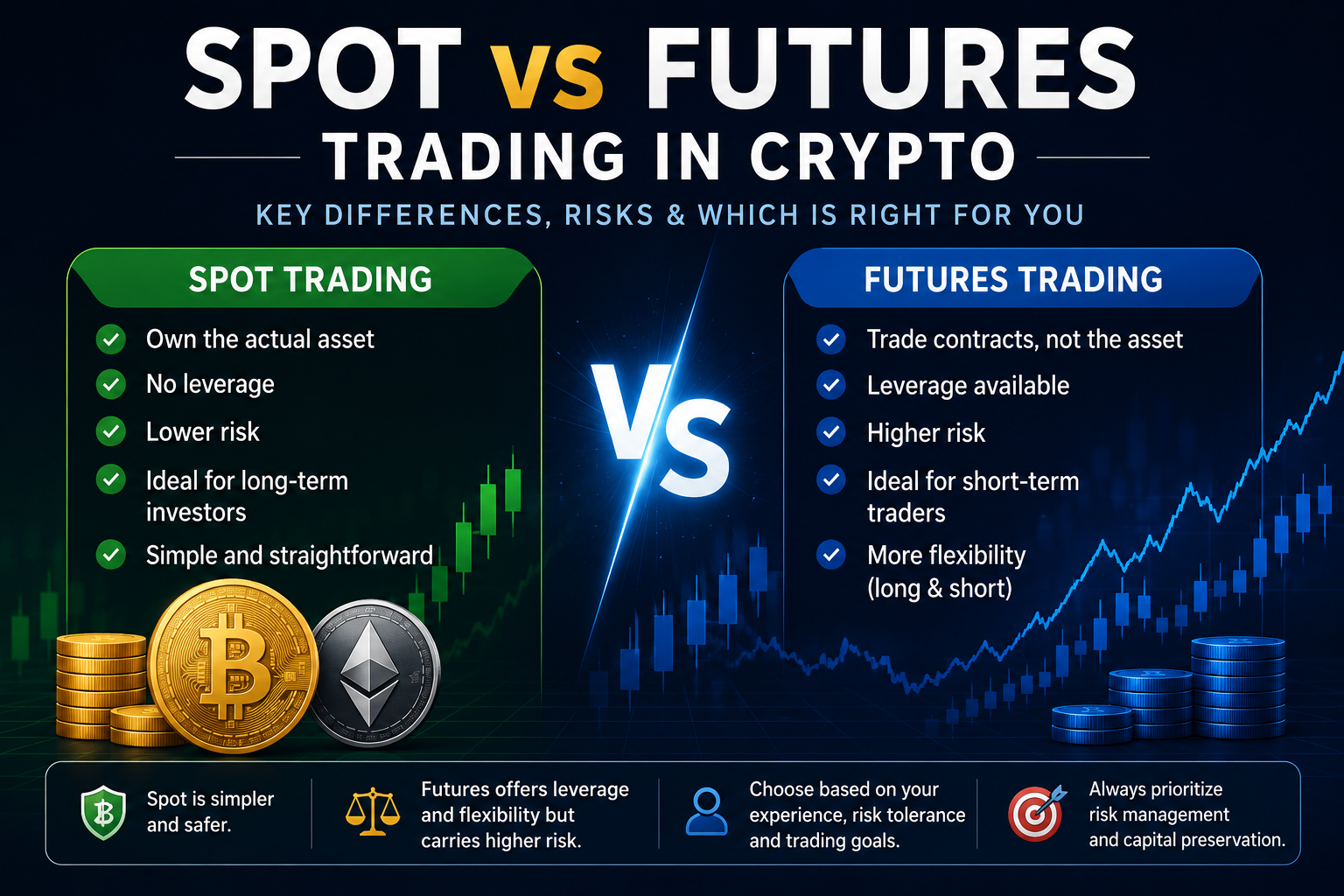
Spot Trading vs Derivatives
Understanding this distinction is critical for beginners.
Spot Trading
Spot trading means buying the actual cryptocurrency at the current market price.
If you buy ₹1,000 worth of Bitcoin, you own that amount directly.
Best for beginners: Yes.
Derivatives Trading
Derivatives such as futures and perpetual contracts allow you to speculate on price movements without owning the asset. These products often include leverage, which can magnify both gains and losses.
Best for beginners: Generally no.
Spot vs Derivatives Comparison
| Feature | Spot Trading | Derivatives Trading |
| Own the Asset | Yes | No |
| Leverage | Optional or none | Common |
| Risk Level | Lower | Much higher |
| Complexity | Simple | Advanced |
| Beginner Friendly | Yes | No |
If you are starting with ₹5,000, spot trading is usually the most appropriate approach.
Key Terms to Understand
Before placing your first trade, become familiar with:
- Market Order: Executes immediately at the current price.
- Limit Order: Executes only at your chosen price.
- Stop-Loss: Automatically exits if price moves against you.
- Take-Profit: Automatically locks in gains.
- Volatility: The speed and magnitude of price movements.
- Liquidity: How easily an asset can be bought or sold.
Key Takeaway
Learning the basics of cryptocurrency is the foundation of successful trading.
Before risking your ₹5,000, make sure you understand:
- The difference between Bitcoin and altcoins.
- How blockchain technology works.
- The role of wallets and exchanges.
- Why spot trading is generally safer for beginners than derivatives.
A strong foundation will help you avoid common mistakes and make more informed decisions as you begin your crypto trading journey.
5. Step 2: Choose a Reliable Crypto Exchange in India
Choosing the right crypto exchange is one of the most important decisions you will make as a beginner. Your exchange acts as the gateway between your bank account and the cryptocurrency market, so security, transparency, and compliance should be your top priorities.
A good exchange makes it easy to deposit funds, execute trades, and withdraw money safely. A poor-quality platform can expose you to unnecessary risks such as hidden fees, weak security, or regulatory issues.
What Is a Crypto Exchange?
A crypto exchange is an online platform where you can buy, sell, and store cryptocurrencies.
Think of it as the crypto equivalent of a stock broker.
Using an exchange, you can:
- Deposit Indian Rupees (INR)
- Buy cryptocurrencies like Bitcoin and Ethereum
- Sell your holdings when you choose
- Withdraw funds back to your bank account
What to Look for in a Crypto Exchange
1. Security
Security should be your highest priority.
Look for exchanges that offer:
- Two-factor authentication (2FA)
- Cold storage for customer assets
- Withdrawal whitelists
- Anti-phishing protection
- Proof-of-reserves or transparency reports
Well-established exchanges typically invest heavily in security systems and risk monitoring.
2. Trading Fees
Fees can reduce your returns, especially with a small ₹5,000 account.
Common charges include:
- Trading fees
- Deposit fees
- Withdrawal fees
- Spread costs
Many major exchanges offer competitive spot trading fees, often around 0.1% to 0.5%, though actual costs vary by platform and account tier.
3. Liquidity
Liquidity refers to how easily you can buy or sell an asset without significantly affecting its price.
Higher liquidity generally means:
- Faster order execution
- Tighter bid-ask spreads
- Reduced slippage
Large exchanges usually offer better liquidity for popular coins.
4. Regulatory Compliance
Choose platforms that follow Know Your Customer (KYC) and Anti-Money Laundering (AML) requirements.
For Indian users, regulatory compliance is especially important because tax reporting and transaction monitoring rules apply to virtual digital assets. FIU-registered platforms generally provide a more structured compliance framework for Indian residents. (Flitpay.com)
5. Ease of Use
As a beginner, you want a platform with:
- A clean interface
- Simple order placement
- Responsive customer support
- Educational resources
The easier the platform is to use, the more you can focus on learning trading fundamentals.
Popular Global Crypto Exchanges
Binance
One of the world’s largest crypto exchanges, offering:
- Extensive coin selection
- Deep liquidity
- Competitive fees
- Spot and advanced trading tools
Binance has taken steps to meet Indian compliance requirements and remains widely used by Indian traders. (Cryptonews)
Coinbase
Known for:
- Strong security practices
- Beginner-friendly design
- Institutional reputation
Coinbase is widely respected globally, though service availability and features in India may vary over time.
Other Platforms to Research
These platforms are commonly used by Indian investors and may simplify INR deposits and tax reporting.
Questions to Ask Before Signing Up
Before choosing an exchange, ask:
- Is the platform available to Indian users?
- Does it support INR deposits and withdrawals?
- What are the total trading and withdrawal fees?
- Does it offer strong security features?
- Is the company transparent and well-established?
- How does it handle Indian tax reporting requirements?
Why Compliance Matters in India
Cryptocurrency trading is permitted in India, but profits are currently subject to tax rules that include a flat tax on gains and a 1% TDS on many qualifying transactions under existing law. Tax treatment can change, so always verify the latest rules or consult a qualified tax advisor. (NFT Plazas)
Using a compliant exchange can help you:
- Maintain accurate transaction records
- Simplify tax reporting
- Reduce regulatory uncertainty
My Beginner Recommendation
If you are starting with just ₹5,000, choose a platform that is:
- Easy to use
- Well-established
- Security-focused
- Transparent about fees
- Supportive of Indian users
Your goal is not to find the exchange with the most features, but the one that helps you learn safely and efficiently.
Key Takeaway
A reliable crypto exchange is the foundation of your trading journey.
When selecting a platform, prioritize:
- Security
- Competitive fees
- High liquidity
- Regulatory compliance
- Beginner-friendly design
Taking time to choose the right exchange can help protect your capital and make your first crypto trading experience much smoother.
6. Step 3: Complete KYC Verification
Before you can start buying and selling cryptocurrencies, most reputable exchanges require you to complete a process called KYC (Know Your Customer).
KYC is a standard identity verification procedure used by financial institutions and regulated trading platforms to confirm that users are who they claim to be.
Although it may seem like an extra step, completing KYC is essential for account security, regulatory compliance, and smooth deposits and withdrawals.
What Is KYC Verification?
KYC is the process of submitting personal information and identity documents to a crypto exchange.
Once your documents are reviewed and approved, your account gains access to features such as:
- INR deposits and withdrawals
- Cryptocurrency purchases
- Higher transaction limits
- Enhanced account security
Without KYC, your account may be restricted or unable to trade.
Documents Commonly Required for KYC in India
The exact requirements vary by exchange, but most platforms request the following:
1. Government-Issued Photo ID
You may be asked to provide one of the following:
- PAN Card
- Aadhaar Card
- Passport
- Driving Licence
- Voter ID
2. PAN Card
Many exchanges serving Indian residents require PAN details for tax and compliance purposes.
3. Selfie Verification
You may need to upload a live selfie or short video to confirm your identity.
4. Proof of Address
Some platforms may request:
- Aadhaar Card
- Bank statement
- Utility bill
- Passport
5. Mobile Number and Email Address
You will typically verify both using OTP codes.
How the KYC Process Works
The process usually takes only a few minutes.
Step 1: Enter Personal Details
Provide your legal name, date of birth, and address.
Step 2: Upload Documents
Submit clear images of the required identification documents.
Step 3: Selfie Verification
Complete facial verification if requested.
Step 4: Wait for Approval
Verification may take anywhere from a few minutes to a couple of days depending on the platform.
Why Identity Verification Is Necessary
1. Regulatory Compliance
Exchanges are required to follow anti-money laundering and financial regulations.
2. Fraud Prevention
Verification helps reduce identity theft, account abuse, and unauthorized activity.
3. Secure Banking Access
Most exchanges require verified identities before enabling INR deposits and withdrawals.
4. Higher Limits
Verified users typically receive larger deposit and withdrawal limits.
5. Account Recovery
If you lose access to your account, verified information can help restore ownership.
Tips for a Smooth KYC Process
To avoid delays:
- Use your exact legal name.
- Upload high-quality images.
- Ensure documents are valid and unexpired.
- Complete verification from a secure internet connection.
- Enable two-factor authentication after approval.
Is KYC Safe?
Well-established exchanges use encrypted systems and security controls to protect personal data.
To reduce risk:
- Sign up only on official websites.
- Avoid sharing documents through email or messaging apps.
- Enable strong passwords and 2FA.
Can You Trade Without KYC?
Some offshore platforms may advertise limited no-KYC access, but they often carry higher risks and may restrict withdrawals or discontinue service.
For most beginners in India, using a reputable exchange that requires KYC is the more responsible and secure approach.
Key Takeaway
KYC verification is an essential step before you begin crypto trading.
By submitting your identity documents, you gain access to:
- Secure trading features
- INR deposits and withdrawals
- Higher account limits
- Better protection and recovery options
Completing KYC may take a few minutes, but it lays the foundation for a safer and more reliable trading experience.
7. Step 4: Deposit ₹5,000
Once your exchange account is verified, the next step is to deposit your initial capital. For this guide, we are using ₹5,000 as a practical starting amount.
This amount is large enough to gain meaningful experience, yet small enough to keep your financial risk under control.
Remember, your goal at this stage is not to chase huge profits. It is to learn how deposits, order execution, and risk management work in real market conditions.
How to Deposit ₹5,000 into Your Crypto Exchange Account
Most exchanges provide a “Deposit,” “Add Funds,” or “Buy Crypto” option in the dashboard.
The process typically looks like this:
- Log in to your verified exchange account.
- Navigate to the INR deposit section.
- Select your preferred payment method.
- Enter ₹5,000.
- Complete the payment.
- Confirm that the balance appears in your account.
Once the funds are credited, you are ready to place your first trade.
Available Payment Methods in India
The exact funding methods depend on the exchange, but common options include:
UPI (Unified Payments Interface)
UPI is often the fastest and most convenient method for Indian users.
Pros:
- Instant transfers
- Easy to use
- Widely supported
IMPS / NEFT / RTGS Bank Transfer
Traditional bank transfers may be available for larger or manual deposits.
Pros:
- Secure and familiar
- Suitable for direct transfers
Debit Card
Some platforms support card-based purchases, though fees may be higher.
P2P (Peer-to-Peer)
Certain exchanges facilitate P2P transactions between users.
Pros:
- Can offer additional funding flexibility
Cons:
- Requires extra caution and verification
Check Deposit Fees Before Funding
Some exchanges charge fees for deposits, while others may waive them for selected methods.
Before transferring money, review:
- Deposit fees
- Minimum deposit limits
- Processing times
- Payment method availability
With a small account, minimizing fees helps preserve your capital.
Security Tips Before Funding Your Account
Before depositing money, make sure your account and device are secure.
1. Enable Two-Factor Authentication (2FA)
Use an authenticator app such as Google Authenticator or Authy.
2. Verify the Website URL
Always confirm you are on the exchange’s official website.
3. Use a Strong Password
Create a unique password that is not used elsewhere.
4. Avoid Public Wi-Fi
Use a trusted network when logging in and transferring funds.
5. Start with a Small Deposit
Even if you plan to invest more later, ₹5,000 is a sensible amount for your first deposit.
6. Confirm Payment Details Carefully
Double-check account numbers, QR codes, and payment references.
Keep Records of Your Deposit
Save screenshots or transaction confirmations for:
- Personal recordkeeping
- Performance tracking
- Tax reporting
Organized records are especially important for cryptocurrency transactions.
Should You Deposit All ₹5,000 at Once?
Depositing the full ₹5,000 is reasonable if you intend to allocate it gradually.
For example:
- ₹2,000 in Bitcoin
- ₹1,500 in Ethereum
- ₹1,000 reserved for future opportunities
- ₹500 held as a cash buffer for fees or flexibility
This approach avoids putting all your capital into a single trade.
Key Takeaway
Depositing ₹5,000 is a practical first step into crypto trading.
Before funding your account:
- Choose a secure payment method.
- Review all applicable fees.
- Enable 2FA.
- Verify the exchange website.
- Maintain proper records.
By treating this deposit as the start of your trading education, you build a disciplined foundation for long-term success.
8. Step 5: Decide How to Allocate ₹5,000
Once your ₹5,000 is deposited, the next step is deciding how to distribute your capital. Asset allocation is important because it helps you balance risk and avoid putting all your money into a single cryptocurrency.
For beginners, a diversified approach can reduce volatility while still providing exposure to growth opportunities.
Why Asset Allocation Matters
Different cryptocurrencies carry different levels of risk.
- Bitcoin is generally considered the most established and relatively less volatile large-cap cryptocurrency.
- Ethereum has broad adoption and a strong ecosystem.
- Smaller altcoins can offer higher upside, but they also come with greater uncertainty and sharper price swings.
- Keeping some funds in cash provides flexibility to buy later or cover fees.
By spreading your capital across categories, you can reduce concentration risk.
Sample Beginner Portfolio for ₹5,000
A simple educational example might look like this:
| Allocation | Percentage | Amount |
| Bitcoin | 40% | ₹2,000 |
| Ethereum | 30% | ₹1,500 |
| High-Risk Altcoin | 20% | ₹1,000 |
| Cash Reserve | 10% | ₹500 |
| Total | 100% | ₹5,000 |
This structure provides exposure to established cryptocurrencies while limiting the portion allocated to higher-risk assets.
40% in Bitcoin (₹2,000)
Bitcoin is often considered the foundation of the crypto market.
Reasons beginners may prioritize Bitcoin:
- Largest market capitalization
- Broad institutional interest
- High liquidity
- Strong brand recognition
Bitcoin can still be volatile, but many investors view it as a core long-term holding.
30% in Ethereum (₹1,500)
Ethereum is the leading smart contract platform and supports decentralized applications, NFTs, and many blockchain-based services.
Reasons beginners may consider Ethereum:
- Large developer ecosystem
- Diverse use cases
- Strong market adoption
Ethereum often complements Bitcoin in a balanced crypto portfolio.
20% in a High-Risk Altcoin (₹1,000)
This portion can be used to explore a more speculative project, such as:
- Solana
- Chainlink
- Avalanche
Because these assets can be significantly more volatile, keeping this allocation modest helps limit downside risk.
10% Held in Cash (₹500)
Holding a small cash reserve offers several benefits:
- Buy opportunities during market pullbacks
- Flexibility to average into positions
- Coverage for fees
- Reduced pressure to deploy all capital immediately
Maintaining some liquidity is a simple but effective risk management habit.
Alternative Conservative Allocation
If you prefer lower risk, you could use:
- 60% Bitcoin
- 30% Ethereum
- 10% Cash
This approach removes the speculative altcoin component entirely.
Important Reminder
This sample portfolio is provided for educational purposes only and should not be considered personalized investment advice. Cryptocurrency markets are highly volatile, and any asset can decline significantly in value.
Always perform your own research and invest only what you can afford to lose.
Key Takeaway
A thoughtful allocation plan can help beginners manage risk while learning how the market behaves.
A sample ₹5,000 portfolio might include:
- ₹2,000 in Bitcoin
- ₹1,500 in Ethereum
- ₹1,000 in a high-risk altcoin
- ₹500 in cash
By diversifying and keeping a small reserve, you create a balanced starting point for your crypto trading journey.
9. Step 6: Understand Risk Management

Risk management is the single most important skill in trading.
Many beginners focus on finding the “best coin” or the “perfect strategy,” but experienced traders know that long-term success depends more on controlling losses than on maximizing gains.
If you protect your capital, you give yourself the opportunity to stay in the market long enough to improve.
Why Risk Management Matters
Cryptocurrency markets are highly volatile. Even strong projects like Bitcoin and Ethereum can experience sharp price swings.
Without a clear risk management plan, a few poor trades can significantly damage a small account.
With a ₹5,000 account, preserving capital should be your highest priority.
Risk Only 1–2% of Capital Per Trade
A common guideline among traders is to risk no more than 1–2% of total capital on any single trade.
Example with ₹5,000
- 1% risk = ₹50
- 2% risk = ₹100
This means that if your stop-loss is hit, your loss should generally be limited to ₹50–₹100 on that trade.
By keeping losses small, you can withstand a series of losing trades without significantly impacting your account.
Why Small Losses Matter
Consider the difference:
| Loss Per Trade | 5 Losing Trades |
| ₹50 | ₹250 |
| ₹100 | ₹500 |
| ₹500 | ₹2,500 |
Small, controlled losses are manageable. Large losses are much harder to recover from.
Always Use Stop-Loss Orders
A stop-loss is an order that automatically exits your position when price reaches a predefined level.
Benefits of a Stop-Loss
- Limits downside risk
- Removes emotional decision-making
- Enforces discipline
- Protects your trading capital
Example
Suppose you buy ₹1,000 worth of Bitcoin and decide to risk ₹50.
You place a stop-loss at a level where your maximum loss would be approximately ₹50, excluding fees and potential slippage.
If the market moves against you, the trade closes automatically.
Avoid Emotional Trading
Emotions are one of the biggest causes of trading mistakes.
Common Emotional Traps
FOMO (Fear of Missing Out)
Buying because prices are rising rapidly and you fear being left behind.
Panic Selling
Selling impulsively during temporary market declines.
Revenge Trading
Taking oversized trades after a loss in an attempt to recover quickly.
Overconfidence
Increasing risk excessively after a few winning trades.
How to Stay Disciplined
To reduce emotional decisions:
- Create a trading plan before entering.
- Define entry, stop-loss, and profit targets.
- Follow your rules consistently.
- Keep a trading journal.
- Take breaks after large wins or losses.
Discipline often matters more than prediction.
Use Position Sizing
Position sizing determines how much capital to allocate based on your maximum acceptable loss.
A simplified formula is:
Position Size = Maximum Risk ÷ Percentage Distance to Stop-Loss
This helps you maintain consistent risk across trades.
Think in Terms of Probabilities
No strategy wins every time.
Even skilled traders experience losing trades. The goal is not perfection—it is to keep losses controlled while allowing profitable trades to outweigh them over time.
Beginner Risk Management Rules
If you are starting with ₹5,000:
- Risk only ₹50–₹100 per trade.
- Always use a stop-loss.
- Avoid leverage.
- Do not chase sudden price moves.
- Review every trade objectively.
Key Takeaway
Risk management is the foundation of successful trading.
By:
- Risking only 1–2% of your capital per trade,
- Using stop-loss orders consistently, and
- Avoiding emotional decisions,
you greatly improve your chances of preserving capital and developing into a disciplined trader.
In crypto trading, protecting your money is more important than chasing quick profits.
10. Step 7: Place Your First Spot Trade
Now that your account is funded and you understand the basics of risk management, it is time to place your first trade.
For beginners, the safest way to start is with spot trading. In spot trading, you buy the actual cryptocurrency and own it directly. There is no leverage, no borrowing, and no complex contract mechanics.
If the price rises, your position gains value. If the price falls, your position loses value.
What Is a Spot Trade?
A spot trade is the direct purchase of a cryptocurrency at the current market price.
For example, if you buy ₹1,000 worth of Bitcoin, you own that amount of Bitcoin in your account.
This is generally the most beginner-friendly way to trade because the mechanics are straightforward and risk is limited to the amount invested.
Market Orders vs Limit Orders
When placing a trade, you will usually choose between a market order and a limit order.
Market Order
A market order buys or sells immediately at the best available price.
Advantages
- Fast execution
- Simple to use
Disadvantages
- Final execution price may differ slightly from the price you saw
Best for: Beginners who want immediate execution.
Limit Order
A limit order executes only at a price you specify.
For example, if Bitcoin is trading at ₹90,00,000 and you want to buy only if it drops to ₹89,50,000, you can place a limit order at that price.
Advantages
- Greater control over entry price
Disadvantages
- Order may never be filled
Best for: Traders who are willing to wait for a specific price.
Market Order vs Limit Order
| Feature | Market Order | Limit Order |
| Execution Speed | Immediate | Only at specified price |
| Price Control | Lower | Higher |
| Fill Guarantee | Usually yes | Not guaranteed |
| Beginner Friendly | Yes | Yes |
Both order types are useful, but market orders are often easier for first-time traders.
Example of Your First Spot Trade
Let’s assume you decide to buy ₹1,000 worth of Bitcoin.
Step-by-Step Example
- Open the BTC/INR or BTC/USDT trading pair.
- Select “Buy.”
- Choose “Market Order.”
- Enter ₹1,000.
- Review fees and estimated quantity.
- Confirm the order.
Once executed, the purchased Bitcoin appears in your wallet balance.
What Happens Next?
After your trade is filled:
- You own the cryptocurrency.
- Its value fluctuates with market prices.
- You can hold, sell, or add to the position later.
This is an ideal opportunity to practice setting stop-loss and take-profit levels.
Example Profit and Loss
Suppose you buy ₹1,000 worth of Bitcoin.
If Price Rises 10%
- Position value becomes approximately ₹1,100.
- Profit ≈ ₹100 (before fees and taxes).
If Price Falls 5%
- Position value becomes approximately ₹950.
- Loss ≈ ₹50.
This example illustrates why small trade sizes are useful while you are learning.
Tips for Your First Trade
- Start with ₹500–₹1,000 rather than using your full capital.
- Double-check the order details.
- Review trading fees.
- Set a stop-loss if supported.
- Record the trade in your journal.
The objective is to gain experience, not to maximize profit immediately.
Common Beginner Mistakes
Avoid these early errors:
- Investing all ₹5,000 in one trade.
- Buying purely because a coin is trending.
- Ignoring fees.
- Trading without a plan.
- Entering positions impulsively.
Key Takeaway
Your first spot trade is an important milestone.
By using a small amount and understanding market and limit orders, you gain practical experience while keeping risk manageable.
Start simple:
- Use spot trading.
- Begin with a small position.
- Understand your order type.
- Follow your risk management rules.
Once you complete your first trade, you will have taken a meaningful step toward becoming a more confident and disciplined crypto trader.
11. Step 8: Set Stop-Loss and Take-Profit Levels
One of the most important habits in trading is deciding where you will exit a trade before you enter it.
This means defining two critical price levels:
- Stop-Loss: The price where you accept a small loss and exit the trade.
- Take-Profit: The price where you lock in gains.
By setting these levels in advance, you remove guesswork and reduce emotional decision-making.
What Is a Stop-Loss?
A stop-loss is an order that automatically sells your position if the price moves against you.
Its purpose is simple:
Protect your capital by limiting losses.
Example
Suppose you buy ₹1,000 worth of Bitcoin and are willing to risk ₹50.
You can place a stop-loss at a level where, if triggered, your loss is approximately ₹50 (excluding fees and slippage).
This keeps your downside controlled and aligns with your risk management plan.
What Is a Take-Profit Order?
A take-profit order automatically closes your position once your target price is reached.
Its purpose is to:
Lock in gains systematically instead of relying on emotion.
Example
If your ₹1,000 trade rises to ₹1,100, you may choose to close the position and realize a ₹100 profit before fees and taxes.
Why Both Orders Matter
Without predefined exits, traders often:
- Hold losing trades too long.
- Sell winning trades too early.
- Change decisions based on fear or greed.
Stop-loss and take-profit levels create structure and consistency.
Example Trade Setup
Let’s say you buy ₹1,000 worth of Ethereum.
| Trade Detail | Amount |
| Entry Value | ₹1,000 |
| Maximum Risk | ₹50 |
| Stop-Loss | Approx. 5% below entry |
| Profit Target | Approx. 10% above entry |
| Potential Reward | ₹100 |
In this example:
- Risk = ₹50
- Potential Reward = ₹100
This creates a risk-to-reward ratio of 1:2, meaning the potential reward is twice the potential risk.
Why Risk-to-Reward Ratio Matters
A favorable risk-to-reward ratio means you do not need to win every trade to be profitable.
For example, with a 1:2 ratio:
- One winning trade can offset two losing trades.
This helps create a sustainable trading approach over time.
[dflip id=”1046″ type=”thumb”][/dflip]
Protecting Your Downside
Successful traders focus first on limiting losses.
Key principles include:
- Predetermine the maximum amount you are willing to lose.
- Set the stop-loss immediately after entering.
- Respect the stop-loss without moving it farther away.
- Avoid increasing position size impulsively.
Small losses are a normal part of trading.
Locking in Gains Systematically
Take-profit orders help you:
- Remove emotional hesitation.
- Capture gains according to plan.
- Maintain consistent execution.
Some traders also scale out by taking partial profits while letting the remaining position run.
Common Mistakes to Avoid
Moving the Stop-Loss Farther Away
This increases risk beyond your original plan.
Removing the Stop-Loss
This can turn a manageable loss into a significant drawdown.
Ignoring Profit Targets
Without a plan, greed may prevent you from securing gains.
Risking Too Much for Too Little
Avoid setups where the potential reward does not justify the risk.
Practical Tips for Beginners
When starting with ₹5,000:
- Risk only ₹50–₹100 per trade.
- Aim for a risk-to-reward ratio of at least 1:2.
- Set both stop-loss and take-profit orders before entering.
- Record your trade plan in a journal.
These habits build consistency and discipline.
Key Takeaway
Stop-loss and take-profit orders are essential tools for every trader.
They help you:
- Protect your downside.
- Lock in gains objectively.
- Reduce emotional decisions.
- Maintain a favorable risk-to-reward ratio.
If you learn to plan your exits before you enter a trade, you will be operating with the discipline used by successful traders worldwide.
12. Step 9: Track Every Trade in a Journal
One of the most powerful habits you can develop as a trader is maintaining a detailed trading journal.
A trading journal is a structured record of every trade you take, including your setup, risk, outcome, and emotional state. It helps you understand what is working, what is not, and how to improve over time.
Many successful traders consider journaling one of the most important tools in their trading process.
Why a Trading Journal Matters
Without a journal, it is easy to repeat the same mistakes.
A trading journal helps you:
- Identify profitable patterns.
- Detect recurring mistakes.
- Improve discipline.
- Track emotional behavior.
- Measure progress objectively.
Think of your journal as a personal database of lessons learned.
What to Record for Every Trade
At a minimum, document the following details.
Trade Information
- Date and time
- Cryptocurrency traded (e.g., Bitcoin)
- Position type (buy or sell)
- Entry price
- Stop-loss price
- Take-profit price
- Exit price
- Position size
- Trading fees
- Profit or loss
Trade Reasoning
Write a brief explanation of why you entered the trade.
Examples:
- Breakout above resistance
- Pullback to support
- Trend continuation
- Long-term accumulation
Emotional Notes
Record how you felt before, during, and after the trade.
Examples:
- Confident
- Nervous
- Impatient
- Fearful
- Greedy
Understanding your emotional patterns can be just as valuable as analyzing technical setups.
Example Trading Journal Entry
| Field | Example |
| Date | 16 May 2026 |
| Asset | Bitcoin |
| Entry Price | ₹90,00,000 |
| Exit Price | ₹90,90,000 |
| Position Size | ₹1,000 |
| Stop-Loss | ₹89,55,000 |
| Take-Profit | ₹90,90,000 |
| Profit | ₹100 (before fees and taxes) |
| Reason | Breakout above resistance |
| Emotion | Calm and disciplined |
| Lesson | Followed plan successfully |
How Journaling Accelerates Learning
A trading journal turns every trade into feedback.
1. Reveals Your Best Setups
Over time, you can see which strategies consistently perform well.
2. Highlights Mistakes
You may notice repeated issues such as entering too late or ignoring stop-loss rules.
3. Improves Emotional Awareness
Tracking emotions helps you recognize when fear or greed affects decisions.
4. Builds Accountability
Writing down your plan encourages discipline.
5. Supports Continuous Improvement
You can review data and make evidence-based adjustments.
Questions to Ask During Reviews
At the end of each week or month, review your journal and ask:
- Which setups had the highest success rate?
- Did I follow my trading plan?
- Were losses within my risk limits?
- What emotional mistakes did I make?
- What should I improve next week?
Tools You Can Use for Journaling
You can maintain a journal using:
- Google Sheets
- Microsoft Excel
- Notion
- Your custom JournalX trading journal system
A spreadsheet is often the simplest and most effective option for beginners.
Keep It Simple at First
Your journal does not need to be complex.
If you record:
- Entry price
- Exit price
- Profit or loss
- Trade reason
- Emotional notes
you already have a strong foundation.
Consistency matters more than sophistication.
Key Takeaway
A trading journal is one of the most valuable tools for improving as a trader.
By tracking:
- Entry and exit prices,
- Trade reasoning,
- Risk parameters, and
- Emotional observations,
you transform each trade into a learning opportunity.
If you journal consistently, your first ₹5,000 account can become a practical training ground that teaches lessons far more valuable than the short-term profit or loss on any individual trade.
13. Step 10: Review and Improve
Placing trades is only part of the learning process. The real growth happens when you review your results and identify ways to improve.
Every professional trader regularly analyzes past trades to understand what worked, what did not, and what changes can improve future performance.
Think of each trade as feedback. Winning trades show what to repeat, while losing trades reveal areas that need refinement.
Why Reviewing Your Trades Matters
Without regular review, you may continue making the same mistakes.
A structured review helps you:
- Identify your most profitable setups.
- Detect recurring errors.
- Improve risk management.
- Strengthen discipline.
- Build confidence through data.
The goal is not to judge yourself based on one trade, but to evaluate your process over a series of trades.
Analyze Both Wins and Losses
Many beginners focus only on losing trades, but winning trades are equally important to study.
Review Winning Trades
Ask yourself:
- Did I follow my trading plan?
- Was the entry well-timed?
- Did I respect my stop-loss and take-profit levels?
- Was the position size appropriate?
A profitable trade that followed your rules is worth repeating.
Review Losing Trades
Ask yourself:
- Did I break any rules?
- Was the setup weak?
- Did emotions affect my decision?
- Was the loss within my planned risk?
A losing trade can still be a “good trade” if you executed your plan correctly.
Key Performance Metrics to Track
Your trading journal can help you monitor important statistics such as:
- Win rate
- Average profit per winning trade
- Average loss per losing trade
- Risk-to-reward ratio
- Maximum drawdown
- Net profit or loss
These metrics provide a more objective view of your performance.
Example Monthly Review
Suppose you complete 20 trades.
| Metric | Result |
| Total Trades | 20 |
| Winning Trades | 11 |
| Losing Trades | 9 |
| Win Rate | 55% |
| Average Winner | ₹120 |
| Average Loser | ₹60 |
| Net Profit | ₹780 |
This data suggests a positive expectancy because the average winning trade is larger than the average losing trade.
Adjust Your Strategy Over Time
Trading is an iterative process.
As you gather more data, you may choose to:
- Focus on your best-performing setups.
- Eliminate strategies with poor results.
- Tighten risk controls.
- Avoid trading during conditions that do not suit your approach.
- Improve emotional discipline.
Make small, data-driven adjustments rather than frequent dramatic changes.
Questions to Ask During Your Review
At the end of each week or month, consider:
- Which setups performed best?
- Which mistakes occurred repeatedly?
- Did I respect my risk limits?
- Was my trading influenced by fear or greed?
- What is one improvement I will implement next period?
Continuous improvement is built through honest reflection.
Focus on Process, Not Short-Term Profit
A profitable week does not always mean you traded well, and a losing week does not necessarily mean your strategy failed.
The most important question is:
Did I follow my trading plan consistently?
If the answer is yes, you are making progress.
Continuous Improvement Compounds
Small improvements can lead to meaningful long-term results.
Examples include:
- Waiting for higher-quality setups.
- Reducing impulsive trades.
- Improving entry timing.
- Maintaining a consistent risk-to-reward ratio.
Over time, these refinements can significantly improve performance.
Key Takeaway
Reviewing your trades is where real learning happens.
By:
- Analyzing both wins and losses,
- Tracking objective performance metrics, and
- Adjusting your strategy gradually,
you can turn your ₹5,000 learning account into a valuable training ground.
Successful trading is not about perfection. It is about learning from experience and improving one trade at a time.
14. Best Beginner Strategies for a ₹5,000 Account
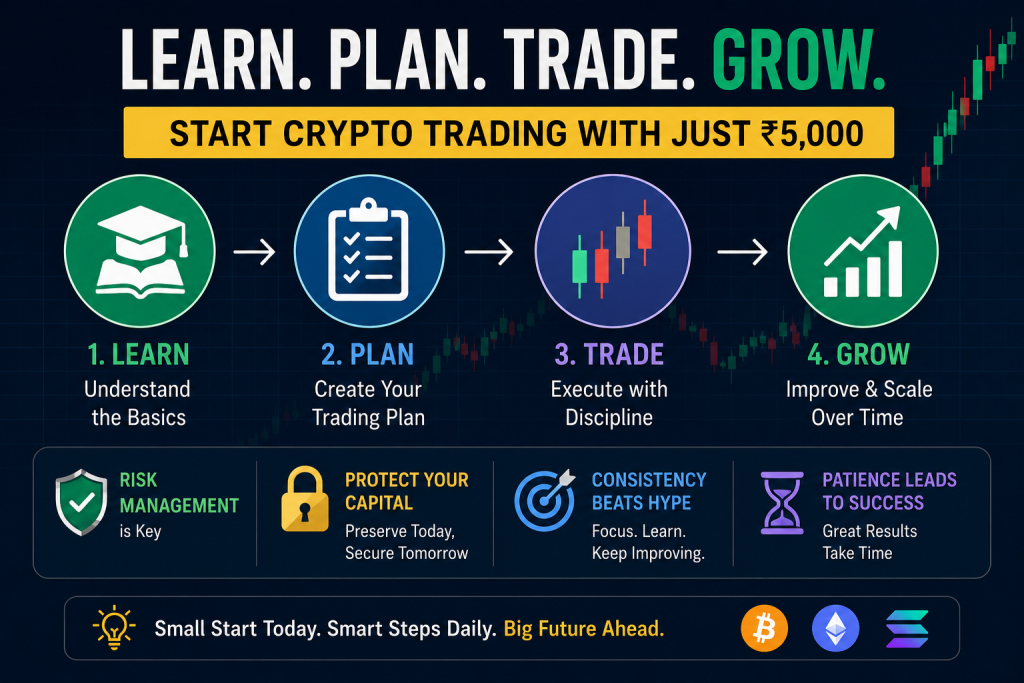
When you are starting with a small amount like ₹5,000, the goal is not to trade constantly or chase every market move. Instead, you should focus on simple, disciplined strategies that help you learn while keeping risk manageable.
The best beginner strategies are easy to understand, require minimal screen time, and emphasize consistency over excitement.
Three of the most practical approaches are:
- Dollar-Cost Averaging (DCA)
- Swing Trading
- Trend-Following
1. Dollar-Cost Averaging (DCA)
Dollar-Cost Averaging (DCA) is a strategy where you invest a fixed amount at regular intervals, regardless of market price.
Instead of investing your full ₹5,000 at once, you spread your purchases over time.
Example DCA Plan
You could invest:
- ₹1,000 this week
- ₹1,000 next week
- ₹1,000 the following week
- ₹1,000 in week four
- ₹1,000 in week five
This approach reduces the impact of short-term price volatility.
Benefits of DCA
- Lowers the risk of buying at a temporary peak
- Encourages discipline
- Reduces emotional decision-making
- Ideal for beginners
DCA is particularly useful for long-term accumulation of assets such as Bitcoin and Ethereum.
2. Swing Trading
Swing trading involves holding positions for several days to several weeks to capture medium-term price movements.
Rather than reacting to every market fluctuation, swing traders focus on higher-probability setups.
Example
You buy Ethereum after a pullback to support and sell after a 10–15% move higher.
Benefits of Swing Trading
- Less stressful than day trading
- Requires fewer trades
- Allows more time for analysis
- Suitable for people with full-time jobs
For many beginners, swing trading offers a balanced combination of opportunity and simplicity.
3. Trend-Following
Trend-following means trading in the direction of the prevailing market trend.
The principle is straightforward:
Buy when the market is trending upward and avoid trading against the trend.
Example
If Bitcoin is making higher highs and higher lows, a trend-following trader looks for buying opportunities during pullbacks.
Benefits of Trend-Following
- Aligns with market momentum
- Helps avoid countertrend trades
- Encourages patience
- Works across multiple timeframes
This strategy teaches beginners to trade with market direction rather than against it.
Strategy Comparison
| Strategy | Time Commitment | Risk Level | Beginner Friendly |
| DCA | Low | Lower | Excellent |
| Swing Trading | Moderate | Moderate | Very Good |
| Trend-Following | Moderate | Moderate | Very Good |
Which Strategy Is Best for You?
The most suitable strategy depends on your goals and personality.
Choose DCA If You:
- Prefer a long-term approach
- Want minimal screen time
- Are focused on learning gradually
Choose Swing Trading If You:
- Enjoy technical analysis
- Can monitor charts periodically
- Want to capture short- to medium-term moves
Choose Trend-Following If You:
- Prefer trading with market momentum
- Value clear, rules-based setups
Suggested Approach for a ₹5,000 Account
A practical beginner approach could be:
- Allocate ₹3,000 using DCA into Bitcoin and Ethereum.
- Use ₹1,500 for occasional swing trades.
- Keep ₹500 in cash for flexibility.
This allows you to learn multiple styles while maintaining a diversified structure.
Strategies Beginners Should Generally Avoid
Until you gain more experience, it is usually wise to avoid:
- High-leverage futures trading
- Scalping
- Meme coin speculation
- Emotion-driven trading
Simple strategies tend to be more sustainable.
Key Takeaway
The best beginner strategies for a ₹5,000 crypto account are:
- Dollar-Cost Averaging (DCA) for disciplined long-term accumulation.
- Swing Trading for capturing medium-term price moves.
- Trend-Following for trading in the direction of momentum.
Start with one approach, track your results, and refine your process as you gain experience. In trading, simplicity and consistency often outperform complexity.
15. Common Mistakes Beginners Should Avoid
Starting your crypto trading journey with ₹5,000 is a smart way to learn, but many beginners lose money because of avoidable mistakes rather than a lack of opportunity.
Understanding these common pitfalls can help you protect your capital and build better trading habits from the beginning.
1. Overtrading
Overtrading occurs when you take too many trades without a clear setup or plan.
Beginners often feel they need to be constantly active in the market, but frequent trading can lead to:
- Higher transaction costs
- Emotional decision-making
- Poor-quality entries
- Faster losses
Example
You enter multiple trades in one day simply because prices are moving, even though none meet your strategy criteria.
How to Avoid It
- Trade only when your setup appears.
- Limit the number of trades you take.
- Focus on quality rather than quantity.
- Follow a written trading plan.
Remember: sometimes the best trade is no trade.
2. Using Leverage Too Early
Leverage allows you to control a larger position with a smaller amount of capital.
While leverage can amplify gains, it also magnifies losses and increases liquidation risk.
Example
With 10x leverage, a 10% adverse move can result in a near-total loss of the capital allocated to that position.
Why Beginners Should Avoid It
- Higher emotional pressure
- Faster losses
- Increased complexity
- Greater risk of liquidation
For a ₹5,000 account, spot trading is generally a more appropriate starting point.
3. Chasing Hype Coins
Many new traders buy cryptocurrencies because they are trending on social media or being promoted by influencers.
This behavior is often driven by FOMO (Fear of Missing Out).
Risks of Hype-Driven Trading
- Buying near short-term peaks
- High volatility
- Limited fundamental support
- Sharp reversals
How to Avoid It
- Conduct your own research.
- Focus on established assets such as Bitcoin and Ethereum.
- Wait for setups that align with your strategy.
- Avoid investing based solely on online excitement.
4. Ignoring Fees and Taxes
Small costs can have a meaningful impact on a ₹5,000 account.
Trading Fees
Every buy and sell transaction may incur fees.
Withdrawal Fees
Moving funds off the exchange may involve additional charges.
Taxes
In India, cryptocurrency transactions may be subject to tax obligations and transaction-level reporting requirements, depending on current law.
Why This Matters
If you generate ₹200 in profit but pay ₹50 in fees and have tax liabilities, your net return is lower than expected.
How to Avoid It
- Review the fee schedule before trading.
- Keep detailed transaction records.
- Understand applicable tax rules.
- Consult a qualified tax professional if needed.
Other Mistakes to Watch For
Beginners may also struggle with:
- Investing more than they can afford to lose
- Trading without a stop-loss
- Ignoring risk management
- Acting on rumors
- Letting emotions override their plan
Summary of Common Mistakes
| Mistake | Why It’s Risky | Better Approach |
| Overtrading | Increases fees and emotional errors | Wait for high-quality setups |
| Using leverage too early | Magnifies losses | Start with spot trading |
| Chasing hype coins | Encourages buying near peaks | Focus on researched assets |
| Ignoring fees and taxes | Reduces actual returns | Track all costs and obligations |
Key Takeaway
Most beginner losses come from poor habits rather than a lack of market opportunity.
To improve your chances of success:
- Avoid overtrading.
- Stay away from leverage until you gain experience.
- Do not chase hype-driven coins.
- Account for fees and taxes.
By focusing on discipline and risk control, you give your ₹5,000 account the best chance to become a valuable learning tool and a strong foundation for long-term growth.
16. How Much Can You Realistically Earn with ₹5,000?
One of the most common questions beginners ask is:
How much money can I realistically make by starting crypto trading with ₹5,000?
The honest answer is that returns can vary widely. While cryptocurrency markets can produce strong gains, they are also highly volatile and can generate losses.
With a small account, your early objective should be to build skills and consistency rather than expect large profits immediately.
Realistic Return Scenarios
To understand what is possible, let’s look at some simple examples.
| Return | Profit on ₹5,000 | Account Value |
| 5% | ₹250 | ₹5,250 |
| 10% | ₹500 | ₹5,500 |
| 20% | ₹1,000 | ₹6,000 |
| -10% | -₹500 | ₹4,500 |
| -20% | -₹1,000 | ₹4,000 |
These examples are shown before trading fees, taxes, and slippage.
What These Numbers Mean
5% Return = ₹250 Profit
A modest but realistic gain for a well-executed trade or short series of trades.
10% Return = ₹500 Profit
A strong result for a beginner, especially if achieved while following strict risk management.
20% Return = ₹1,000 Profit
A substantial gain, but not something you should expect consistently in the short term.
The Power of Compounding
If you earn consistent returns and reinvest profits, your account can grow over time.
For example, repeated positive months can gradually increase your capital base. However, actual results depend on market conditions, discipline, fees, and taxes.
The more important lesson is that consistent execution matters more than any single winning trade.
Why Consistency Matters More Than Quick Gains
Many beginners focus on doubling their account as quickly as possible.
This mindset often leads to:
- Excessive risk-taking
- Overtrading
- Emotional decisions
- Large drawdowns
A better objective is:
Develop a repeatable process that produces disciplined, risk-controlled results over time.
Even modest returns can compound when combined with sound risk management.
Example: Conservative Growth
Suppose you average a 5% monthly return (before costs).
| Month | Approximate Account Value |
| Start | ₹5,000 |
| 1 | ₹5,250 |
| 3 | ₹5,788 |
| 6 | ₹6,701 |
| 12 | ₹8,979 |
This illustration is hypothetical and does not guarantee future results.
Focus on Skill Development First
When you start with ₹5,000, the most valuable outcome may not be the immediate profit.
Your first account helps you learn:
- Risk management
- Position sizing
- Emotional control
- Strategy testing
- Trade journaling
These skills can become far more valuable than the short-term return on a small account.
Realistic Expectations for Beginners
A healthy mindset is:
- Preserve your capital.
- Aim for steady improvement.
- Accept that losses are part of trading.
- Treat the account as a learning tool.
If you can consistently follow your plan, you are making meaningful progress.
Can You Become Wealthy Starting with ₹5,000?
A ₹5,000 account alone is unlikely to create significant wealth quickly.
However, it can become the foundation for:
- Developing a profitable process
- Building confidence
- Scaling gradually as skills improve
Long-term success comes from discipline, not from the size of your starting capital.
Key Takeaway
With ₹5,000, realistic returns might look like:
- 5% gain = ₹250
- 10% gain = ₹500
- 20% gain = ₹1,000
While these profits may seem modest, the real opportunity lies in developing consistency and sound trading habits.
In the early stages, focus on protecting capital, learning from each trade, and improving your process. Over time, those skills can become your most valuable asset.
17. Taxation and Regulatory Considerations in India
Before you start crypto trading, it is essential to understand how cryptocurrency is taxed and regulated in India.
Many beginners focus solely on profits, but taxes and compliance can significantly affect your net returns. Ignoring these obligations can lead to reporting issues, interest, and penalties.
Cryptocurrency taxation in India falls under the rules for Virtual Digital Assets (VDAs). (cleartax)
Is Crypto Legal in India?
As of 2026, buying, holding, and selling cryptocurrencies is not prohibited in India. However:
- Cryptocurrencies are not legal tender.
- Profits may be taxable.
- Exchanges and users are subject to compliance requirements.
Regulations can evolve, so it is important to stay informed and use reputable platforms.
Current Crypto Tax Rules in India (2026)
1. Flat 30% Tax on Profits
Income from the transfer of cryptocurrencies and other VDAs is generally taxed at a flat rate of 30%, plus applicable surcharge and 4% health and education cess. (cleartax)
This rate applies regardless of:
- Your income tax slab
- Holding period
- Whether you are a beginner or active trader
2. 1% TDS on Certain Transactions
A 1% Tax Deducted at Source (TDS) may apply to qualifying crypto transfers above prescribed thresholds. This TDS is usually deducted by the exchange and can generally be claimed as tax credit when filing your return. (cleartax)
3. Limited Deductions
Under the VDA tax regime, only the cost of acquisition is generally allowed as a deduction. Most other expenses are not deductible for calculating taxable income. (Paytm)
4. Loss Set-Off Restrictions
Losses from VDA transfers generally cannot be set off against other income or carried forward to future years. (Paytm)
Example of Tax Impact
Suppose you buy cryptocurrency for ₹5,000 and later sell it for ₹6,000.
- Purchase Cost: ₹5,000
- Sale Value: ₹6,000
- Profit: ₹1,000
At a 30% tax rate, the base tax on the ₹1,000 gain would be ₹300, plus applicable surcharge and cess.
This example is simplified and excludes fees, TDS credits, and other personal tax considerations.
Why Recordkeeping Is Essential
Maintaining accurate records makes tax filing much easier.
Track the following for every transaction:
- Date and time
- Asset traded
- Buy and sell prices
- Quantity
- Fees
- TDS deducted
- Profit or loss
Good records also help you evaluate trading performance.
Tools That Can Help
Many traders use:
- Google Sheets
- Microsoft Excel
- Exchange transaction reports
- Specialized crypto tax software
Your JournalX trading journal can also serve as a valuable recordkeeping tool.
Why You Should Consult a Qualified Tax Professional
Tax rules can be complex, especially if you:
- Trade frequently
- Use multiple exchanges
- Transfer assets between wallets
- Receive airdrops or staking rewards
- Engage in decentralized finance (DeFi)
A Chartered Accountant (CA) or tax advisor can help ensure accurate reporting based on your specific circumstances.
Regulatory Considerations Beyond Taxes
In addition to tax compliance, traders should:
- Use reputable exchanges.
- Complete KYC verification.
- Protect account security.
- Stay updated on legal developments.
Rules and enforcement practices may change over time.
Practical Tips for Indian Crypto Traders
- Save all trade confirmations and statements.
- Download annual transaction reports.
- Reconcile TDS deducted by exchanges.
- Set aside funds for taxes.
- Review official guidance before filing.
For official information, refer to the Income Tax Department of India.
Key Takeaway
Crypto trading in India can be exciting, but taxes and compliance are an important part of the process.
As of 2026, key rules generally include:
- 30% tax on profits from VDAs.
- 1% TDS on certain qualifying transactions.
- Limited deductions.
- Restrictions on using losses.
By maintaining accurate records and consulting a qualified tax professional, you can trade with greater confidence and avoid unnecessary compliance issues.
18. Recommended Tools and Resources

Using the right tools can make your crypto trading journey much easier and more efficient. Whether you want to track prices, analyze charts, or store your assets securely, a few trusted platforms can save you time and help you make more informed decisions.
Below are three essential tools every beginner should know.
1. Price Tracking: CoinMarketCap
CoinMarketCap is one of the most widely used websites for tracking cryptocurrency prices and market data.
It provides real-time information on thousands of cryptocurrencies, including:
- Current price
- Market capitalization
- Trading volume
- Historical charts
- Supply statistics
- Project descriptions
Why Beginners Should Use CoinMarketCap
With CoinMarketCap, you can:
- Compare different cryptocurrencies.
- Monitor price movements.
- Research top-performing coins.
- Build and track a watchlist.
- Stay updated on market trends.
Example Use Case
Before buying Bitcoin or Ethereum, you can review:
- Recent price performance
- Market ranking
- Trading volume
- Basic project information
This helps you make more informed decisions.
2. Market Research and Chart Analysis: TradingView
TradingView is one of the most popular charting and market analysis platforms used by traders worldwide.
It offers:
- Interactive charts
- Technical indicators
- Drawing tools
- Watchlists
- Price alerts
- Community analysis
Why TradingView Is Valuable
TradingView allows you to:
- Analyze trends and support/resistance levels.
- Use indicators such as moving averages and RSI.
- Set alerts for key price levels.
- Save chart layouts.
- Study other traders’ ideas.
Example Use Case
If you are planning to buy Bitcoin, you can analyze whether the market is trending upward and identify potential entry and exit levels.
3. Security Wallets: Ledger
Ledger is one of the best-known hardware wallet providers for securely storing cryptocurrencies offline.
Popular devices include:
- Ledger Nano S Plus
- Ledger Nano X
Why Hardware Wallets Matter
A hardware wallet stores your private keys offline, significantly reducing exposure to online threats.
Benefits include:
- Enhanced security
- Protection from exchange failures
- Long-term storage capability
- Full control over your assets
When Should Beginners Consider a Hardware Wallet?
If you plan to hold a meaningful amount of cryptocurrency for the long term, a hardware wallet can provide an additional layer of security.
For very small balances, many beginners initially keep assets on a reputable exchange, but learning self-custody is valuable as holdings grow.
Additional Useful Resources
You may also find these tools helpful:
- Google Sheets – Track trades and performance.
- Notion – Organize research and journaling.
- CoinGecko – Alternative market data source.
- Fear & Greed Index – Sentiment indicator.
Recommended Beginner Workflow
A simple workflow could look like this:
- Research coins on CoinMarketCap.
- Analyze charts on TradingView.
- Execute trades on your chosen exchange.
- Record each trade in your journal.
- Store long-term holdings securely using Ledger.
This process helps you trade more systematically.
Key Takeaway
The right tools can make you a more organized and informed trader.
Essential resources for beginners include:
- CoinMarketCap for price tracking and research.
- TradingView for chart analysis.
- Ledger for secure long-term storage.
Used together, these tools provide a strong foundation for researching, analyzing, and protecting your crypto investments.
19. Frequently Asked Questions
Can I Start Crypto Trading with ₹5,000?
Yes, you can absolutely start crypto trading with ₹5,000.
Most exchanges allow you to buy fractional amounts of cryptocurrencies such as Bitcoin and Ethereum, so you do not need a large amount of money to begin.
Starting with ₹5,000 is actually a sensible approach because it allows you to:
- Learn how the market works.
- Practice risk management.
- Build confidence.
- Limit potential losses.
Your primary goal should be education and experience rather than immediate profits.
Which Crypto Is Best for Beginners?
Many beginners choose established cryptocurrencies with large market capitalizations and strong liquidity.
Common examples include:
- Bitcoin
- Ethereum
These assets are widely followed, highly liquid, and generally less speculative than many smaller altcoins.
That said, all cryptocurrencies are volatile, and no asset is guaranteed to perform well.
Is Crypto Trading Legal in India?
As of 2026, buying, holding, and selling cryptocurrencies is not prohibited in India.
However:
- Cryptocurrencies are not legal tender.
- Profits may be taxable.
- Exchanges and users are subject to compliance requirements.
Because regulations can evolve, it is important to stay informed and use reputable platforms.
How Much Can I Earn from ₹5,000?
Your returns depend on market conditions, strategy, fees, taxes, and risk management.
Illustrative examples:
- 5% gain = ₹250 profit
- 10% gain = ₹500 profit
- 20% gain = ₹1,000 profit
These figures are before fees and taxes.
While the profits may appear modest, the real value of a small account is the opportunity to develop trading skills and discipline.
Should Beginners Use Leverage?
In most cases, beginners should avoid leverage.
Leverage can magnify gains, but it also increases losses and may lead to liquidation.
For new traders, spot trading is generally the more appropriate starting point because:
- It is simpler to understand.
- Risk is limited to the amount invested.
- There is no borrowing involved.
Once you have gained experience and a proven process, you can decide whether advanced products are appropriate for your goals and risk tolerance.
Key Takeaway
Starting crypto trading with ₹5,000 is entirely possible and can be an excellent way to learn.
For most beginners:
- Focus on major cryptocurrencies like Bitcoin and Ethereum.
- Use regulated, security-focused exchanges.
- Understand taxes and compliance in India.
- Avoid leverage.
- Prioritize learning and consistency over quick profits.
A small account, managed with discipline, can provide valuable experience and a strong foundation for long-term success.
20. Final Thoughts
Starting your crypto trading journey with just ₹5,000 may seem modest, but it can be one of the smartest ways to enter the market.
You do not need a large account to begin. What matters most is developing the right habits, understanding how the market works, and learning how to manage risk effectively.
In many cases, the lessons you gain from trading a small account are far more valuable than the short-term profits you earn.
Start Small and Focus on Education
Your first ₹5,000 should be viewed as an investment in your financial education.
Use it to learn:
- How crypto exchanges work
- How to place spot trades
- How to set stop-loss and take-profit levels
- How to manage emotions
- How to maintain a trading journal
The goal at this stage is to build knowledge and confidence, not to get rich quickly.
Protect Your Capital
Capital preservation should always come before profit.
If you lose your account because of poor risk management, you lose the opportunity to continue learning.
Make capital protection your top priority by:
- Risking only a small percentage of your account per trade
- Using stop-loss orders
- Avoiding leverage
- Diversifying your exposure
- Staying patient
Successful traders think first about how much they could lose, not how much they might gain.
Build Discipline Before Increasing Account Size
One of the biggest mistakes beginners make is adding more capital before proving they can trade consistently.
Before increasing your account size, focus on:
- Following your trading plan
- Respecting risk limits
- Tracking every trade
- Reviewing performance
- Managing emotions effectively
Once you demonstrate consistent execution over time, you can consider scaling gradually.
Also Read: How Crypto Trading Works (Simple Explanation): A Beginner’s Guide
Trading Is a Skill, Not a Shortcut
Crypto trading can be rewarding, but it requires patience, discipline, and continuous learning.
Like any valuable skill, success develops over time through practice and experience.
There will be winning trades, losing trades, and important lessons along the way.
The traders who succeed are typically those who remain consistent, adaptable, and focused on long-term improvement.
A Practical Beginner Mindset
A healthy approach is:
“I am using ₹5,000 to build a skill that could benefit me for years.”
This perspective reduces pressure and encourages disciplined decision-making.
Final Takeaway
If you remember only three things from this guide, let them be:
- Start small and prioritize learning.
- Protect your capital at all times.
- Build discipline before increasing your account size.
If you approach crypto trading with patience and a commitment to continuous improvement, even a small starting amount can become the foundation of a valuable long-term skill.
Your first ₹5,000 is not just trading capital—it is the beginning of your education as a trader.
21. Risk Disclaimer
Cryptocurrency trading and investing involve substantial risk and may not be suitable for all investors. Digital assets such as Bitcoin and Ethereum are highly volatile, and their prices can fluctuate significantly over short periods of time. You may lose part or all of the capital you invest.
The information provided in this article is for educational and informational purposes only and should not be construed as financial, investment, legal, tax, or accounting advice. Nothing in this guide constitutes a recommendation to buy, sell, or hold any cryptocurrency or other financial instrument.
Past performance is not indicative of future results. Any examples of returns, strategies, or portfolio allocations are hypothetical and are intended solely to illustrate concepts. Actual results will vary based on market conditions, fees, taxes, execution quality, and individual decision-making.
Before making any investment decision, you should conduct your own research, carefully assess your financial situation, and consult with a qualified financial advisor, Chartered Accountant (CA), or legal professional as appropriate.
By reading this article, you acknowledge that you are solely responsible for your investment decisions and any gains or losses that may result from them.
22. About the Author
Shiva Naresh is the founder of Zyqorr.com, a digital news and financial education platform dedicated to helping readers understand trading, investing, and personal finance in a practical, beginner-friendly way.
As an active trader and market researcher, Shiva specializes in technical analysis, price action trading, and risk management across multiple asset classes, including stocks, forex, commodities, and cryptocurrencies. He regularly studies major market instruments such as Bitcoin, Ethereum, gold (XAU/USD), and leading global indices to identify trends, market opportunities, and risk factors.
Through Zyqorr.com, Shiva publishes in-depth educational guides, market insights, and data-driven analysis designed to simplify complex financial concepts into clear, actionable content. He also creates comprehensive eBooks, research reports, and digital tools to help traders and investors build stronger foundations and make more informed decisions.
In addition to content creation, Shiva is developing innovative projects such as JournalX, an advanced trading journal platform, and other digital products aimed at supporting traders worldwide.
His mission is to make high-quality financial education accessible to everyone by combining real-world trading experience, structured research, and a commitment to transparency and continuous learning.