
Table of Contents
How the Stock Market Works (Simple Explanation)
The stock market may seem complicated at first, filled with charts, numbers, and financial jargon. But in reality, the basic concept is surprisingly simple.
At its core, the stock market is a place where people buy and sell ownership in companies.
When you buy a stock, you own a small part of a business. If that company grows and becomes more valuable, your investment may grow too. If the company performs poorly, the stock price can fall.
In this beginner-friendly guide, we’ll explain how the stock market works in simple language, including:
- What stocks are
- Why companies sell shares
- How investors make money
- What causes stock prices to rise and fall
- Risks and advantages of investing
Whether you are a student, beginner investor, or simply curious about finance, this guide will help you understand the foundations of the stock market clearly.
Understanding how the stock market works is essential for anyone interested in investing, trading, or building long-term wealth. The stock market allows companies to raise capital while giving investors opportunities to participate in business growth. Learning how the stock market works can help beginners make smarter financial decisions, manage risks effectively, and avoid common investing mistakes.
What Is the Stock Market?


The stock market is a system where investors buy and sell shares of publicly listed companies.
Think of it like a large marketplace:
- Companies come to raise money
- Investors come to buy ownership
- Prices change based on demand and supply
Popular stock exchanges include:
These exchanges help ensure transparency, regulation, and smooth trading.
What Is a Stock?
A stock (also called a share or equity) represents partial ownership in a company.
For example:
If a company has 1 million shares and you own 1,000 shares, you own a tiny portion of that business.
Companies issue stocks to raise money for:
- Expansion
- Research
- Hiring employees
- Paying debt
- Building products
When the company grows successfully, investors may benefit through rising stock prices or dividends.
Why Do Companies Sell Shares?
Businesses often need large amounts of capital to grow.
Instead of borrowing only from banks, companies can:
- Divide ownership into shares
- Sell those shares to the public
- Raise money from investors
This process is called an Initial Public Offering (IPO).
For example:
A technology company may go public to raise funds for:
- Building new products
- Expanding globally
- Improving infrastructure
In return, investors receive ownership stakes.
How the Stock Market Works
Here’s the simple process:
Step 1: A Company Lists Its Shares
A company becomes publicly traded through an IPO.
Step 2: Investors Buy Shares
People purchase shares through brokers or trading platforms.
Step 3: Prices Move Constantly
Stock prices rise or fall based on:
- Company performance
- News
- Economic conditions
- Investor sentiment
- Demand and supply
Step 4: Investors Sell Shares
Investors can sell shares anytime during market hours.
If the selling price is higher than the buying price, they make a profit. If lower, they incur a loss.
Major Participants in the Market
The stock market includes several participants:
| Participant | Role |
| Retail Investors | Individual people investing money |
| Institutional Investors | Mutual funds, banks, hedge funds |
| Brokers | Platforms that execute trades |
| Companies | Businesses raising capital |
| Regulators | Authorities ensuring fair markets |
In India, the market is regulated by Securities and Exchange Board of India.
What Makes Stock Prices Move?

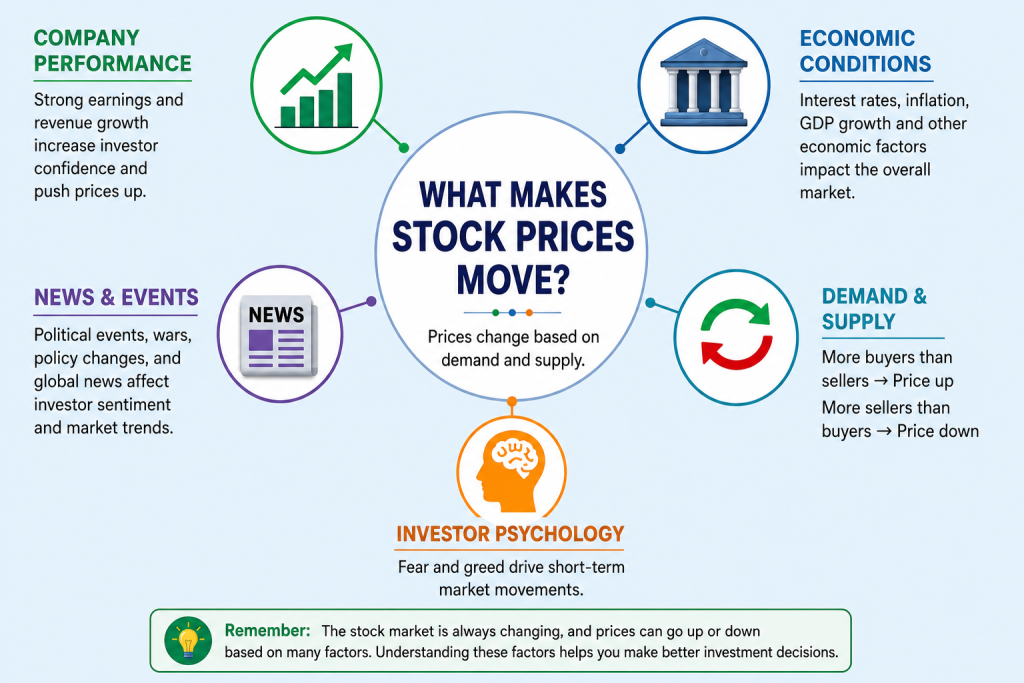
Stock prices constantly fluctuate due to demand and supply.
If more people want to buy a stock than sell it:
- Price rises
If more people want to sell than buy:
- Price falls
Several factors affect prices:
Company Performance
Strong profits often attract investors.
Economic Conditions
Interest rates, inflation, and GDP growth impact markets.
News & Events
Global events, wars, elections, or technological breakthroughs can move stocks rapidly.
Investor Psychology
Fear and greed often drive short-term market movements.
How Investors Make Money
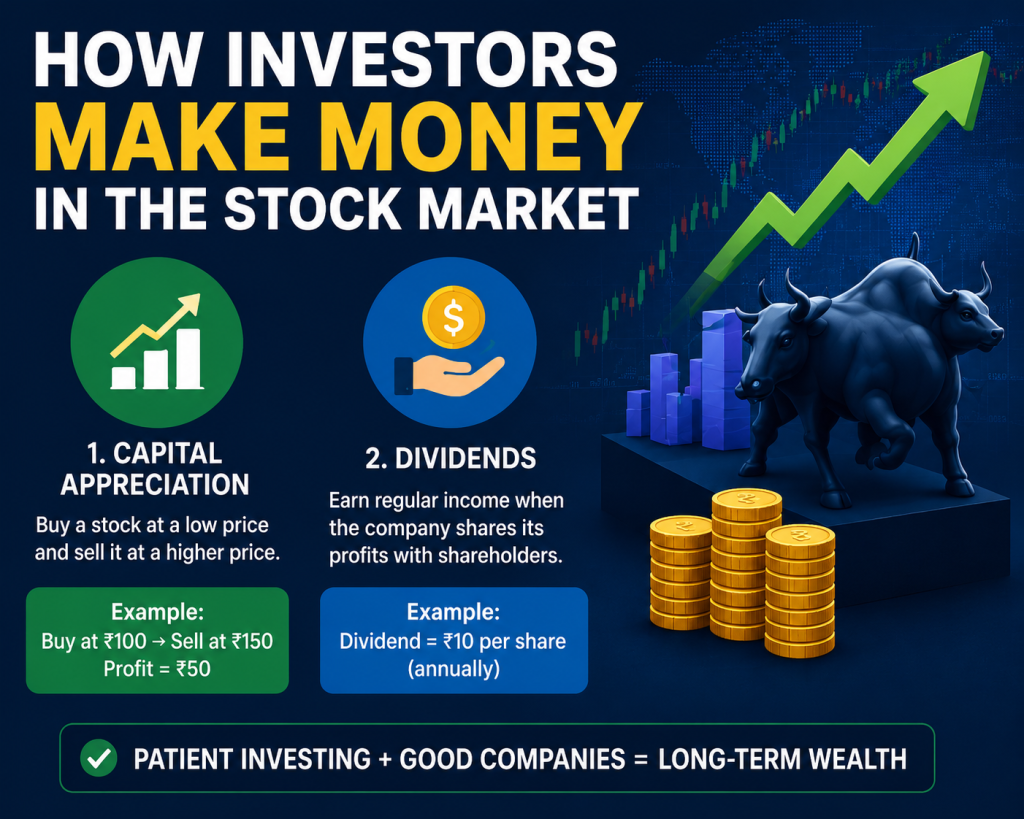
There are mainly two ways investors profit from stocks.
1. Capital Appreciation
Buying low and selling high.
Example:
- Buy a stock at ₹100
- Sell at ₹150
- Profit = ₹50 per share
2. Dividends
Some companies share profits with investors regularly.
For example:
A company may pay ₹10 dividend per share annually.
Types of Stock Markets
Primary Market
Where companies first issue shares through IPOs.
Secondary Market
Where investors buy and sell existing shares among themselves.
Most daily trading happens in the secondary market.
Difference Between Investing and Trading
| Investing | Trading |
| Long-term approach | Short-term approach |
| Focus on company growth | Focus on price movements |
| Lower frequency | Frequent buying/selling |
| Often lower stress | Higher risk and volatility |
Long-term investing is generally considered more suitable for beginners.
Simple Example of Stock Investing
Imagine you invested ₹10,000 in a company.
If the stock grows by 20%:
- Your investment becomes ₹12,000
If the stock falls by 10%:
- Your investment becomes ₹9,000
This demonstrates how stock values fluctuate based on market conditions.
Advantages of the Stock Market
Wealth Creation
Historically, stocks have outperformed many traditional investments over long periods.
Ownership in Businesses
You become a partial owner of companies you believe in.
Liquidity
Stocks can usually be bought or sold quickly during market hours.
Passive Income
Dividend-paying stocks may provide recurring income.
Inflation Protection
Equities often help investors stay ahead of inflation over time.
Risks and Disadvantages
Market Volatility
Prices can fluctuate sharply in short periods.
Risk of Loss
Investments can lose value if companies perform poorly.
Emotional Decisions
Fear and greed can lead to poor investment choices.
Economic Uncertainty
Global recessions and crises can impact markets heavily.
No Guaranteed Returns
Unlike fixed deposits, stock market returns are never guaranteed.
Important Terms Beginners Should Know
| Term | Meaning |
| Share/Stock | Ownership in a company |
| IPO | Initial Public Offering |
| Dividend | Profit paid to shareholders |
| Bull Market | Rising market |
| Bear Market | Falling market |
| Portfolio | Collection of investments |
| Market Capitalization | Total company value |
| Volatility | Speed of price movement |
Tips for New Investors

Start Small
Avoid investing large amounts initially.
Learn Before Investing
Understand business fundamentals and risks.
Diversify
Do not put all money into one stock.
Think Long-Term
Patience often matters more than short-term predictions.
Avoid Emotional Trading
Make decisions based on research, not fear or hype.
Use Trusted Platforms
Choose regulated brokers and verified financial sources.
Frequently Asked Questions (FAQs)
Is the stock market gambling?
No. Investing in quality businesses based on research differs significantly from gambling. However, speculative trading without knowledge can become risky.
Can beginners invest in stocks?
Yes. Beginners can start with small investments and gradually learn about markets and risk management.
How much money do I need to start?
Many brokers allow investing with very small amounts, depending on the stock price and platform.
Why do stock prices change every second?
Prices change continuously because buyers and sellers constantly place orders.
Is stock market investing safe?
All investments carry risk. Diversification, education, and long-term thinking may help reduce risk.
What is the best strategy for beginners?
Many financial experts recommend:
- Long-term investing
- Diversification
- Consistent investing
- Avoiding emotional decisions
Authoritative References
For further learning, readers can explore:
- Securities and Exchange Board of India (SEBI)
- National Stock Exchange of India (NSE)
- Bombay Stock Exchange (BSE)
- U.S. Securities and Exchange Commission (SEC)
- Investopedia Stock Market Basics
Final Thoughts
Understanding how the stock market works is one of the most valuable financial skills in today’s world.
The stock market is not just for professional traders or wealthy investors. With proper education, discipline, and risk awareness, anyone can begin learning about investing.
The key is to:
- Start with basics
- Focus on long-term learning
- Manage risks carefully
- Avoid unrealistic expectations
Successful investing is usually built through patience, consistency, and continuous learning rather than quick profits.
For beginners, understanding the fundamentals is far more important than chasing short-term market trends.
Now that you understand how the stock market works, you can begin exploring investing with greater confidence. While markets involve risks, learning how the stock market works provides a strong foundation for long-term financial education and smarter investment decisions.
Financial Disclaimer
This article is for educational and informational purposes only and should not be considered financial, investment, or legal advice. Investing in stocks involves risk, including potential loss of capital. Always conduct your own research and consult a qualified financial advisor before making investment decisions.
Also Read: What Is Stock Trading? Ultimate Beginner’s Guide to Profitable Stock Trading in India (2026)


