
Table of Contents
Intraday vs Swing vs Long-Term Trading: Complete Guide for Beginners

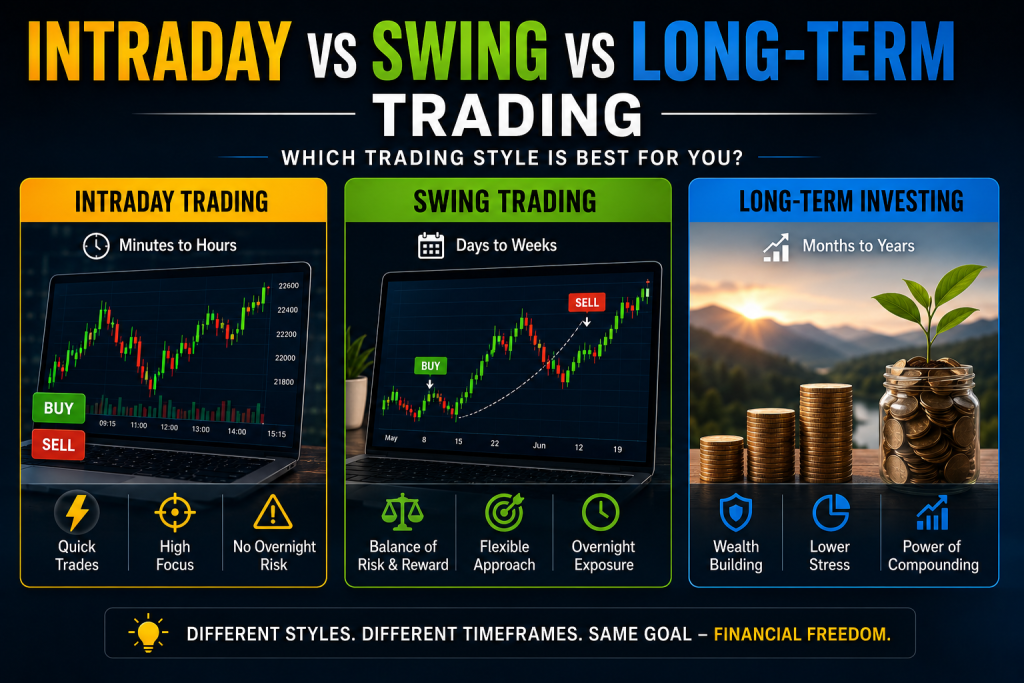
Financial markets offer multiple ways to grow wealth, but choosing the right trading style is one of the most important decisions every trader or investor must make. Some traders prefer quick profits within hours, while others hold positions for days, months, or even years.
The three most popular approaches are:
- Intraday Trading
- Swing Trading
- Long-Term Trading/Investing
Each style has different risk levels, time commitments, psychological demands, and profit potential.
In this comprehensive guide on Intraday vs Swing vs Long-Term Trading, we will compare the advantages, risks, profitability, and suitability of each trading style.
In this detailed guide, we will compare intraday vs swing vs long-term trading, explain how each works, discuss advantages and disadvantages, and help you decide which approach suits your personality, lifestyle, and financial goals.
What Is Intraday Trading?
Intraday trading, also called day trading, involves buying and selling financial instruments within the same trading day. Positions are closed before the market closes, meaning traders avoid overnight risk.
Intraday traders usually focus on:
- Stocks
- Forex
- Crypto
- Futures & Options
- Commodities
The main goal is to capture short-term price movements.
Example of Intraday Trading
Suppose a trader buys shares of Reliance Industries at ₹2,900 in the morning and sells them at ₹2,935 within two hours. The trader earns ₹35 per share before brokerage and taxes.
Key Features
- Very short holding period
- Requires active monitoring
- Fast decision-making
- High volatility exposure
- Uses technical analysis heavily
What Is Swing Trading?
Swing trading involves holding positions for several days or weeks to capture medium-term price movements.
Swing traders attempt to profit from market “swings” caused by momentum, trends, breakouts, or reversals.
Example of Swing Trading
A trader buys shares of Tata Motors at ₹950 after a breakout pattern and sells them at ₹1,050 after two weeks.
Key Features
- Medium-term holding period
- Less stressful than intraday trading
- Combines technical and fundamental analysis
- Requires patience and discipline
- Overnight risk exists
What Is Long-Term Trading or Investing?
Long-term trading, often called investing, involves holding assets for months or years based on long-term growth potential.
Long-term investors focus more on business fundamentals, industry growth, management quality, and economic trends rather than short-term price fluctuations.
Example of Long-Term Investing
An investor purchases shares of Infosys and holds them for 5 years expecting growth in India’s IT sector.
Key Features
- Long holding period
- Lower stress compared to active trading
- Focus on wealth creation
- Power of compounding plays a major role
- Less screen time required
Major Differences Between Intraday, Swing, and Long-Term Trading
| Feature | Intraday Trading | Swing Trading | Long-Term Trading |
| Holding Time | Minutes to hours | Days to weeks | Months to years |
| Risk Level | High | Medium | Lower |
| Time Requirement | Very high | Moderate | Low |
| Analysis Type | Mostly technical | Technical + fundamental | Mostly fundamental |
| Stress Level | Very high | Moderate | Lower |
| Capital Growth Speed | Fast but risky | Balanced | Slow and stable |
| Suitable For | Full-time traders | Working professionals | Investors |
| Overnight Risk | No | Yes | Yes |
| Frequency of Trades | Very high | Medium | Low |
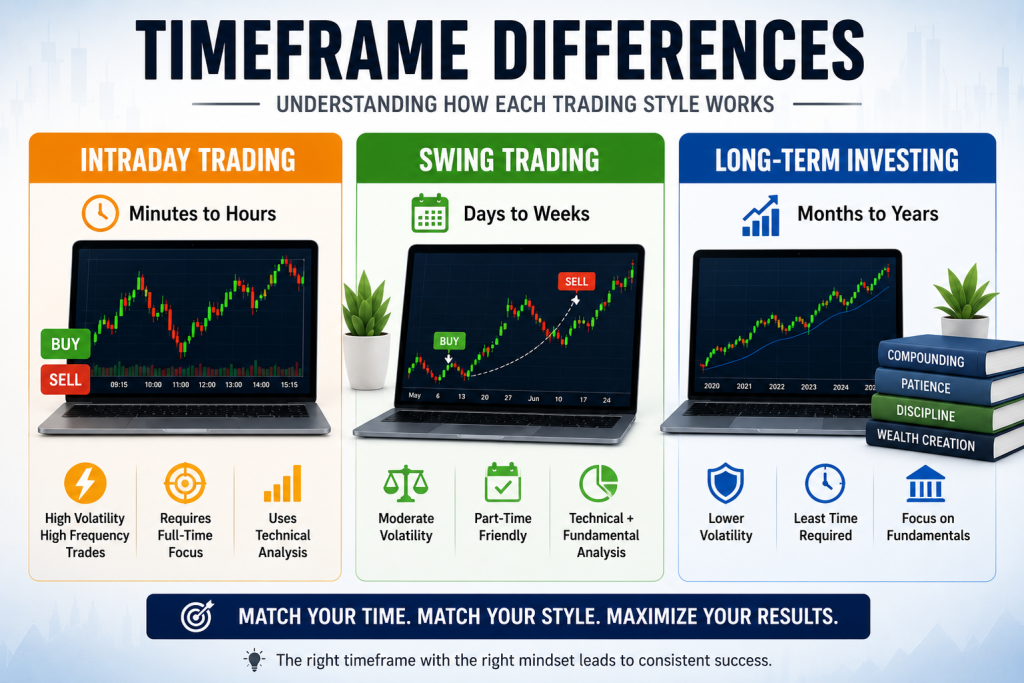
Time Commitment Comparison
Intraday Trading
Intraday trading requires constant market monitoring. Traders may spend 6–8 hours daily analyzing charts and managing positions.
This style is suitable for:
- Full-time traders
- Experienced market participants
- High-discipline individuals
Swing Trading
Swing trading is more flexible. Traders can analyze markets after work or during weekends.
This style works well for:
- Working professionals
- Part-time traders
- Intermediate traders
Long-Term Investing
Long-term investing requires the least daily attention.
Ideal for:
- Beginners
- Busy professionals
- Retirement-focused investors
- Wealth builders
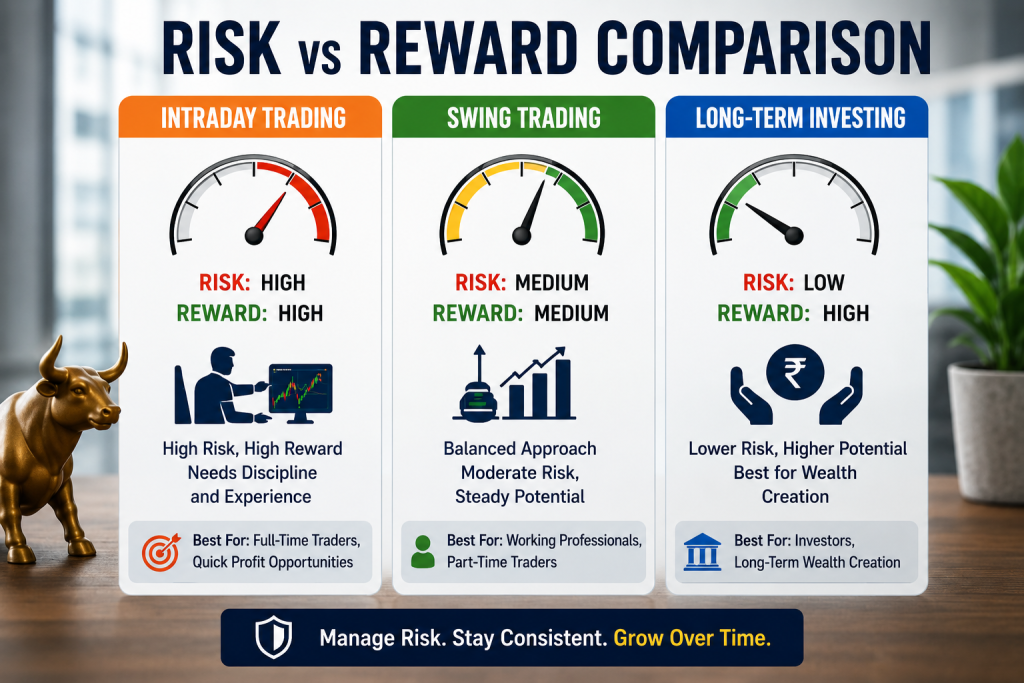
Risk and Reward Analysis
Intraday Trading Risk
Intraday trading carries high risk because leverage, volatility, and emotional decisions can lead to rapid losses.
Common risks include:
- Overtrading
- Revenge trading
- Slippage
- Emotional stress
However, skilled traders may generate quick returns.
Swing Trading Risk
Swing trading reduces noise compared to intraday trading but still faces:
- Overnight gaps
- Market reversals
- Trend failures
Risk can be controlled using stop-loss orders.
Long-Term Investing Risk
Long-term investing is generally safer when diversified properly, but risks still exist:
- Economic downturns
- Poor company fundamentals
- Sector collapse
- Inflation impact
Historically, quality companies tend to recover over long periods.
Capital Requirements
Intraday Trading
Often requires:
- Higher capital
- Margin understanding
- Brokerage awareness
- Risk management discipline
Frequent trading costs can impact profitability.
Swing Trading
Swing trading can start with moderate capital because trades are less frequent.
Long-Term Investing
Long-term investing is highly beginner-friendly. Investors can start with SIPs, ETFs, or gradual stock accumulation.
Practical Trading Style Examples
Scenario 1: Fast-Paced Trader
A trader enjoys quick decisions, chart analysis, and high adrenaline.
Best fit:
- Intraday trading
Scenario 2: Working Professional
Someone with a full-time job wants market participation without constant monitoring.
Best fit:
- Swing trading
Scenario 3: Wealth Builder
An investor wants long-term wealth growth with lower stress.
Best fit:
- Long-term investing
Pros and Cons of Intraday Trading
Advantages
- Quick profit opportunities
- No overnight holding risk
- High liquidity
- Daily trading opportunities
Disadvantages
- Extremely stressful
- High emotional pressure
- Requires strong discipline
- High transaction costs
- Significant learning curve
Pros and Cons of Swing Trading
Advantages
- Flexible schedule
- Better risk-reward opportunities
- Less screen time
- Easier for beginners than intraday trading
Disadvantages
- Overnight market risk
- Slower profits compared to intraday
- Requires patience
Pros and Cons of Swing Trading
Advantages
- Flexible schedule
- Better risk-reward opportunities
- Less screen time
- Easier for beginners than intraday trading
Disadvantages
- Overnight market risk
- Slower profits compared to intraday
- Requires patience
Which Trading Style Is Best for Beginners?

For most beginners, swing trading or long-term investing is generally safer and more practical than intraday trading.
Why Beginners Struggle With Intraday Trading
Many new traders underestimate:
- Emotional pressure
- Risk management importance
- Market volatility
- Capital preservation
Without proper education and strategy testing, beginners may experience heavy losses.
Better Beginner Approach
A balanced path could be:
- Start with long-term investing
- Learn risk management
- Practice swing trading
- Move to intraday only after gaining experience
Common Mistakes Traders Make
1. Overtrading
Taking too many trades often leads to emotional decisions and losses.
2. Ignoring Stop Loss
Risk management is essential in all trading styles.
3. Using Excessive Leverage
High leverage can destroy trading accounts quickly.
4. Chasing Fast Profits
Many traders focus on quick money instead of sustainable growth.
5. Lack of Education
Markets reward preparation and discipline, not gambling behavior.
Essential Risk Management Tips
Use Proper Position Sizing
Never risk a large portion of your capital on a single trade.
Maintain a Risk-Reward Ratio
Many professional traders aim for at least:
Risk-Reward Ratio=1:2\text{Risk-Reward Ratio} = 1:2Risk-Reward Ratio=1:2
This means risking ₹1 to potentially earn ₹2.
Diversify Investments
Long-term investors should diversify across sectors and asset classes.
Keep a Trading Journal
Track:
- Entry and exit points
- Emotions
- Mistakes
- Performance metrics
Intraday vs Swing vs Long-Term Trading: Final Comparison
| Trading Style | Best For | Difficulty Level | Stress Level |
| Intraday Trading | Full-time traders | High | High |
| Swing Trading | Working professionals | Medium | Medium |
| Long-Term Investing | Beginners & investors | Lower | Lower |
Frequently Asked Questions (FAQs)
Is intraday trading better than swing trading?
Not necessarily. Intraday trading offers faster opportunities but carries higher stress and risk. Swing trading is generally more balanced for most traders.
Can beginners start with intraday trading?
Beginners can learn intraday trading, but starting directly with real money is risky. Proper education and practice are essential.
Which trading style is most profitable?
Profitability depends on skill, discipline, market conditions, and risk management—not just trading style.
Is long-term investing safer?
Historically, diversified long-term investing has been more stable than short-term trading, but all investments carry risk.
Can I combine all three trading styles?
Yes. Many market participants use separate portfolios for intraday trading, swing trading, and long-term investing.
Which is better: Intraday vs Swing vs Long-Term Trading?
There is no single “best” trading style because each approach suits different personalities, goals, risk tolerance, and time availability.
- Intraday trading is suitable for active traders who can monitor markets continuously and handle higher risk and make fast decisions.
- Swing trading is ideal for traders looking for a balanced approach with moderate time commitment and medium-term opportunities.
- Long-term trading or investing is generally better for beginners and wealth builders who prefer lower stress, long-term growth, and the power of compounding.
Choosing between Intraday vs Swing vs Long-Term Trading depends on your financial goals, trading experience, emotional discipline, and lifestyle. Many successful market participants even combine multiple trading styles to diversify their strategies and income opportunities.
Authoritative References
- National Stock Exchange of India (NSE)
- Securities and Exchange Board of India (SEBI)
- Investopedia Trading Education
- TradingView Market Charts
Conclusion
Choosing between intraday, swing, and long-term trading depends on your personality, experience, risk tolerance, time availability, and financial goals.
- Intraday trading suits highly disciplined active traders.
- Swing trading offers balance and flexibility.
- Long-term investing focuses on stable wealth creation and compounding.
There is no universally “best” trading style. The best approach is the one that matches your lifestyle and allows consistent risk management.
Before risking real money, invest time in learning market psychology, technical analysis, and capital protection strategies.
Successful trading is not about making quick money—it is about surviving, growing consistently, and managing risk intelligently.
Understanding the differences between Intraday vs Swing vs Long-Term Trading can help traders choose a strategy that matches their financial goals and risk tolerance.
Also Read: What Is Stock Trading? Ultimate Beginner’s Guide to Profitable Stock Trading in India (2026)
Financial Disclaimer
This article is for educational and informational purposes only and should not be considered financial, investment, or trading advice. Financial markets involve substantial risk, and past performance does not guarantee future results. Always conduct your own research and consult a qualified financial advisor before making investment decisions.


