Table of Contents
How to Open a Demat Account in India?
Investing in the Indian stock market has become more accessible, transparent, and streamlined than ever before. Whether your ultimate goal is to build a long-term retirement portfolio of blue-chip stocks, systematically invest in mutual funds via SIPs, or actively trade the daily market swings using price action strategies, your first required step is opening a Demat account.
In 2026, the process of how to open a Demat account in India is highly digitized. Gone are the days of tedious paperwork and week-long waiting periods. With modern digital onboarding, Digilocker integration, and Aadhaar-based eKYC, you can open a Demat account online from your smartphone in under 15 minutes.
However, for a beginner, the sheer volume of choices can be paralyzing. Navigating the differences between broker types, understanding hidden Depository Participant (DP) charges, and ensuring platform security can still be overwhelming.
If you are wondering how to open a Demat account in India, this comprehensive guide from Zyqorr breaks down exactly how to do it safely, how to avoid hidden fees that eat into your profits, and how to choose the perfect broker tailored to your specific trading or investing style.
What Is a Demat Account India?

Before learning how to open a Demat account in India, you must understand what it is. A Demat account, short for “Dematerialized Account,” serves as a highly secure digital vault. for your financial securities. Decades ago, investors traded physical paper share certificates, which were prone to theft, forgery, damage, and incredibly slow transfer times. Dematerialization is the process of converting those physical certificates into electronic format.
In India, Demat accounts are strictly regulated by the Securities and Exchange Board of India (SEBI) to ensure maximum retail investor protection. Your broker does not actually hold your shares; instead, they are held by one of two government-backed central depositories:
Your broker merely acts as a Depository Participant (DP)—a bridge between you and the depository.
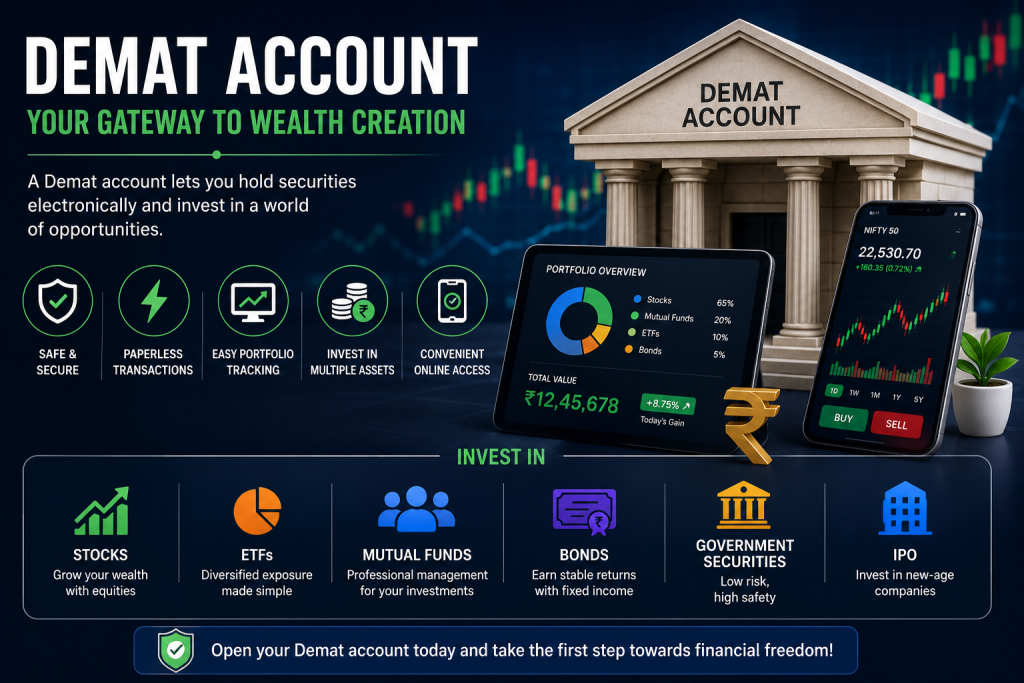
Furthermore, a Demat account is incredibly versatile. It holds much more than just direct company shares. You can use it to store a diverse portfolio of assets, including:
- Equity Stocks and IPO (Initial Public Offering) allotments
- Exchange Traded Funds (ETFs) like NiftyBeES or GoldBeES
- Direct Mutual Funds
- Government Bonds, Corporate Bonds, and Sovereign Gold Bonds (SGBs)
- Real Estate Investment Trusts (REITs) and Infrastructure Investment Trusts (InvITs)
The “Financial Trinity”: How Does a Demat Account Work?
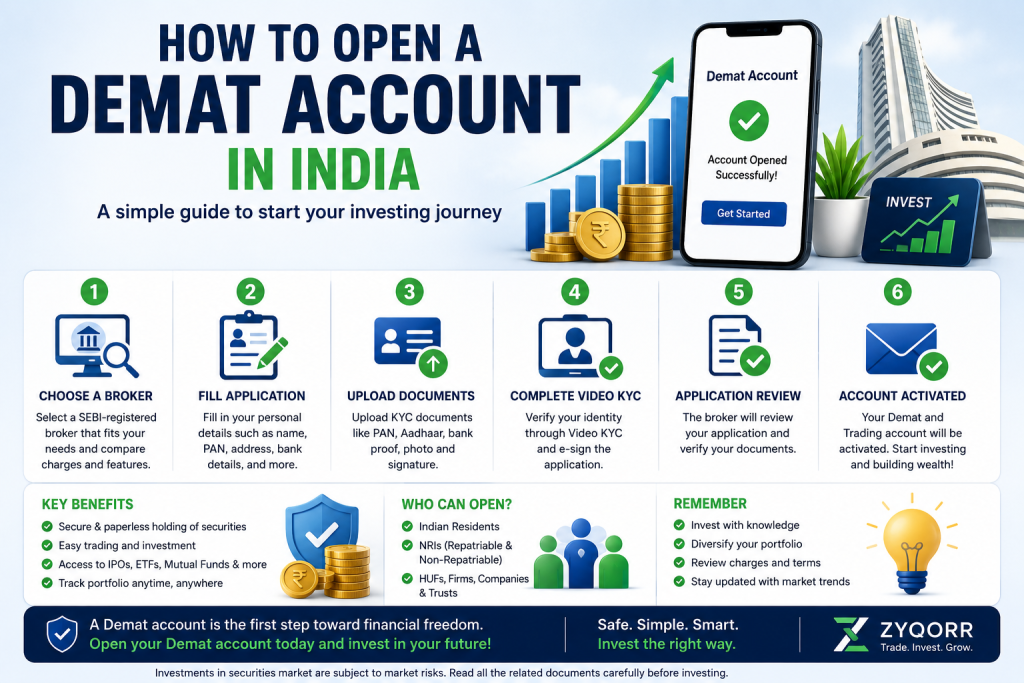
When learning how to open a Demat account in India, beginners often confuse Demat accounts with Trading accounts. To participate in the stock market, you actually need a “trinity” of accounts, and they all work together seamlessly in the background.
- Your Savings Bank Account: The source of your capital. You transfer money from your personal bank to your broker to fund your investments.
- Your Trading Account: The execution platform. Provided by your broker, this is the app or website where you search for stocks, view charts, and hit the “Buy” or “Sell” button.
- Your Demat Account: The storage vault. Once your buy order is executed and settled (which happens on a T+1 settlement cycle in India), the digital shares are deposited into your Demat Account for long-term safekeeping.
Quick Comparison: Demat vs. Trading Account
| Feature | Demat Account | Trading Account |
| Primary Purpose | Digital storage vault for your purchased securities. | Platform used to execute buy and sell orders in the market. |
| Stores Shares? | Yes. | No, it only facilitates the transaction. |
| Cash Handling? | Does not hold cash. | Holds your uninvested capital and margin. |
| Linked to Bank? | Indirectly (through the trading account). | Directly linked for instant fund transfers via UPI/Netbanking. |
Pro Tip: When you decide to sell a stock you own, the shares are automatically pulled from your Demat account by the depository, and the resulting cash profit is deposited into your Trading account. You can then withdraw that cash back to your primary bank account at your convenience.
Discount Brokers vs. Full-Service Brokers: Making the Right Choice
Before you start the registration process for how to open a Demat account in India, you must decide what type of broker fits your specific needs. This is the most crucial operational decision for a beginner. Brokers in India generally fall into three categories:
1. Discount Brokers
When researching how to open a Demat account in India, you will find that discount brokers have revolutionized the market by slashing fees for self-directed (DIY) investors.
- Examples: Zerodha, Upstox, Groww
- Pros: They offer flat-fee brokerage (typically ₹20 per trade for intraday/F&O) and often zero-commission for long-term equity delivery. They boast modern, clean UI/UX, fast execution, and seamless advanced charting integrations (like TradingView).
- Cons: They do not provide personalized stock advisory services, relationship managers, or hand-holding. You are entirely responsible for your own research.
2. Full-Service Brokers
Full-service brokers are traditional firms that offer a wide array of financial services under one roof.
- Examples: Motilal Oswal, Angel One, Sharekhan
- Pros: They provide dedicated relationship managers, daily research reports, stock tips, portfolio management services (PMS), and personalized investment advice.
- Cons: Their brokerage structures are often percentage-based (e.g., 0.5% of the trade value), which can become incredibly expensive if you trade frequently or with large capital.
3. Bank-Backed Brokers
These brokers offer a “3-in-1” account, seamlessly combining your bank, trading, and demat accounts.
- Examples: HDFC Securities, ICICI Direct, SBI Securities
- Pros: Ultimate convenience. Funds move instantly without needing third-party UPI or NEFT transfers. Excellent for conservative, long-term investors who want everything in one ecosystem.
- Cons: They typically have the highest brokerage charges and AMC fees in the industry, and their trading interfaces can sometimes feel clunky compared to modern tech-first discount brokers.
Also Read: How the Stock Market Works (Simple Explanation)
Documents Required to Open a Demat Account
Thanks to eKYC (Electronic Know Your Customer), the process of how to open a Demat account in India no longer requires physical photocopies. Keep the following digital documents (or clear photos) ready on your phone or desktop:
| Document | Purpose & Important Notes |
| PAN Card | Mandatory identity proof. You cannot invest in Indian markets without a valid Permanent Account Number. |
| Aadhaar Card | Mandatory for address verification and e-Signing. Crucial: Your Aadhaar must be linked to your active mobile number to receive OTPs. |
| Bank Proof | A personalized cancelled cheque, latest bank statement (last 6 months), or the front page of your passbook. |
| Signature | A clear photograph of your signature done with a blue or black pen on a blank white piece of paper. |
| Income Proof (Optional) | Only required if you intend to trade in the F&O (Futures & Options) or Commodity segments. (e.g., Form 16, latest salary slip, or 6-month bank statement). |
How to Open a Demat Account in India: The Step-by-Step Process
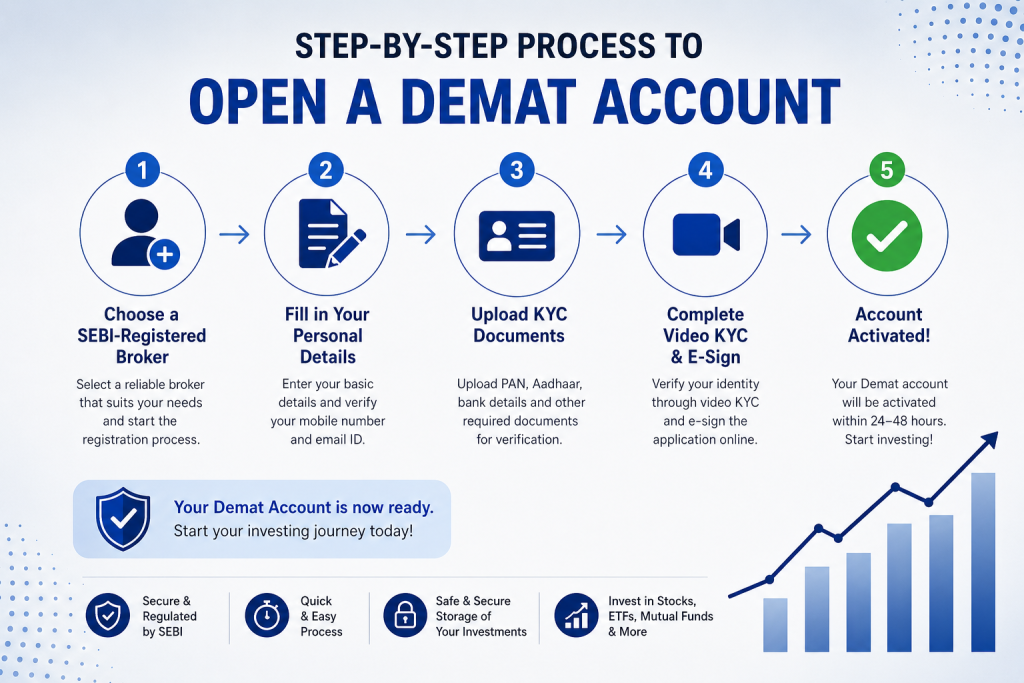
While the exact UI will vary slightly from broker to broker, the regulatory onboarding process for how to open a Demat account in India follows this exact framework:
Step 1: Complete Initial Online Registration
Navigate to your chosen SEBI-registered broker’s official website or download their mobile app. Enter your mobile number and email ID. You will receive OTPs on both to verify your contact information. Once verified, you will be prompted to enter your PAN number and date of birth. The system will automatically fetch your basic name details from the Income Tax database.
Step 2: KYC via Digilocker & Bank Linking
Most modern brokers will redirect you to Digilocker (a government secure storage service) to fetch your Aadhaar details instantly. This bypasses the need to manually type your address. Next, you will link your bank account by entering your Account Number and IFSC code. The broker will typically deposit ₹1 into your account via IMPS (“penny drop” verification) to ensure the bank account is active and belongs to you.
Step 3: Upload Additional Documents
If the Digilocker fetch was incomplete, you will manually upload the digital photos of your PAN card, bank proof, and your signature image.
Step 4: Complete In-Person Verification (IPV)
To prevent identity fraud, SEBI mandates an In-Person Verification. Don’t worry, you don’t need to visit an office. The broker’s app will access your front camera. You will be asked to record a short 5-to-10-second video of your face. Some brokers may ask you to read a 4-digit code displayed on the screen aloud, or simply write it on a paper and hold it up to the camera.
Step 5: Nominee Addition
SEBI has made it mandatory to declare a nominee for your Demat account (or explicitly opt-out). It is highly recommended to add a trusted family member as a nominee during this step to ensure a smooth transition of your assets in the event of an unforeseen tragedy.
Step 6: E-Sign the Application via Aadhaar
This is the final and most important step. You will be redirected to the official NSDL or CDSL portal. You will enter your 12-digit Aadhaar number and receive a final OTP on your Aadhaar-linked mobile number. Submitting this OTP digitally signs your entire account opening form.
Step 7: Account Activation
Once successfully submitted, the broker’s compliance team will verify your details against government databases. If everything matches, your account is typically activated within 24 to 48 hours. You will receive a welcome email containing your login credentials and your unique 16-digit Demat Account Number (also known as a BO ID).
Demat Account Charges to Watch Out For
When researching how to open a Demat account in India, you will see many brokers aggressively market ‘Free Account Opening,’ but investing is an ongoing process with structural costs. Be fully aware of these standard charges:
- Account Opening Fee: A one-time setup fee, currently waived by many discount brokers but still charged by traditional ones (ranging from ₹0 to ₹500).
- Annual Maintenance Charges (AMC): A yearly subscription fee to maintain your account with the depository. This ranges from ₹0 to ₹1,000 depending on the broker. Some brokers waive this for the first year.
- Brokerage Charges: The active fee charged every time you buy or sell.
- DP Charges (Depository Participant Charges): A hidden fee that catches many beginners off guard. It is a flat fee (usually ₹13.5 to ₹20 + GST) charged by the depository every time you sell a stock from your holdings, regardless of whether you sold 1 share or 1,000 shares.
- Regulatory Charges: These are non-negotiable taxes paid to the government, including STT (Securities Transaction Tax), Stamp Duty, SEBI turnover fees, and 18% GST on your brokerage.
Pro Tip: If you plan to swing trade or book profits frequently, DP charges can severely eat into your margins if you constantly buy and sell very small quantities of stock. Factor this fixed cost into your risk management and position-sizing strategy.
Also Read: Intraday vs Swing vs Long-Term Trading: Complete Guide for Beginners
How to Open a Demat Account in India: Common Mistakes to Avoid
- Overlooking Platform Stability During Volatility: A sleek app means nothing if it crashes on budget day or during a market crash. Read user reviews specifically regarding app downtime and server stability before committing your capital to a broker.
- Diving Straight into F&O (Futures & Options): Brokers make the most money when you trade options, but it is incredibly risky. Up to 90% of retail traders lose money in F&O. Stick to standard equity delivery (buying stocks and holding them) while you learn the mechanics of the market.
- Ignoring Cybersecurity Protocol: Your Demat account holds your hard-earned wealth. Treat it like a bank vault. Always enable Two-Factor Authentication (2FA) or biometric lock (FaceID/Fingerprint) on your broker’s app. Never share your login credentials, and ignore unsolicited SMS tips promising guaranteed returns.
- Failing to Update Contact Information: Ensure your email and phone number are always up to date. Depositories send SMS alerts every time a transaction occurs in your account. If your account is ever compromised, these alerts are your first line of defense.
Frequently Asked Questions (FAQs)
If you still have lingering doubts about how to open a Demat account in India, review these common queries from beginners:
Is a Demat account mandatory in India?
Yes. Under SEBI guidelines, holding and trading listed equity shares in physical paper form is no longer permitted for retail investors. A Demat account is mandatory to buy, sell, and store shares electronically. However, you do not strictly need a Demat account to invest in mutual funds, though many investors choose to store them there for consolidated portfolio tracking.
Can I open multiple Demat accounts?
Yes, you can legally open multiple Demat accounts with different brokers in India. There is no regulatory limit, provided all accounts are linked to the same primary PAN card.
- Note: While this allows you to test different trading platforms, keep in mind that you will be responsible for paying multiple Annual Maintenance Charges (AMC) across those accounts.
What is the minimum balance requirement for a Demat account?
There is no minimum balance requirement to keep a Demat account active. You can hold zero shares and maintain a zero cash balance in your linked trading account without facing any penalties.
Is a PAN card mandatory for opening a Demat account?
Yes, a PAN card is completely mandatory under SEBI and income tax regulations. It acts as the core identifier for tracking your capital gains, taxes, and investments. You cannot bypass this requirement, even for minor accounts.
Can students open a Demat account in India?
Yes. Any Indian citizen above the age of 18 can open a fully operational Demat account, including students. You simply need to provide standard valid KYC documents, including a PAN card, Aadhaar card, and an active bank account in your name.
How long does the Demat account activation process take?
Thanks to real-time eKYC and instant automated verification systems, most modern discount brokers will activate your account within 4 to 24 hours. In cases that require manual compliance review, it may take up to 2 business days.
Is investing through a Demat account safe?
Investing through a Demat account is highly secure because your assets are not stored by the broker itself, but by central government-regulated depositories (NSDL or CDSL). Even if your stockbroker goes bankrupt, your shares remain entirely safe in your name within the depository vault. To ensure personal safety, always enable two-factor authentication (2FA) and avoid sharing your trading login passwords or OTPs.
How can I open a Demat account in India online?
Opening a Demat account online is a completely paperless process that can be completed from your smartphone or laptop. The digital onboarding flow typically follows these steps:
- Registration: Visit a SEBI-registered broker’s app or website and verify your mobile number and email using OTPs.
- Identity & Bank Linking: Enter your PAN card details and link your bank account via your account number and IFSC code.
- eKYC Verification: Authenticate your identity digitally, usually via Digilocker integration to safely fetch your official address details.
- In-Person Verification (IPV): Record a brief 5-to-10-second selfie video using your front camera to verify your identity in real-time.
- Aadhaar e-Sign: Digitally sign your application by entering an OTP sent to your Aadhaar-linked mobile number. Once verified, your account is typically activated within 4 to 24 hours.
Is it safe to open a Demat account in India digitally?
Yes, opening and maintaining a Demat account digitally is highly secure in India due to strict regulatory frameworks. Your digital applications are processed using encrypted government-backed systems like Digilocker and Aadhaar eKYC portals. Furthermore, your actual shares are never kept by the broker; they reside safely with central depositories (NSDL or CDSL) regulated directly by SEBI.
To maximize your digital security:
- Always ensure you are using the official website or verified mobile application of a SEBI-registered broker.
- Set up strong login passwords and enable mandatory Two-Factor Authentication (2FA) or biometric locks.
- Never share your trading account passwords, PINs, or transaction OTPs with anyone.
Final Thoughts
Understanding how to open a Demat account in India is a straightforward, digitized process, but it represents merely the starting line of your financial journey. A Demat account is a tool—what matters is how you use it.
Knowing how to open a Demat account in India is just the first step; your ultimate success will depend on your disciplined research, your understanding of market structures, and your ability to control risk and emotional psychology. Choose a broker that aligns with your specific trading style, remain vigilant about keeping your transactional costs low, and prioritize financial education before scaling up your capital.
Now that you know exactly how to open a Demat account in India, you are fully equipped to begin your long-term wealth creation journey.
- About the Author: Shiva Naresh is an active market trader, digital entrepreneur, and the author of AI Prompt Engineering for Traders. Through the Zyqorr Blog, he breaks down complex market mechanics into actionable, research-driven strategies for retail investors.*
Financial Disclaimer: This article is strictly for educational and informational purposes only and should not be construed as financial, investment, tax, or legal advice. Investing in the stock market involves significant risks, including the potential loss of capital. Always conduct your own independent research, verify facts, and consult a SEBI-registered financial advisor before making any investment decisions.


