Table of Contents
Introduction
The uncomfortable truth is that most trading failures aren’t due to poor market analysis or bad timing – they’re caused by emotional decision-making that overrides logic and strategy. Fear, greed, hope, and anger can turn a well-planned trade into a devastating loss faster than any market crash. This psychological battle happens in your mind before it shows up in your trading account.
Why emotions control your trades is a question that every trader must answer if they want to achieve consistent profitability in the markets. Whether you’re a beginner struggling with your first losses or an experienced trader wondering why your technical analysis isn’t translating to profits, understanding the psychological forces at play is crucial for your success.
In this comprehensive guide, you’ll learn the science behind emotional trading, discover practical strategies to build mental discipline, and understand how to create a systematic approach to managing your trading psychology. By the end of this article, you’ll have the tools to recognize emotional triggers, develop a stronger trading mindset, and make decisions based on analysis rather than feelings.
The Psychology Behind Trading Emotions
The Evolutionary Brain vs. Modern Markets
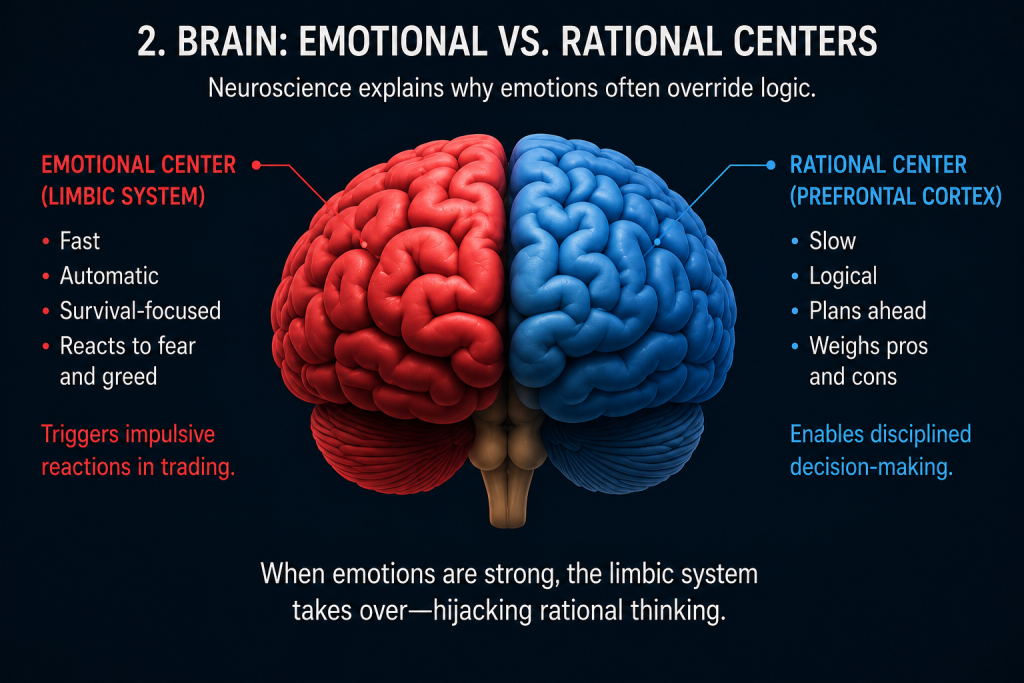
Understanding why emotions control your trades begins with recognizing that our brains evolved for survival in prehistoric environments, not for making rational financial decisions. The same neural pathways that helped our ancestors escape predators now trigger panic selling during market downturns.
When you see red numbers on your trading screen, your amygdala – the brain’s alarm system – activates within milliseconds. This fight-or-flight response floods your system with stress hormones like cortisol and adrenaline, preparing your body for immediate action. However, these same hormones that once saved lives now sabotage trading performance by:
- Impairing rational decision-making
- Reducing focus and memory
- Creating tunnel vision
- Increasing impulsive behavior
- Heightening risk aversion or risk-seeking behavior
The Neuroscience of Trading Decisions
Research from Investopedia shows that successful trading requires managing these biological responses rather than fighting them. The prefrontal cortex, responsible for logical thinking and planning, can be overwhelmed by emotional centers during high-stress situations.
This explains why traders who perform well in calm markets often struggle during volatile periods. The emotional intensity literally changes how their brains process information, making it nearly impossible to follow predetermined strategies.
Key Neurological Factors:
- Dopamine release during winning trades creates addictive patterns
- Loss aversion makes losses feel twice as powerful as equivalent gains
- Confirmation bias leads to seeking information that supports existing positions
- Recency bias overweights recent events in decision-making
How Fear Controls Your Trading Decisions
Fear of Missing Out (FOMO)
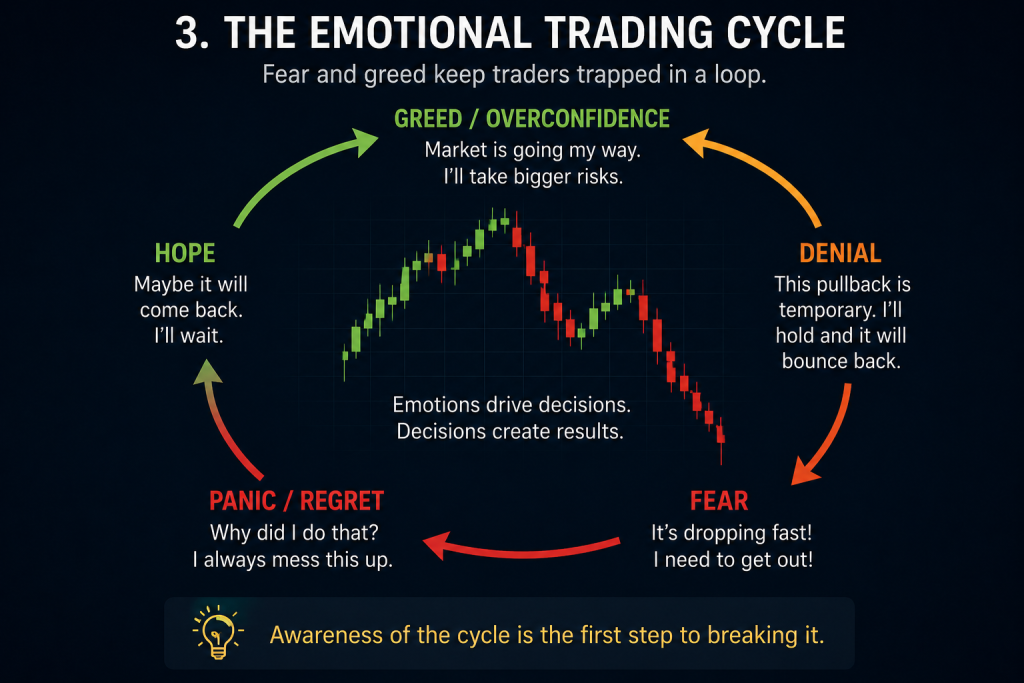
FOMO represents one of the most common ways emotions control trades. This psychological phenomenon drives traders to abandon their strategies and chase price movements based on what others are doing rather than their own analysis.
Real-World FOMO Example:
During the 2021 GameStop rally, countless traders saw the stock rising from $20 to over $400 and felt compelled to join the movement. Many bought near the peak, driven by fear of missing out on “easy money.” When the stock crashed back below $50, these emotion-driven decisions resulted in substantial losses.
Fear of Loss
This fear manifests in two destructive ways:
1. Premature Profit-Taking
Traders close winning positions too early because they fear giving back gains. A stock might be up 10% with strong momentum, but fear makes them sell instead of letting profits run according to their strategy.
2. Holding Losing Positions
Paradoxically, fear of realizing losses causes traders to hold losing positions longer than planned, hoping for recovery. This violates fundamental risk management principles and often leads to catastrophic losses.
Fear of Being Wrong
Professional pride and ego often prevent traders from admitting mistakes quickly. This fear of being wrong leads to:
- Ignoring stop-loss levels
- Adding to losing positions (averaging down inappropriately)
- Refusing to exit when original thesis is invalidated
- Overconfidence in failing strategies
The Destructive Power of Greed
Position Sizing and Overconfidence
Greed explains why emotions control your trades during winning streaks just as much as during losses. After several successful trades, greed whispers that bigger position sizes will generate bigger profits. This emotional escalation often leads to account-destroying losses when the inevitable reversal occurs.
The Mathematics of Greed:
| Position Size | Winning Streak Impact | Single Loss Recovery Needed |
|---|---|---|
| 1% per trade | 10 wins = 10% gain | 1% loss = easy recovery |
| 5% per trade | 10 wins = 50% gain | 25% loss = 33% gain needed |
| 10% per trade | 10 wins = 100% gain | 50% loss = 100% gain needed |
The Winner’s Curse
Ironically, winning streaks can be more dangerous than losing periods because they fuel overconfidence. Greed makes traders believe they’ve “figured out” the market, leading to increasingly risky behavior that eventually destroys accumulated profits.
Hope: The Silent Account Killer
The Danger of False Optimism
Hope might seem like a positive emotion, but in trading, it’s often destructive. When positions move against you, hope prevents you from following risk management rules and cutting losses appropriately.
Common Hope-Driven Mistakes:
- Moving stop-losses further away as prices approach them
- Holding positions through earnings or major news events
- Converting day trades into swing trades when losing
- Believing “it has to bounce back” without fundamental justification
The Sunk Cost Fallacy
Hope feeds the sunk cost fallacy – the belief that previous investments justify continuing losing trades. Professional traders understand that past decisions are irrelevant to current market conditions. Each moment requires fresh analysis, not hope for previous decisions to be vindicated.
Anger and Revenge Trading
The Most Destructive Emotion
Anger might be the most dangerous emotion in trading because it leads to revenge trading – attempting to “get back” at the market after losses. This emotional response typically results in:
- Abandoning position sizing rules
- Ignoring stop-losses entirely
- Taking excessive risks to recover losses quickly
- Trading with money you can’t afford to lose
Breaking the Revenge Cycle
Understanding why emotions control your trades includes recognizing that markets are impersonal. They don’t care about your financial situation, emotional state, or need for revenge. Successful traders learn to process losses as business expenses rather than personal attacks.
Building a Disciplined Trading Mindset
The Three Pillars of Trading Psychology
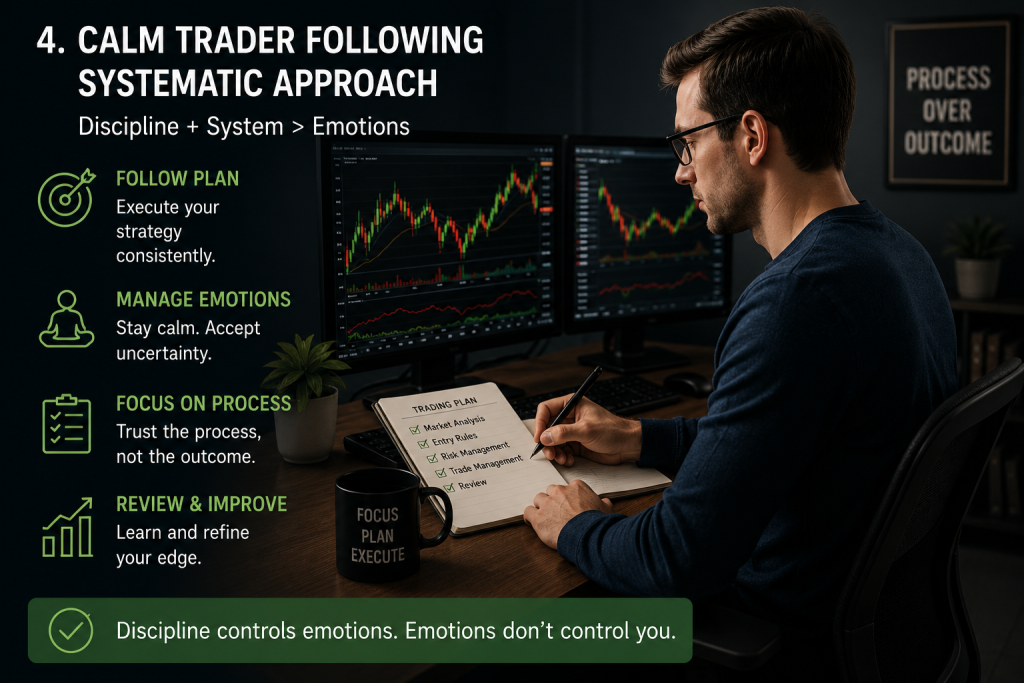
1. Acceptance of Uncertainty
Professional traders accept that markets are inherently unpredictable. This acceptance prevents the emotional roller coaster of trying to control uncontrollable outcomes.
2. Process Over Outcomes
Focus on following your trading process consistently rather than individual trade results. Good processes executed poorly are worse than mediocre processes executed consistently.
3. Long-Term Perspective
Individual trades are just data points in a larger statistical sample. Emotional attachment to single trades prevents objective decision-making.
Developing Mental Models
Create specific mental frameworks for different market scenarios:
During Losses:
- View losses as cost of doing business
- Focus on preserving capital for future opportunities
- Review what went wrong objectively
- Adjust position sizes if necessary
During Wins:
- Resist urge to increase position sizes dramatically
- Take partial profits to secure gains
- Maintain same risk management standards
- Prepare mentally for inevitable drawdowns
Practical Examples of Emotional Trading
Case Study 1: The FOMO Trader
Situation: Sarah sees Bitcoin rallying 20% in one day after positive regulatory news. Despite having no Bitcoin in her portfolio strategy, she buys $10,000 worth at the day’s high.
Emotional Drivers: Fear of missing out, greed, social proof from seeing others profit
Outcome: Bitcoin pulls back 30% the next week. Sarah’s emotional decision results in a $3,000 loss.
Lesson: FOMO-driven trades rarely align with planned strategies and often result in buying tops or selling bottoms.
Case Study 2: The Hope Trader
Situation: Mike buys Tesla stock at $250 with a stop-loss at $230. The stock drops to $232, but he doesn’t sell because he “knows” it will recover.
Emotional Drivers: Hope, ego, loss aversion
Outcome: Tesla continues falling to $180 before recovering. Mike’s $2,000 planned loss becomes a $7,000 actual loss.
Lesson: Hope without fundamental justification leads to much larger losses than originally planned.
Case Study 3: The Revenge Trader
Situation: After losing $5,000 on a failed oil trade, David immediately puts $15,000 into a high-risk options position to “get even quickly.”
Emotional Drivers: Anger, desire for revenge, loss recovery urgency
Outcome: The options expire worthless, turning a $5,000 loss into a $20,000 disaster.
Lesson: Revenge trading typically compounds losses rather than recovering them.
Benefits of Emotional Control
Improved Performance Metrics
Traders who master their emotions consistently outperform those who don’t. According to research from TradingView, disciplined traders show:
Performance Improvements:
- 25-40% better risk-adjusted returns
- 50% fewer catastrophic losses
- Higher win rates through better entry/exit timing
- Improved position sizing leading to smoother equity curves
- Better adaptation to changing market conditions
Psychological Benefits
Beyond financial performance, emotional control provides:
- Reduced stress and trading-related anxiety
- Better sleep without worry about open positions
- Improved relationships not affected by trading results
- Greater confidence in your trading abilities
- Long-term sustainability in your trading career
Compound Effects
Small improvements in emotional control compound over time:
| Year | Emotional Trader Return | Disciplined Trader Return | Difference |
|---|---|---|---|
| 1 | 5% | 12% | 7% |
| 3 | 15.8% | 40.5% | 24.7% |
| 5 | 27.6% | 76.2% | 48.6% |
| 10 | 62.9% | 210.6% | 147.7% |
Assumes emotional trader has higher volatility and occasional large losses
Risks of Emotional Trading
Financial Consequences
Understanding why emotions control your trades includes recognizing the severe financial risks of emotional decision-making:
Account Destruction Patterns:
- 90% of day traders lose money within their first year
- Average account blowup happens within 4-6 months for emotional traders
- Revenge trading cycles can destroy years of accumulated profits in days
- Position sizing errors during emotional states often lead to catastrophic losses
Career-Ending Mistakes
Emotional trading can lead to decisions that permanently damage your trading career:
- Trading with borrowed money during emotional states
- Violating broker risk management rules
- Making trades based on insider information during panic
- Abandoning proven strategies during temporary drawdowns
Psychological Damage
Beyond financial losses, emotional trading creates lasting psychological effects:
- Learned helplessness from repeated emotional failures
- Analysis paralysis from fear of making wrong decisions
- Overconfidence cycles leading to increasingly risky behavior
- Depression and anxiety from trading-related financial stress
Step-by-Step Guide to Emotional Management
Phase 1: Self-Assessment (Week 1-2)
Step 1: Identify Your Emotional Triggers
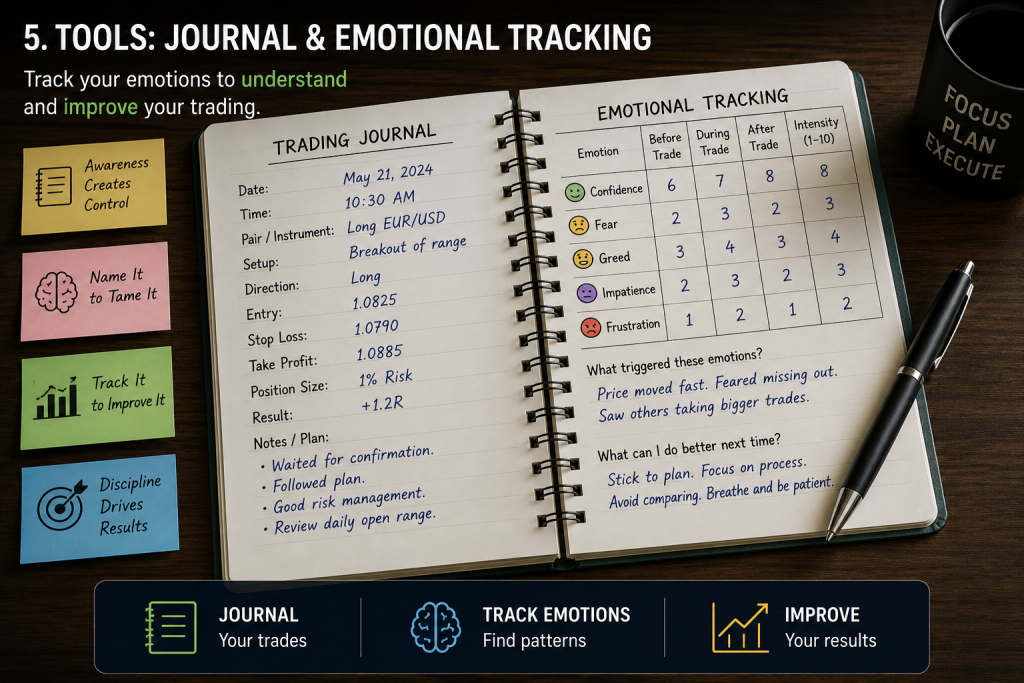
Keep a detailed trading journal for two weeks, recording:
- Entry and exit emotions
- Market conditions during emotional trades
- Personal stress levels
- External factors affecting your mood
Step 2: Analyze Your Patterns
Review your journal to identify:
- Which emotions affect you most
- Time of day when emotions peak
- Market conditions that trigger emotional responses
- Personal situations that impact trading decisions
Step 3: Quantify Your Emotional Impact
Calculate the cost of emotional trades:
- Compare emotional vs. planned trade results
- Identify your most expensive emotional patterns
- Set specific improvement targets
Phase 2: Building Discipline (Week 3-8)
Step 4: Create Non-Negotiable Rules
Develop strict trading rules that apply regardless of emotions:
- Maximum position size per trade
- Stop-loss levels that cannot be moved
- Daily loss limits that force you to stop trading
- Mandatory break periods after emotional trades
Step 5: Implement Pre-Trade Routines
Create consistent routines before each trade:
- Check your emotional state (1-10 scale)
- Review your trading plan
- Confirm position sizing calculations
- Set stop-loss and target levels
- Visualize both winning and losing scenarios
Step 6: Practice Stress Management
Develop techniques to manage stress during trading:
- Deep breathing exercises
- Progressive muscle relaxation
- Brief meditation sessions
- Physical exercise between trading sessions
Phase 3: Advanced Emotional Management (Week 9-16)
Step 7: Scenario Planning
Prepare specific responses for common emotional situations:
For Fear-Based Decisions:
- Use smaller position sizes during high-fear periods
- Focus on capital preservation over profit maximization
- Take profits earlier than normal if fear is high
- Avoid trading during high-anxiety periods
For Greed-Based Decisions:
- Set profit targets before entering trades
- Use scaling out strategies to secure gains
- Maintain consistent position sizing regardless of recent wins
- Take regular breaks during winning streaks
Step 8: Develop Support Systems
- Find accountability partners who understand trading psychology
- Join trading communities focused on discipline
- Consider working with a trading coach or mentor
- Use trading buddy systems for objective feedback
Step 9: Advanced Monitoring
Implement sophisticated tracking systems:
- Real-time emotion monitoring during trades
- Performance metrics that account for emotional state
- Regular review sessions to identify improvement areas
- Adjustment of rules based on performance data
Phase 4: Mastery and Maintenance (Ongoing)
Step 10: Continuous Refinement
- Monthly review of emotional trading patterns
- Quarterly updates to trading rules and procedures
- Annual assessment of psychological development
- Ongoing education about trading psychology
Expert Tips for Trading Psychology
From Professional Traders
Tip 1: The 24-Hour Rule
Never make major trading decisions within 24 hours of significant losses. This cooling-off period prevents revenge trading and allows rational thinking to return.
Tip 2: Position Sizing Based on Confidence
Adjust position sizes based on your confidence level in trades. If you’re uncertain or emotional, use smaller positions regardless of technical setup quality.
Tip 3: The Three-Strike Rule
After three consecutive losses, take a mandatory break to reassess your strategy and emotional state. This prevents emotional spirals that lead to larger losses.
From Trading Psychologists
Tip 4: Separate Trading Identity from Personal Worth
Your value as a person isn’t determined by trading results. This separation prevents ego-driven decisions that often lead to emotional trading.
Tip 5: Focus on Process Metrics
Track metrics like:
- Percentage of trades following your plan
- Consistency of position sizing
- Adherence to stop-loss rules
- Time between recognizing mistakes and correcting them
Tip 6: Use Visualization Techniques
Regularly visualize yourself executing perfect trades – entering positions calmly, managing risk appropriately, and exiting according to plan regardless of profit or loss.
Common Mistakes to Avoid
Mistake 1: Ignoring Emotional State Before Trading
The Problem: Trading when angry, stressed, or overly excited without accounting for how emotions might affect decisions.
The Solution: Implement a pre-trading emotional check. Rate your emotional state on a 1-10 scale and adjust your trading plan accordingly. If you’re above 7 (very emotional), consider not trading or reducing position sizes significantly.
Mistake 2: Moving Stop-Losses Against You
The Problem: When trades move against you, hope drives you to move stop-losses further away, increasing potential losses.
The Solution: Set stop-losses when you enter positions and treat them as sacred. If market conditions truly change, exit the position and re-evaluate rather than moving stops.
Mistake 3: Increasing Position Sizes After Wins
The Problem: Greed after winning streaks leads to dramatically larger positions that can wipe out accumulated profits with single losses.
The Solution: Maintain consistent position sizing regardless of recent performance. If you want to increase size, do it gradually and based on account growth, not emotional state.
Mistake 4: Trading to Recover Losses Quickly
The Problem: After significant losses, the urge to “get even” leads to high-risk trades that often compound losses.
The Solution: Accept that losses are part of trading. Focus on making good trades rather than recovering specific amounts. Set daily loss limits and stop trading when reached.
Mistake 5: Comparing Yourself to Others
The Problem: Social media and trading forums create pressure to match others’ returns, leading to inappropriate risk-taking or strategy abandonment.
The Solution: Focus on your own consistent profitability rather than comparing to others. Remember that most social media trading content is cherry-picked highlights, not complete performance records.
Mistake 6: Trading Without a Plan
The Problem: Entering trades based on “gut feelings” or emotional impulses rather than predetermined strategies.
The Solution: Develop comprehensive trading plans that specify entry criteria, exit strategies, position sizing, and risk management. Never enter trades that don’t meet your written criteria.
Mistake 7: Overtrading During Emotional States
The Problem: Both winning and losing streaks can lead to overtrading as emotions drive you to seek more action.
The Solution: Set maximum daily trade limits and stick to them. Quality over quantity is always preferable in trading.
Frequently Asked Questions
How do I know if emotions are controlling my trades?
You can identify emotional trading through several warning signs:
- Making trades that don’t follow your written strategy
- Moving stop-losses away from your original plan
- Increasing position sizes after wins or losses
- Trading immediately after significant gains or losses
- Feeling anxious, angry, or overly excited while trading
- Making decisions based on what others are doing rather than your analysis
Track these behaviors in a trading journal to identify patterns and frequency of emotional decision-making.
What’s the biggest emotional mistake traders make?
The biggest mistake is revenge trading after losses. When traders try to “get back” at the market by taking increasingly risky trades, they typically compound their losses rather than recover them. This emotional response can destroy accounts that took years to build in just a few days of angry trading.
The key is accepting that losses are a normal part of trading and focusing on making good decisions rather than recovering specific amounts quickly.
How long does it take to develop emotional control in trading?
Developing emotional control typically takes 6-12 months of consistent practice, but it varies significantly among individuals. Factors that influence the timeline include:
- Previous experience with high-stress situations
- Natural emotional regulation abilities
- Commitment to following structured improvement plans
- Quality of education and support systems
- Frequency of trading and practice
Most traders see noticeable improvement within 2-3 months of implementing structured emotional management techniques, but mastery is an ongoing process that continues throughout your trading career.
Should I stop trading when I’m emotional?
Yes, stopping trading during highly emotional states is often the best decision. If you rate your emotional state above 7 on a 1-10 scale (where 10 is extremely emotional), consider taking a break until you return to a calmer state.
However, you can also trade with modified rules during emotional periods:
- Reduce position sizes by 50-75%
- Focus on familiar strategies only
- Set tighter daily loss limits
- Take profits earlier than normal
- Avoid new or complex trades
Can successful traders completely eliminate emotions?
No, and trying to eliminate emotions entirely is counterproductive. Emotions provide valuable information about market conditions and your psychological state. The goal is to manage emotions effectively rather than eliminate them.
Successful traders learn to:
- Recognize emotional states quickly
- Understand how emotions affect their decision-making
- Adjust their trading approach based on emotional state
- Use emotions as additional data points rather than primary decision drivers
- Channel emotions productively rather than suppressing them completely
What’s the difference between intuition and emotional trading?
Intuition in trading comes from pattern recognition developed through extensive experience and study. It’s based on subconscious processing of multiple market factors and typically aligns with your trading strategy.
Emotional trading, on the other hand, is driven by fear, greed, hope, or anger and usually contradicts your planned approach. Key differences include:
Intuitive Trading:
- Feels calm and confident
- Aligns with your trading plan
- Based on market observation and experience
- Considers risk management carefully
- Can be explained logically after the fact
Emotional Trading:
- Feels urgent or panicked
- Contradicts your normal strategy
- Based on internal emotional state rather than market conditions
- Often ignores risk management
- Decisions seem irrational in hindsight
Conclusion
Understanding why emotions control your trades is the foundation of becoming a consistently profitable trader. The human brain’s evolutionary wiring creates powerful emotional responses that can override logical decision-making in milliseconds. Fear, greed, hope, and anger aren’t character flaws – they’re biological responses that require systematic management rather than willpower alone.
The journey to emotional mastery in trading requires acknowledging that psychology accounts for roughly 80% of trading success, while technical analysis and market knowledge make up the remaining 20%. This doesn’t diminish the importance of developing analytical skills, but it puts them in proper perspective. You can have the best market analysis in the world, but if emotions drive your decisions, you’ll struggle to achieve consistent profitability.
The strategies outlined in this guide – from pre-trading routines and strict position sizing rules to scenario planning and stress management – aren’t theoretical concepts. They’re practical tools used by professional traders who’ve learned to work with their emotions rather than against them. Implementing these approaches takes time, practice, and patience, but the results speak for themselves in improved performance metrics and reduced trading stress.
Remember that developing emotional control is an ongoing process, not a destination. Even experienced traders continue refining their psychological approach as markets evolve and life circumstances change. The key is maintaining awareness of your emotional state, following predetermined rules regardless of how you feel, and treating each trade as just one data point in a larger statistical sample.
Start implementing these emotional management techniques gradually, focusing on one area at a time rather than trying to change everything at once. Track your progress through detailed journaling, celebrate improvements in process adherence rather than just profits, and remember that sustainable trading success comes from consistent good decisions compounded over time.
Ready to take your trading psychology to the next level? Visit Zyqorr.com for advanced trading education, psychological assessment tools, and comprehensive courses designed to help you master both the technical and mental aspects of successful trading.
Also Read: What is Trading Psychology? The Complete Guide to Mastering Your Mind in Trading
Financial Disclaimer
This content is for educational purposes only and should not be considered financial advice. Trading involves substantial risk of loss and is not suitable for all investors. Always conduct your own research and consider your financial situation carefully before making any trading decisions. Past performance does not guarantee future results, and you should never trade with money you cannot afford to lose.
Sources and References
- Investopedia – Trading Psychology
- TradingView – Educational Content
- Federal Reserve Economic Research on Behavioral Finance
- SEC Investor Education Materials on Risk Management
- Academic studies on behavioral economics and trading psychology
- Professional trading psychology research and case studies