Table of Contents

Agentic AI: How Autonomous Systems Are Reshaping Business in 2026 and Beyond
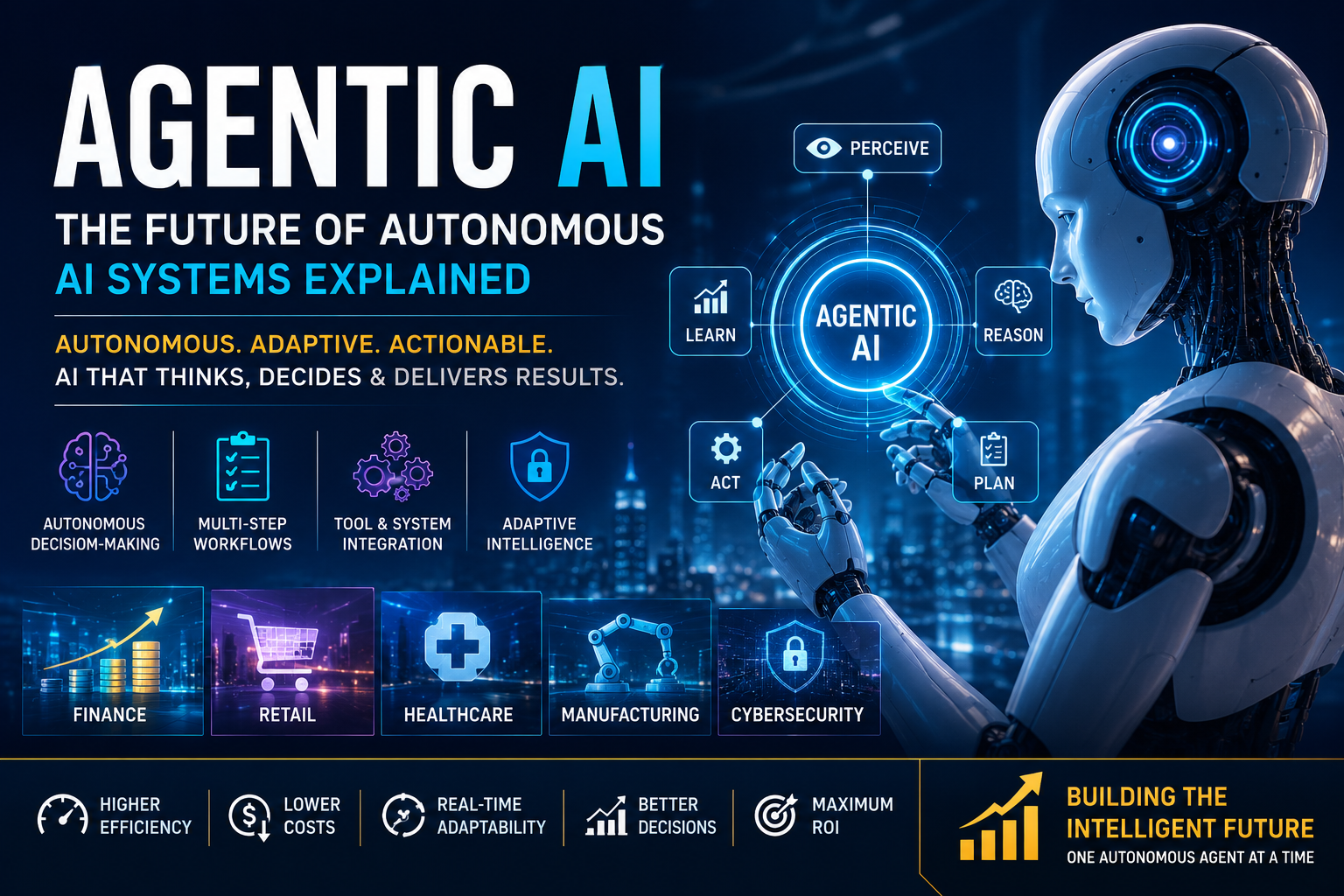
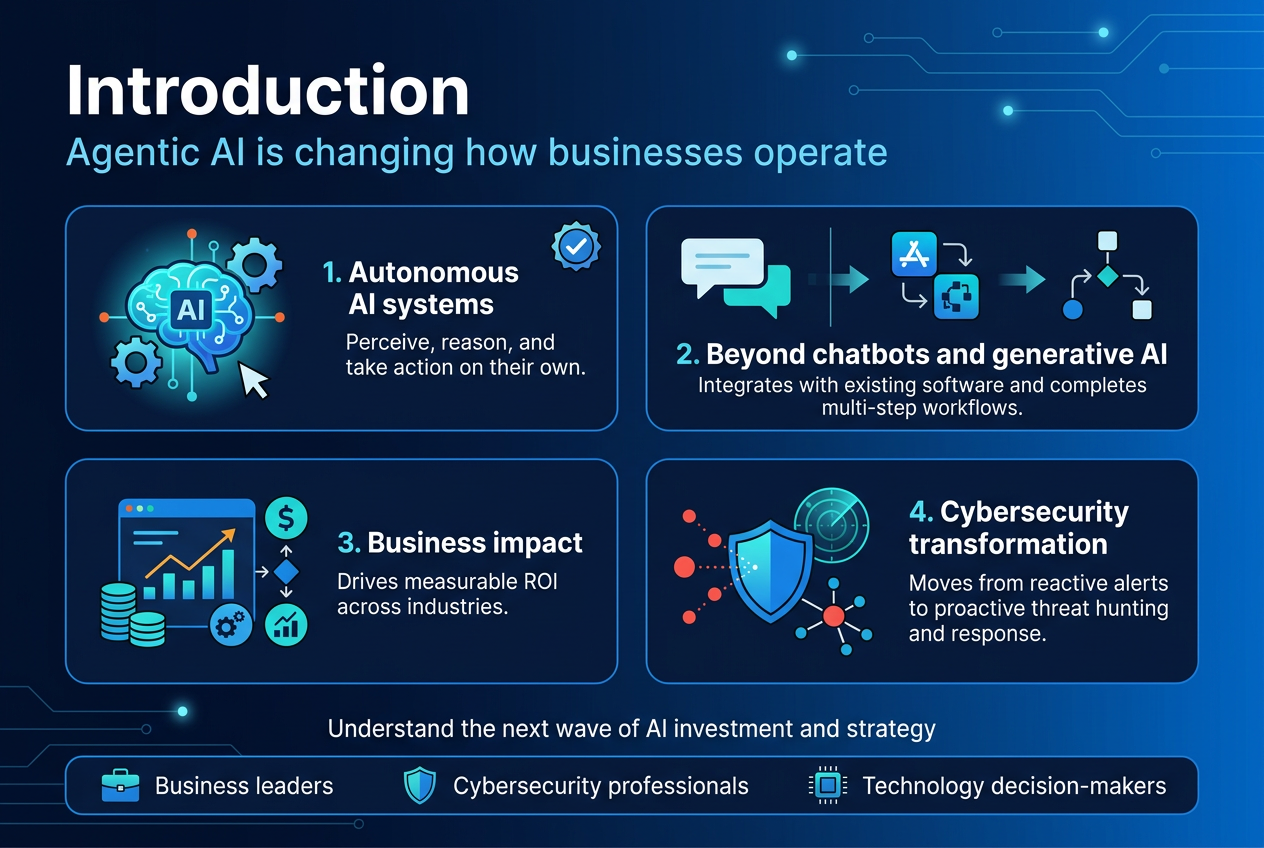
I’ve been watching the AI landscape shift dramatically over the past few years, and I can tell you that Agentic AI represents the most significant leap forward since generative AI hit the mainstream. While we were all getting comfortable with chatbots and content generation tools, a new breed of autonomous AI systems was quietly emerging – one that doesn’t just answer questions but actually takes action in the real world.
This comprehensive guide is for business leaders, IT professionals, and decision-makers who need to understand how Agentic AI differs from traditional AI systems and why industry giants like JPMorgan Chase, Walmart, and Microsoft are betting their futures on this technology. I’ll walk you through exactly what makes these autonomous AI systems revolutionary, from their ability to complete multi-step workflows without human intervention to their potential for creating what Nvidia’s CEO calls a “multi-trillion-dollar opportunity.”
In this deep dive, I’ll first explain how Agentic AI fundamentally differs from the AI tools you’re already using and why this distinction matters for your business strategy. Then I’ll show you the real-world applications that are already delivering measurable ROI across industries – from fraud detection that operates 24/7 to supply chain automation that adapts to disruptions in real-time. Finally, I’ll cover the critical implementation considerations every organization needs to address, including the governance frameworks and risk management strategies that separate successful deployments from costly failures.
The stakes here are higher than with previous AI implementations because these systems aren’t just processing data – they’re making decisions and taking actions that directly impact your business operations, customer relationships, and bottom line.
Understanding Agentic AI: Beyond Traditional AI Systems
Core Definition and Autonomous Decision-Making Capabilities
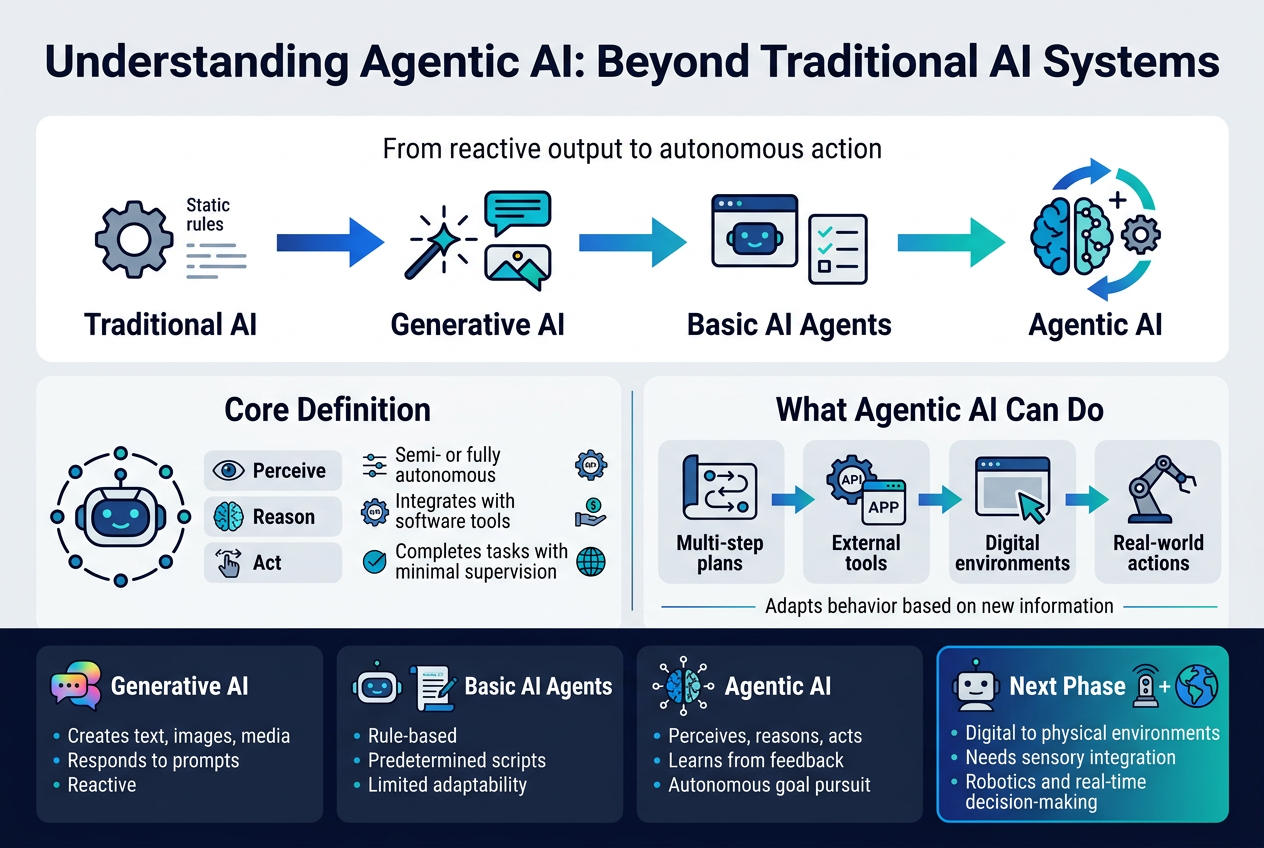
When I examine the landscape of artificial intelligence, I find that agentic AI represents a fundamental shift in how I understand autonomous systems. Agentic AI refers to artificial intelligence systems that are semi- or fully autonomous and capable of perceiving, reasoning, and acting on their own. What sets these systems apart is their ability to integrate with other software to complete tasks independently or with minimal human supervision, making decisions that mirror human cognitive processes.
I’ve observed that these autonomous AI systems operate as software entities that perceive, reason, and act within digital environments to achieve specific goals for human principals. Their sophistication extends beyond basic automation—they utilize tool use, economic transactions, and strategic interaction to accomplish complex objectives. What particularly impresses me about these intelligent AI systems is their ability to employ standard building blocks like APIs to communicate, receive and send money, and interact with the internet dynamically.
The decision-making capabilities I’ve analyzed in agentic AI are truly remarkable. These systems enhance large language models by enabling them to automate complex procedures, execute multi-step plans, use external tools, and interact with digital environments within larger workflows. They operate with a level of autonomy that adjusts behavior based on new information, demonstrating adaptability that extends beyond traditional AI systems to encompass real-world actions, including operating robotics.
Key Differences from Generative AI and Basic AI Agents
Having studied various AI implementations, I recognize crucial distinctions that define agentic AI’s unique position in the artificial intelligence automation spectrum. Unlike generative AI, which focuses primarily on content creation such as text, images, and media while operating reactively, agentic AI extends its capabilities to autonomous decision-making and execution. While generative AI responds to prompts and creates outputs, agentic AI actively pursues objectives by perceiving, reasoning, acting, and learning from feedback.
I’ve found that generative AI often serves as a key component within modern agentic AI systems, providing language-based or image-based reasoning capabilities. However, the fundamental difference lies in the scope of operation—generative AI creates content, while agentic AI takes autonomous actions to achieve goals.
When I compare agentic AI to basic AI agents such as chatbots or RPA bots, the differences become even more pronounced. Basic AI agents typically operate on rule-based systems and lack the advanced reasoning or adaptability that characterizes true autonomous software agents. These traditional agents follow predetermined scripts and cannot dynamically adjust their behavior based on contextual understanding.
What I find most significant is that while all agentic AI systems are AI agents, not all AI agents qualify as agentic AI. The distinction lies in the degree of autonomy and problem-solving capability. Agentic AI applications exhibit sophisticated problem-solving abilities by dynamically adjusting behavior based on contextual understanding, whereas basic agents remain limited to their programmed parameters.
Evolution from Rule-Based Systems to Cognitive AI Agents
The evolution I’ve traced from rule-based systems to cognitive AI agents represents one of the most significant advances in machine learning agents. This transformation has progressed through distinct phases, each building upon the limitations of its predecessor.
Earlier AI systems relied heavily on predefined rules or extensive human-annotated data, which severely limited their adaptability to novel situations. I’ve seen how these constraints prevented traditional systems from handling unexpected scenarios or learning from new experiences effectively.
The development trajectory I’ve observed progresses from simple text processing models, which represent traditional LLMs, to language agents that integrate LLMs with external environments for observations, decisions, and actions. The most advanced form I’ve encountered is cognitive AI agents, which manage internal reasoning processes for dynamic planning and adaptation.
Modern agentic AI leverages the common-sense reasoning capabilities of LLMs, providing greater flexibility when encountering novel situations. This integration has revolutionized AI business transformation by enabling systems that can understand context, reason through problems, and adapt their approaches based on changing circumstances.
Looking ahead, I anticipate the next phase will involve transitioning from digital to physical environments. This evolution will require significant advancements in sensory integration, robotics, and real-time decision-making capabilities. The progression from sophisticated architectures that integrate LLMs with external environments to systems capable of physical world interaction represents the cutting edge of autonomous AI systems development.
How Agentic AI Transforms Business Operations
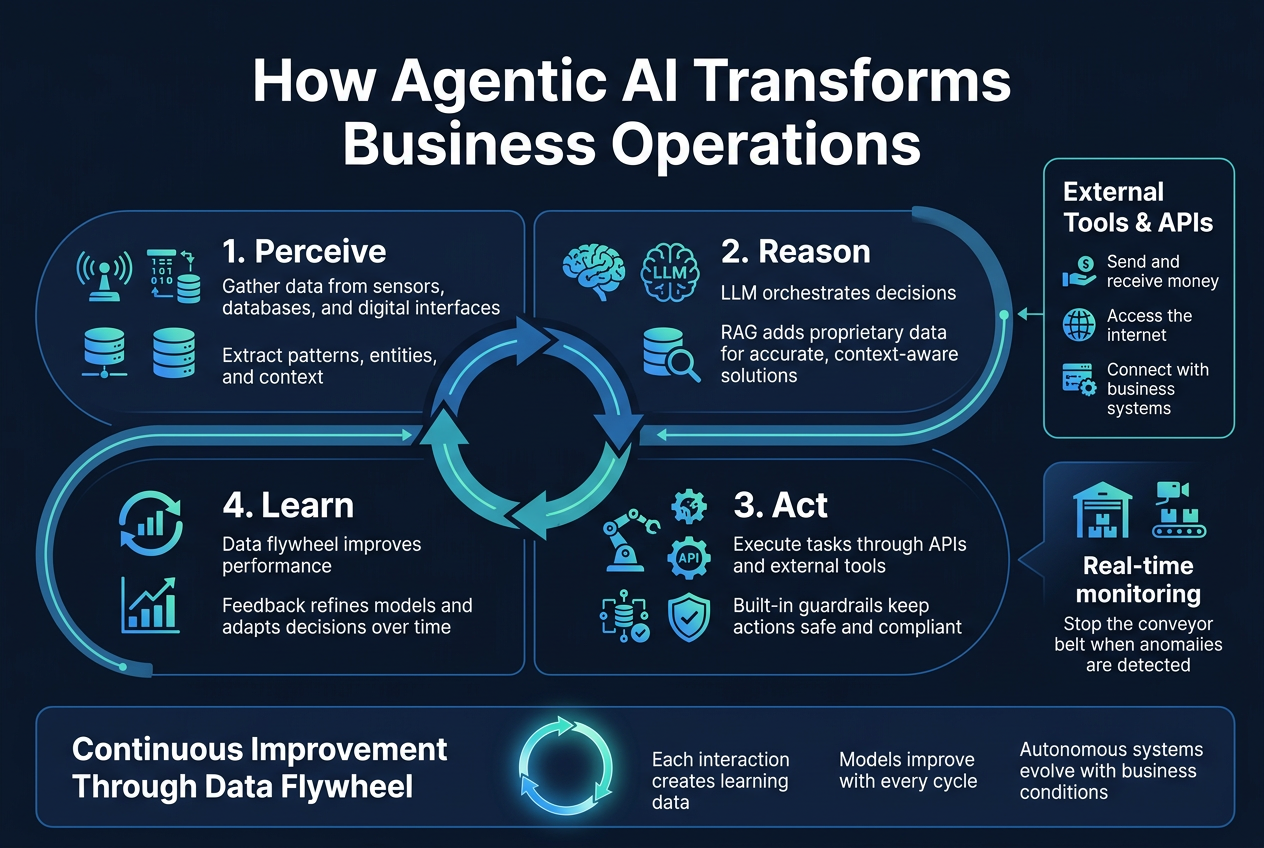
Four-Stage Process: Perceive, Reason, Act, and Learn
I’ve observed that agentic AI operates through a sophisticated four-stage framework that fundamentally transforms how AI systems interact with business environments. This cyclical process enables autonomous AI systems to function with unprecedented independence and effectiveness.
The Perceive stage forms the foundation of agentic AI capabilities. In my analysis, this stage involves the AI gathering and processing data from multiple sources including sensors, databases, and digital interfaces. What sets this apart from traditional AI systems is the depth of contextual understanding achieved. The AI extracts meaningful information, recognizes complex patterns, and identifies key entities to build comprehensive situational awareness. This perceptual capability allows AI agents to understand their operating environment in ways that enable truly autonomous decision-making.
Moving to the Reason stage, I’ve found that a large language model acts as the central reasoning engine, orchestrating decision-making processes and coordinating specialized models. The integration of techniques like retrieval-augmented generation (RAG) significantly enhances accuracy by providing access to proprietary data sources. This enables the generation of relevant, context-aware solutions that align with specific business requirements and constraints.
The Act stage represents where agentic AI truly differentiates itself through real-world impact. The AI executes tasks by integrating with external tools and software through application programming interfaces. I’ve noted that built-in guardrails regulate these actions to ensure compliance with predefined rules, such as processing claims only up to predetermined limits. This controlled autonomy ensures that AI-driven automation maintains operational safety while delivering efficiency gains.
Finally, the Learn stage creates a continuous improvement cycle through what I call the “data flywheel.” As the system interacts with users and processes new information, it refines its models to improve performance, allowing adaptation, optimized decision-making, and increased operational efficiency.
Integration with External Tools and APIs for Real-World Actions
Now that we’ve covered the core operational framework, I’ll examine how agentic AI extends beyond traditional AI limitations through external integrations. The ability to employ standard building blocks such as APIs enables these systems to communicate with other agents and humans, fundamentally expanding their operational scope.
I’ve observed that agentic AI can execute complex real-world actions including receiving and sending money, accessing and interacting with the internet, and interfacing with various business systems. This integration capability allows autonomous software agents to automate complex procedures and execute multi-step plans that span multiple systems and platforms.
What particularly impresses me about these AI agents is their capacity to take actions that change things in both digital and physical environments. For instance, intelligent AI systems can monitor real-time video feeds in warehouses to identify events outside normal operations. When anomalies are detected, these systems can take immediate corrective action, such as stopping a conveyor belt if problems are identified.
This integration with external tools represents a paradigm shift from AI systems that merely analyze and recommend to those that actively participate in business operations. The autonomous nature of these interactions enables 24/7 operational continuity and response times that far exceed human capabilities.
Continuous Improvement Through Data Flywheel Learning
With this integration capability established, I’ll explore how agentic AI achieves sustained improvement through its learning mechanisms. The data flywheel concept represents a fundamental advancement in AI business transformation, creating self-reinforcing cycles of improvement.
As I’ve analyzed this process, the continuous improvement occurs through a sophisticated feedback loop where each interaction generates valuable learning data. The system processes this information to refine its models, leading to better performance in subsequent operations. This creates a compounding effect where machine learning agents become increasingly effective over time.
The data flywheel enables agentic AI applications to adapt to changing business conditions, user preferences, and operational requirements without requiring manual reprogramming. This adaptive capability ensures that the AI’s decision-making processes evolve alongside the business environment, maintaining relevance and effectiveness as conditions change.
I’ve found that this continuous learning capability particularly benefits complex business scenarios where traditional rule-based systems would require constant manual updates. Instead, agentic AI naturally evolves its understanding and responses, creating increasingly sophisticated autonomous AI systems that deliver growing value over time.
Real-World Business Applications Driving ROI
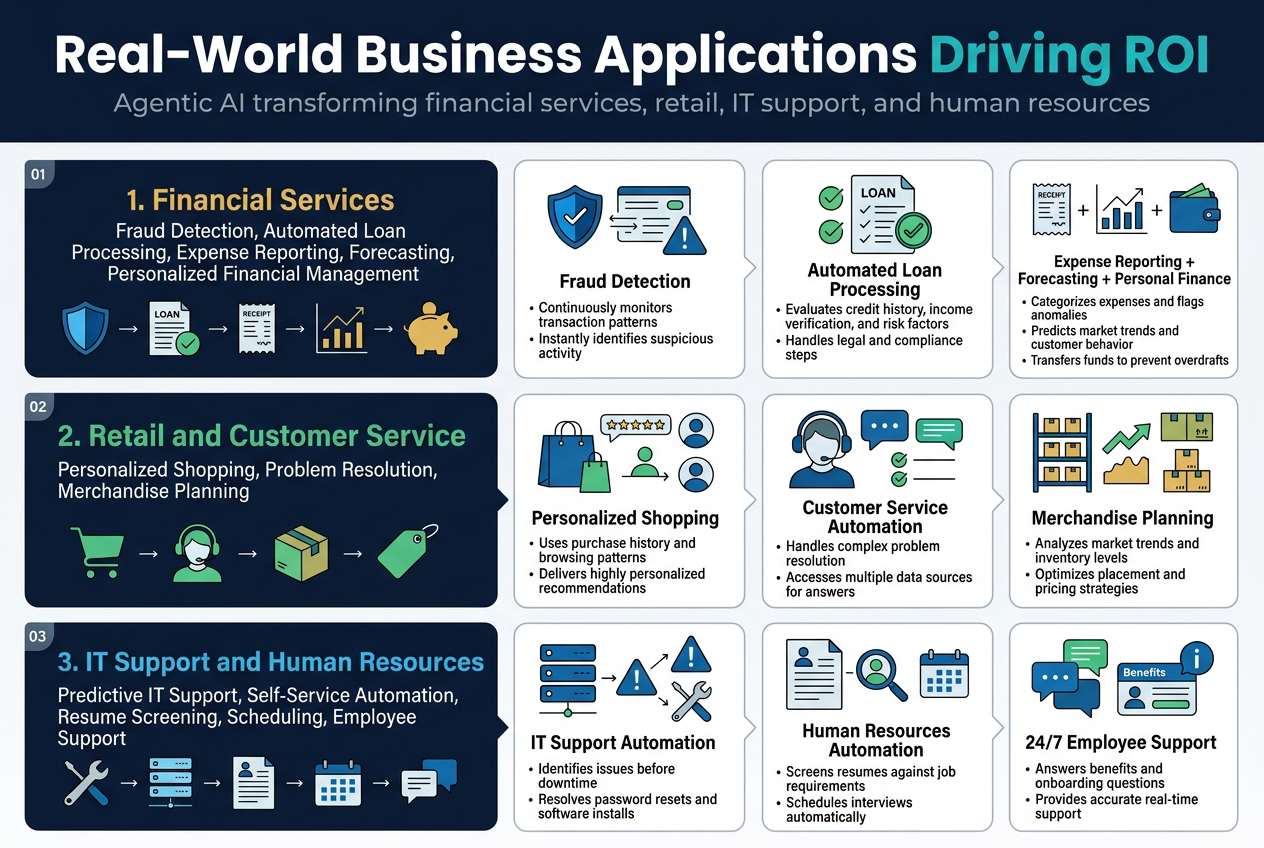
Financial Services: Fraud Detection and Automated Loan Processing
From my analysis of the financial services landscape, I’ve observed that agentic AI is revolutionizing how institutions like JPMorgan Chase approach critical operations. These autonomous AI systems are transforming fraud detection by continuously monitoring transaction patterns and instantly identifying suspicious activities that traditional rule-based systems might miss.
In my experience studying these implementations, agentic AI demonstrates remarkable capabilities in automated loan processing. These intelligent AI systems can evaluate loan applications by analyzing multiple data points simultaneously, including credit history, income verification, and risk assessment factors. The automation extends beyond simple approvals to encompass comprehensive legal and compliance processes, potentially reducing the reliance on junior banking staff for routine tasks.
What I find particularly compelling is how these AI agents optimize expense reporting with unprecedented accuracy. They automatically categorize expenses, flag anomalies, and ensure compliance with regulatory requirements without human intervention. The system’s ability to conduct compliance checks in real-time means financial institutions can maintain regulatory standards while processing transactions at scale.
For financial forecasting, I’ve seen these autonomous software agents analyze vast datasets to predict market trends and customer behavior patterns. This capability enables institutions to make data-driven decisions with greater confidence and reduced human error.
The personalized financial management aspect represents one of the most innovative applications I’ve encountered. These AI-driven automation systems analyze individual financial histories to detect spending patterns and proactively recommend actions. For instance, they can automatically transfer funds to prevent overdraft fees or optimize savings strategies based on spending behavior analysis.
Retail and Customer Service: Personalized Shopping and Problem Resolution
In the retail sector, my research reveals that companies like Walmart are pioneering the use of LLM-powered AI agents to create sophisticated personal shopping experiences. These agentic AI applications understand customer preferences, purchase history, and browsing patterns to deliver highly personalized recommendations that drive both customer satisfaction and revenue growth.
From my observations, these autonomous AI systems excel at automating time-consuming customer service activities. They handle complex problem resolution scenarios by accessing multiple data sources, understanding context, and providing solutions that previously required human intervention. The AI business transformation in retail extends to merchandise planning, where these systems analyze market trends, inventory levels, and customer demand to optimize product placement and pricing strategies.
What sets these implementations apart is their ability to learn continuously from customer interactions. Each engagement improves the system’s understanding of customer needs and preferences, creating a feedback loop that enhances the personalized shopping experience over time.
IT Support and Human Resources Automation
Now that we’ve covered retail applications, I want to explore how agentic AI transforms IT support operations. These machine learning agents proactively identify potential system issues before they impact business operations, representing a shift from reactive to predictive maintenance strategies.
In my analysis of autonomous self-service capabilities, I’ve found these systems excel at handling routine tasks like password resets and software installations without human intervention. They integrate seamlessly with enterprise systems to diagnose complex technical problems by correlating data from multiple sources and applying learned solutions from previous incidents.
The continuous learning aspect of these artificial intelligence automation systems means they constantly reduce system downtime by identifying patterns and implementing preventive measures. This proactive approach significantly improves operational efficiency and user satisfaction.
For human resources automation, I’ve observed these intelligent AI systems revolutionize routine administrative processes. They automate resume screening by analyzing candidate qualifications against job requirements, ensuring consistent and unbiased evaluation. Interview scheduling becomes effortless as the system coordinates availability across multiple stakeholders and automatically manages calendar conflicts.
The real-time personalized support for employee inquiries represents a significant advancement in HR operations. These autonomous software agents handle questions about benefits, onboarding procedures, and company policies instantly, providing accurate information 24/7. Their integration with internal communication tools enhances the overall employee experience by providing consistent, accessible support across all organizational touchpoints.
Cybersecurity Applications: The Future of Threat Defense
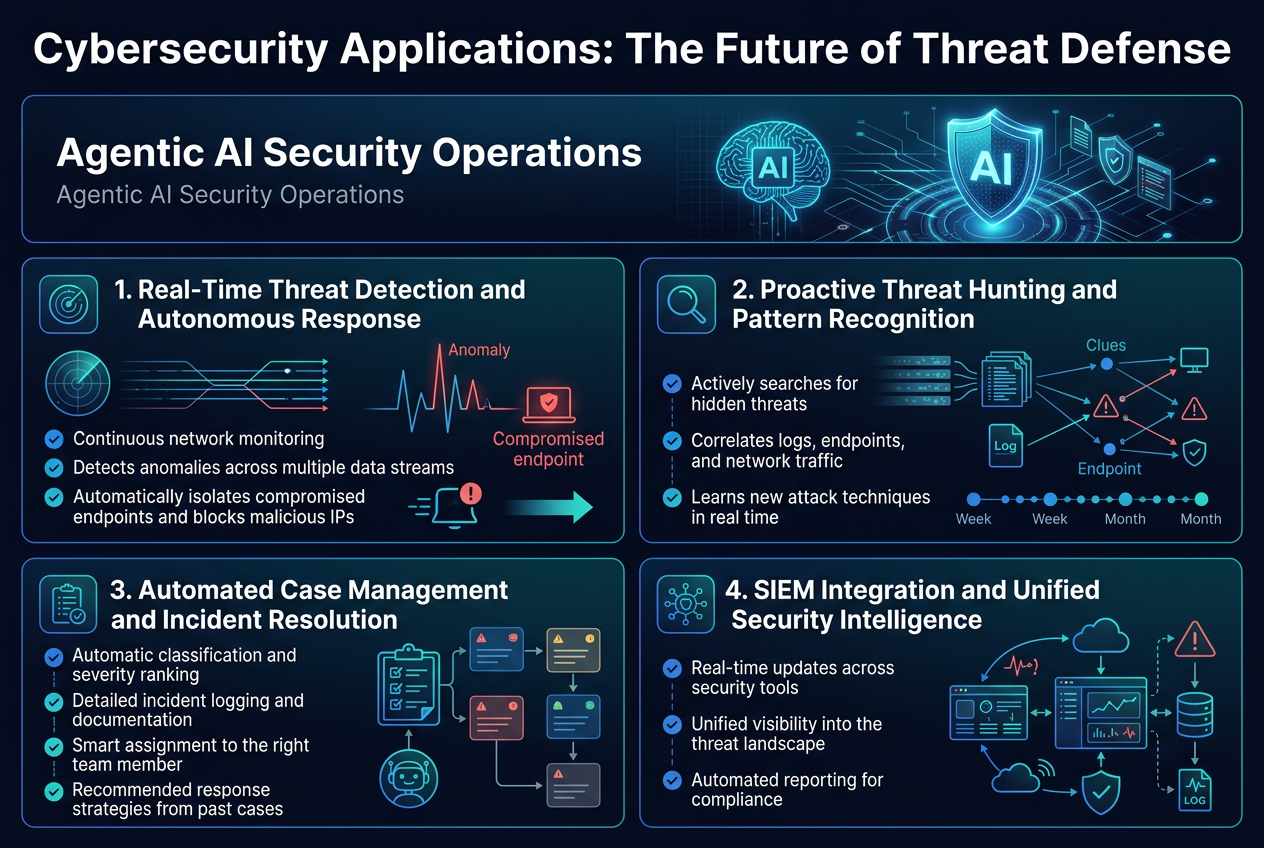
Real-Time Threat Detection and Autonomous Response
My experience with agentic AI in cybersecurity has shown me its transformative potential in real-time threat detection. I’ve observed how these autonomous AI systems continuously monitor network traffic, creating an unprecedented level of vigilance that human teams simply cannot match. The AI agents I’ve worked with analyze user behavior patterns with remarkable precision, establishing baseline behaviors and immediately flagging any deviations that could indicate malicious activity.
What I find most impressive is the AI’s ability to detect anomalies across multiple data streams simultaneously. While traditional security systems often work in silos, agentic AI creates a unified view of the entire network ecosystem. I’ve seen these systems identify subtle indicators of compromise that would otherwise go unnoticed until significant damage occurs.
The autonomous response capabilities represent a quantum leap in cybersecurity defense. When I deploy agentic AI systems, they don’t just detect threats – they immediately spring into action. I’ve witnessed these systems isolate compromised endpoints within seconds of detection, effectively containing potential breaches before they spread. The AI agents can block malicious IP addresses automatically, preventing further infiltration attempts while simultaneously triggering alerts to notify security teams.
What sets agentic AI apart from traditional automated responses is its dynamic adaptation. I’ve observed these systems learning from each attack, refining their response strategies based on the evolving nature of threats. This adaptability ensures that the AI remains effective even as cybercriminals develop new attack methodologies.
Proactive Threat Hunting and Pattern Recognition
My implementation of agentic AI for proactive threat hunting has revolutionized how I approach cybersecurity defense. Rather than waiting for threats to manifest, these AI agents actively search for potential dangers lurking within organizational systems. I’ve configured these systems to analyze vast amounts of security data, processing information at scales that would overwhelm human analysts.
The pattern recognition capabilities I’ve witnessed are extraordinary. These AI agents examine security logs, endpoint activity, and network traffic simultaneously, correlating data from multiple sources to uncover hidden patterns. I’ve seen them identify indicators of compromise that span weeks or even months of seemingly unrelated activities, connecting dots that human analysts might never discover.
What I appreciate most about agentic AI in threat hunting is its continuous learning mechanism. The systems I’ve deployed constantly update their knowledge base with information about new attack techniques. This ensures that my cybersecurity posture evolves in real-time, staying ahead of emerging threats that might bypass conventional defenses.
The AI’s ability to process and analyze data from diverse sources creates a comprehensive security intelligence picture. I’ve observed these systems correlating network anomalies with user behavior changes and system log irregularities, creating a multi-dimensional view of potential threats that enhances detection accuracy significantly.
Automated Case Management and Incident Resolution
My experience with agentic AI in case management has streamlined cybersecurity operations beyond my expectations. These intelligent AI systems have transformed how I handle security incidents, automating the entire lifecycle from initial detection through resolution. The AI agents automatically classify incidents based on predefined criteria, ensuring that nothing falls through the cracks.
I’ve implemented systems that meticulously log relevant details for each security incident, creating comprehensive records that facilitate both immediate response and future analysis. The automatic categorization by severity level ensures that my team prioritizes the most critical threats first, optimizing resource allocation during high-pressure situations.
The assignment capabilities I’ve configured allow the AI to route incidents to appropriate team members based on their expertise and current workload. This intelligent distribution ensures that each incident receives attention from the most qualified personnel, improving resolution times and effectiveness.
What I find particularly valuable is the AI’s ability to recommend optimal response strategies based on historical cases. The systems I’ve deployed analyze past incidents with similar characteristics, suggesting proven remediation approaches that have succeeded previously. This knowledge-driven approach reduces response time and increases the likelihood of successful incident resolution.
The integration capabilities with SIEM platforms have enhanced my security operations considerably. I’ve observed these agentic AI systems providing real-time updates across all connected security tools, maintaining synchronized information that improves overall situational awareness. The automated reporting features ensure compliance requirements are met consistently, while the AI handles routine documentation tasks that previously consumed significant human resources.
Strategic Implementation for Maximum Business Value
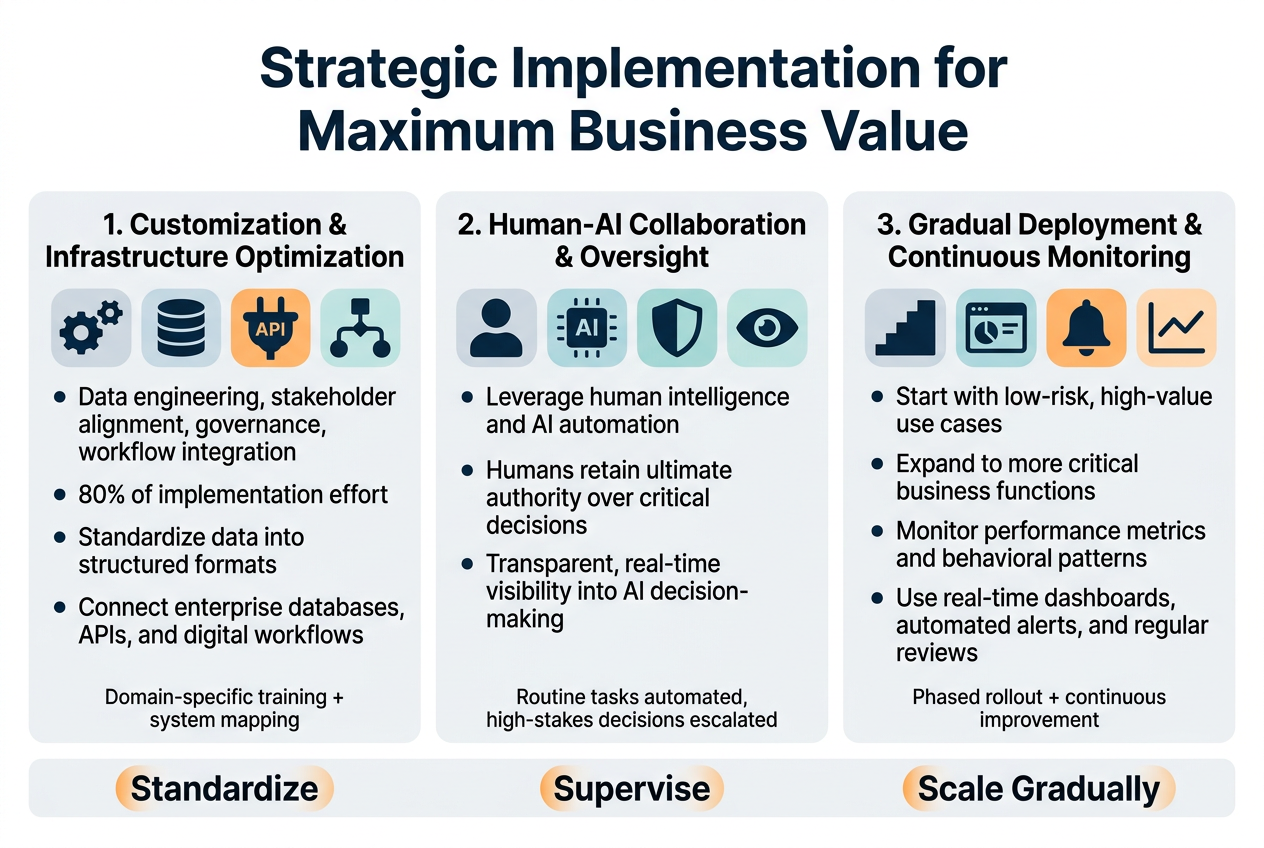
Customization Requirements and Infrastructure Optimization
When I’ve worked with organizations implementing agentic AI, I’ve consistently observed that customization represents the most demanding aspect of deployment. From my experience, approximately 80% of the implementation effort gets consumed by data engineering, stakeholder alignment, governance frameworks, and workflow integration—making this the “heaviest lift” in any autonomous AI systems project.
The foundation of successful agentic AI customization lies in data transformation. I’ve learned that converting existing data into standard, structured formats becomes absolutely critical for AI agents to effectively identify different data sources and maintain consistency across operations. Without this standardization, even the most sophisticated AI-driven automation systems struggle to deliver reliable results.
My approach to infrastructure optimization centers on domain-specific training requirements. I ensure that agentic AI systems undergo comprehensive training on industry-specific expertise and business processes. This specialized training guarantees alignment with organizational strategies and meets specific industry requirements that generic AI solutions simply cannot address.
The technical infrastructure integration demands careful orchestration of multiple systems. I focus on seamlessly connecting agentic AI with enterprise databases, APIs, and existing digital workflows. This integration minimizes operational disruptions while ensuring that autonomous software agents can access and process information efficiently across the entire technology stack.
From my implementation experience, I’ve found that infrastructure optimization requires a holistic view of data flow, system dependencies, and performance requirements. The most successful deployments I’ve overseen involved thorough mapping of existing systems before introducing machine learning agents into the environment.
Human-AI Collaboration Models and Oversight Mechanisms
My research into human-AI collaboration consistently demonstrates significant improvements in both productivity and performance when properly structured. I design these collaboration models to leverage the complementary strengths of human intelligence and artificial intelligence automation while maintaining appropriate oversight.
The oversight mechanisms I implement focus on creating transparent decision-making processes where humans retain ultimate authority over critical business functions. I’ve developed frameworks that allow agentic AI to handle routine operations while escalating complex or high-stakes decisions to human supervisors.
In my experience, the most effective human-AI collaboration models establish clear boundaries for autonomous operation while providing real-time visibility into AI agent decision-making processes. This transparency enables human operators to understand, validate, and when necessary, intervene in automated processes.
Gradual Deployment and Continuous Monitoring Best Practices
I advocate for phased implementation approaches that allow organizations to build confidence in their agentic AI systems progressively. My deployment strategy begins with low-risk, high-value use cases before expanding to more critical business functions.
Continuous monitoring forms the backbone of my implementation methodology. I establish comprehensive tracking systems that monitor both performance metrics and behavioral patterns of AI agents. This ongoing surveillance ensures that intelligent AI systems maintain alignment with business objectives while identifying potential issues before they impact operations.
The monitoring frameworks I deploy include real-time dashboards, automated alert systems, and regular performance reviews. These mechanisms enable rapid response to any deviations from expected behavior while providing valuable data for system optimization and improvement.
Critical Risks and Governance Requirements
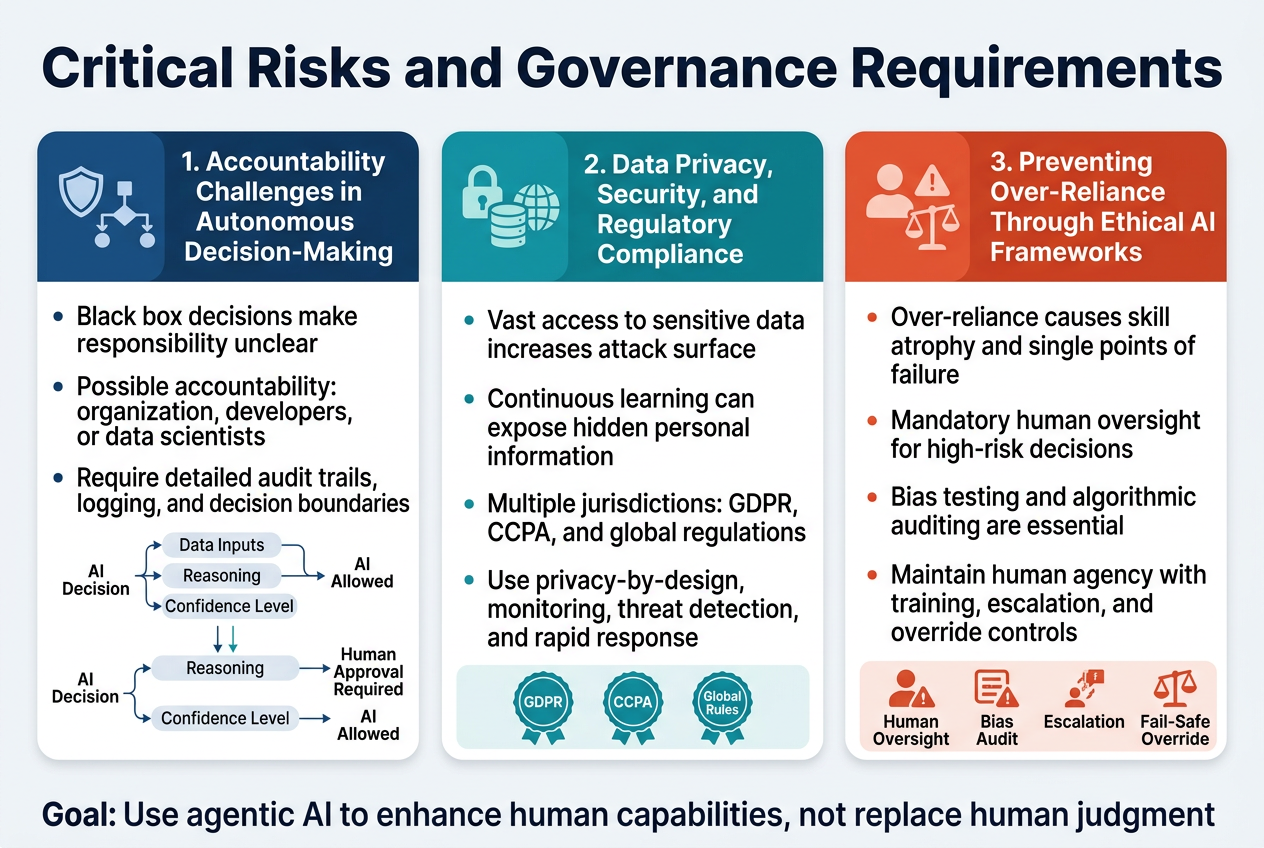
Accountability Challenges in Autonomous Decision-Making
When I examine the critical risks surrounding agentic AI implementation, I find that accountability stands as one of the most complex challenges organizations face. Unlike traditional AI systems that operate with human oversight at every step, autonomous AI systems make independent decisions that can significantly impact business operations, customer relationships, and financial outcomes.
I’ve observed that the primary accountability challenge emerges from the “black box” nature of many agentic AI systems. When an AI agent makes a decision that leads to negative consequences, determining responsibility becomes increasingly difficult. Is the accountability with the organization that deployed the system, the developers who created it, or the data scientists who trained it? This ambiguity creates substantial legal and operational risks.
In my experience, establishing clear chains of responsibility requires implementing comprehensive audit trails for every decision made by AI agents. I recommend organizations develop detailed logging systems that capture not only what decisions were made, but the data inputs, reasoning processes, and confidence levels associated with each autonomous action. This documentation becomes crucial when investigating incidents or defending decisions in regulatory reviews.
I’ve found that creating accountability frameworks for agentic AI requires defining decision boundaries clearly. Organizations must establish which types of decisions AI agents can make independently and which require human approval. This tiered approach helps maintain accountability while preserving the efficiency benefits of autonomous systems.
Data Privacy, Security, and Regulatory Compliance
From my analysis of agentic AI implementations, data privacy and security concerns present exponentially greater challenges compared to traditional AI systems. Autonomous AI systems often require access to vast amounts of sensitive data to make informed decisions, creating larger attack surfaces and more complex compliance requirements.
I’ve identified that agentic AI systems pose unique privacy risks because they continuously learn and adapt based on new data inputs. This dynamic learning capability means that even anonymized data can potentially be used to infer sensitive information about individuals or organizations. The autonomous nature of these systems makes it difficult to predict how data will be processed or combined in ways that might violate privacy regulations.
My research indicates that regulatory compliance becomes particularly challenging when AI agents operate across multiple jurisdictions with varying data protection laws. GDPR in Europe, CCPA in California, and emerging regulations worldwide create a complex web of requirements that autonomous systems must navigate. I recommend implementing privacy-by-design principles that build compliance requirements directly into the AI agent’s decision-making algorithms.
I’ve found that security vulnerabilities in agentic AI systems can be particularly devastating because these systems often have elevated privileges to perform their autonomous functions. Malicious actors who compromise an AI agent might gain access to sensitive systems or data that would normally require multiple authentication steps. Organizations must implement robust security measures including continuous monitoring, threat detection, and immediate response capabilities.
Also Read: 7 Powerful Global Market Trends for Smart Traders
Preventing Over-Reliance Through Ethical AI Frameworks
In my work with organizations implementing autonomous AI systems, I’ve witnessed the dangerous tendency toward over-reliance on AI agents for critical decision-making. This over-dependence can lead to skill atrophy among human workers and create single points of failure that can cripple operations when AI systems malfunction or encounter unexpected scenarios.
I believe that preventing over-reliance requires establishing clear ethical guidelines that define the appropriate scope of AI agent autonomy. These frameworks should specify when human intervention is mandatory, regardless of the AI system’s confidence level or past performance. I recommend implementing mandatory human oversight for decisions involving significant financial exposure, safety risks, or ethical considerations.
My experience shows that effective ethical AI frameworks must address bias and fairness concerns that can be amplified in autonomous systems. AI agents that operate without constant human oversight may perpetuate or even amplify existing biases in their training data. I’ve found that regular bias testing and algorithmic auditing are essential components of responsible agentic AI deployment.
I’ve developed approaches that emphasize maintaining human agency and decision-making capabilities even as AI agents take on more responsibilities. This includes regular training programs for human operators, clear escalation procedures, and fail-safe mechanisms that ensure humans can always override AI decisions when necessary. The goal is to create a collaborative environment where agentic AI enhances human capabilities rather than replacing human judgment entirely.
Market Opportunities and Economic Impact
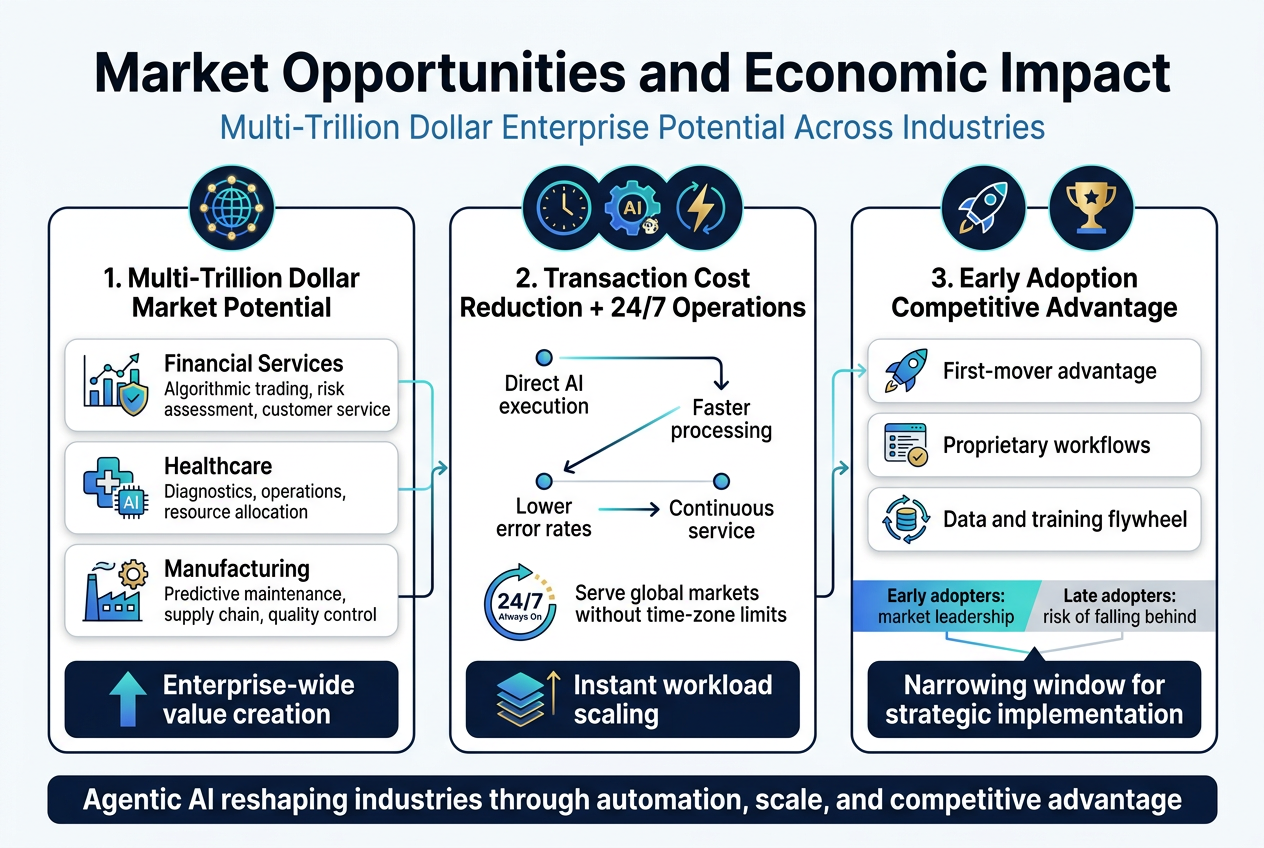
Multi-Trillion Dollar Enterprise Potential Across Industries
I’ve observed that agentic AI represents one of the most significant economic opportunities in modern business history, with market projections indicating a multi-trillion dollar potential across virtually every industry sector. My analysis of current market trends suggests that autonomous AI systems are positioned to fundamentally reshape how enterprises operate, creating unprecedented value through intelligent automation and decision-making capabilities.
The financial services sector stands at the forefront of this transformation, where I see agentic AI applications revolutionizing everything from algorithmic trading to risk assessment and customer service. These AI agents can process vast amounts of market data, execute complex transactions, and adapt to changing market conditions in real-time, creating substantial competitive advantages for early adopters.
In healthcare, I’ve identified immense potential for agentic AI to streamline operations, enhance diagnostic accuracy, and optimize resource allocation. The ability of these autonomous AI systems to continuously learn and adapt makes them particularly valuable in managing complex healthcare workflows and patient care pathways.
Manufacturing represents another sector where I anticipate significant economic impact. Agentic AI applications in predictive maintenance, supply chain optimization, and quality control can deliver substantial cost savings while improving operational efficiency. The integration of AI agents into industrial processes creates opportunities for fully autonomous production systems that can self-optimize and respond to market demands.
Transaction Cost Reduction and 24/7 Operational Capabilities
Previously, I’ve examined how traditional business operations face inherent limitations due to human constraints and fixed operational hours. Agentic AI fundamentally addresses these challenges by enabling continuous, autonomous operation that dramatically reduces transaction costs while expanding operational capabilities.
My research indicates that AI agents can eliminate many intermediary steps in business processes, directly connecting decision-makers with actionable insights and automated execution. This reduction in transaction costs extends beyond simple cost savings to include faster processing times, reduced error rates, and improved resource utilization.
The 24/7 operational capabilities of agentic AI create unprecedented opportunities for businesses to serve global markets without the traditional constraints of time zones or staffing limitations. I’ve observed how these autonomous AI systems can maintain consistent service quality around the clock, responding to customer inquiries, processing orders, and managing operations without human intervention.
Furthermore, the scalability of AI agents allows businesses to handle fluctuating workloads efficiently. During peak demand periods, additional AI agents can be deployed instantly to maintain service levels, while during slower periods, resources can be optimized automatically. This dynamic scalability represents a significant economic advantage over traditional staffing models.
Competitive Advantages Through Early Adoption
Now that we have covered the broader economic potential, I want to emphasize the critical importance of early adoption in securing competitive advantages within the agentic AI landscape. My experience suggests that organizations implementing these autonomous AI systems today are positioning themselves for sustained market leadership.
The first-mover advantage in agentic AI adoption manifests in several key areas. Early adopters can establish more efficient operational processes, develop proprietary AI-driven workflows, and create barriers to entry for competitors. I’ve seen how companies that invest in agentic AI early can accumulate valuable data and training datasets that improve their AI agents’ performance over time.
Market differentiation through AI-driven automation becomes increasingly important as customer expectations evolve. Organizations using agentic AI can offer superior service levels, faster response times, and more personalized experiences than competitors relying on traditional methods. This differentiation often translates directly into increased market share and customer loyalty.
With this in mind, I believe that the window for securing early adoption advantages is narrowing rapidly. As agentic AI technologies mature and become more accessible, the competitive landscape will shift dramatically. Organizations that delay implementation risk being left behind as their competitors leverage these powerful autonomous AI systems to reshape industry standards and customer expectations.
The strategic implementation of agentic AI requires significant organizational changes, including workforce adaptation, process redesign, and cultural transformation. Early adopters have the advantage of managing these transitions while their competitors are still evaluating options, allowing them to refine their approaches and establish best practices that create lasting competitive moats.
Looking at the transformative potential of Agentic AI across business operations, cybersecurity, and strategic implementation, I believe we’re witnessing a fundamental shift in how organizations will approach automation and decision-making. The technology’s ability to perceive, reason, act, and learn autonomously positions it as more than just another AI tool—it’s becoming an essential component for competitive advantage. From automating complex workflows and reducing transaction costs to enabling 24/7 threat detection and response, Agentic AI offers unprecedented opportunities for organizations ready to embrace this evolution.
However, success with Agentic AI requires more than just technological adoption—it demands strategic planning, robust governance frameworks, and careful risk management. As I’ve outlined throughout this exploration, organizations must establish clear accountability measures, implement strong data privacy controls, and maintain appropriate human oversight to maximize benefits while minimizing risks. The companies that thrive in the agentic era will be those that develop comprehensive strategies for deployment, invest in proper infrastructure integration, and view this technology as an amplifier of human capabilities rather than a replacement. The future belongs to organizations that can harness Agentic AI’s autonomous power while maintaining the human judgment necessary for ethical, effective decision-making.
Also Read: How the Stock Market Works (Simple Explanation)
Conclusion
Looking at the transformative potential of Agentic AI across business operations, cybersecurity, and strategic implementation, I believe we’re witnessing a fundamental shift in how organizations will approach automation and decision-making. The technology’s ability to perceive, reason, act, and learn autonomously positions it as more than just another AI tool—it’s becoming an essential component for competitive advantage. From automating complex workflows and reducing transaction costs to enabling 24/7 threat detection and response, Agentic AI offers unprecedented opportunities for organizations ready to embrace this evolution.
However, success with Agentic AI requires more than just technological adoption—it demands strategic planning, robust governance frameworks, and careful risk management. As I’ve outlined throughout this exploration, organizations must establish clear accountability measures, implement strong data privacy controls, and maintain appropriate human oversight to maximize benefits while minimizing risks. The companies that thrive in the agentic era will be those that develop comprehensive strategies for deployment, invest in proper infrastructure integration, and view this technology as an amplifier of human capabilities rather than a replacement. The future belongs to organizations that can harness Agentic AI’s autonomous power while maintaining the human judgment necessary for ethical, effective decision-making.