
Table of Contents
Global Market Trends are currently presenting a masterclass in volatility, resilience, and unprecedented opportunity. If you are watching your portfolio right now, you know exactly how critical this moment is. From the explosive Asian tech boom pushing valuations into the trillions, to the relentless momentum of US markets defying stubborn inflation, the financial landscape is shifting at breakneck speed.
In this comprehensive guide, we will break down the most critical market movements happening right now. You will learn how geopolitical tensions are keeping crude oil fluctuating near the $100 mark, why safe-haven assets like gold have established a staggering new baseline, and most importantly, how you can navigate these developments to protect and grow your wealth.
The Asian Tech Boom: Equities Surge to Historic Peaks
One of the most astonishing Global Market Trends right now is the sheer velocity of the Asian technology sector. Driven by insatiable demand for AI-driven infrastructure and advanced semiconductors, Asian equities have surged to historic peaks.
- Micron Technology’s Massive Leap: We recently saw a staggering 19% jump in Micron Technology. As global supply chains scramble to secure memory chips, Micron has emerged as an undisputed heavyweight, rewarding investors who positioned themselves early in the semiconductor super-cycle.
- SK Hynix Joins the Trillion-Dollar Club: In a historic milestone, South Korea’s SK Hynix officially crossed the $1 trillion market capitalization threshold. This underscores the structural shift in global manufacturing and the permanent premium placed on high-bandwidth memory (HBM) production. You can track these structural tech shifts and real-time market valuations directly via TradingView.


Alt text: A digital stock chart illustrating the latest Global Market Trends in the Asian tech and semiconductor boom.
For more background on leveraging tech equities, check out our Beginner Trading Guides.
US Markets: Defying Inflation for Fresh Highs
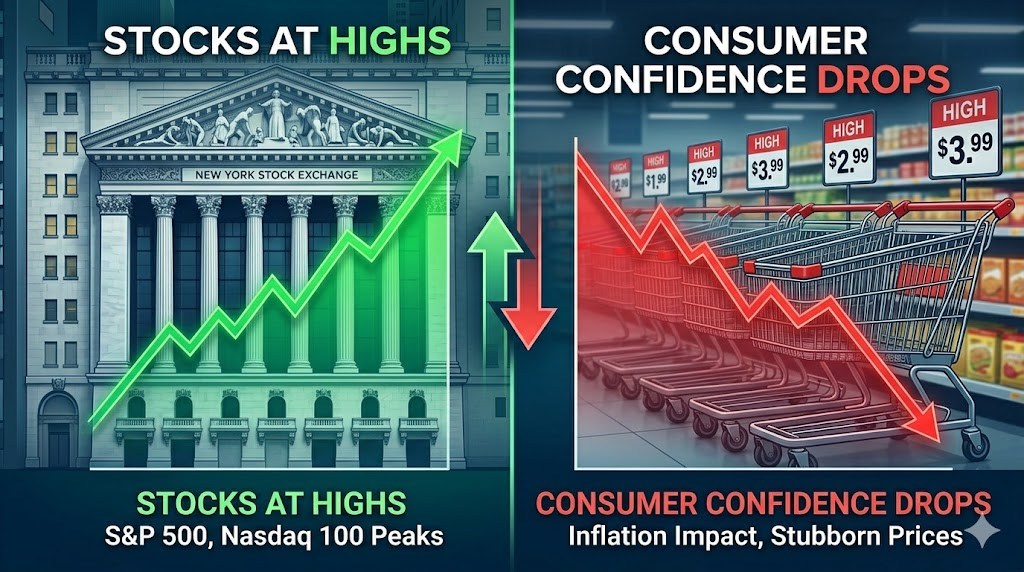
Despite domestic economic headwinds, the US stock market refuses to slow down. The S&P 500 and Nasdaq 100 hit fresh closing highs on Tuesday, carrying immense momentum.
However, this bullish action masks a divergence in the broader economy. Domestic consumer confidence has experienced a noticeable drop, largely due to stubborn inflation eating into purchasing power. Investors are currently prioritizing the robust earnings of mega-cap tech and defensive growth stocks over the reality of the struggling consumer, creating one of the most fascinating Global Market Trends of the decade. Traders closely follow macro metrics provided by the Federal Reserve to anticipate how long these stubborn inflationary pressures might last.
Crude Oil Fluctuations: The $100 Barrel Mark
Commodities traders are facing a high-wire act as Brent and WTI crude fluctuate around the $97 to $100 per barrel mark.
Prices spiked sharply following U.S. military strikes on Iranian missile sites, introducing a heavy “geopolitical risk premium” into the energy markets. However, the market has seen periodic pullbacks as residual diplomatic talks suggest a potential de-escalation. This tug-of-war between military action and diplomatic resolution makes oil highly volatile and ideal for short-term swing traders tracking macroeconomic events.
To understand how to hedge against such volatility, read our comprehensive Risk Management Articles.
Also Read: Indian economic landscape
Gold Stability: The New Safe-Haven Baseline
In times of uncertainty, gold shines. Currently, safe-haven gold contracts have edged slightly up to $4,518 per troy ounce.
What is remarkable about these Global Market Trends is not just the price, but the stability. Gold is remaining near its elevated baseline as global risk hedges continue to accumulate. Central banks and institutional investors are stacking gold to protect against the very inflation that is dragging down US consumer confidence, as well as the geopolitical shocks rocking the crude oil sector. According to institutional asset tracking from the World Gold Council, physical demand continues to provide a firm floor for prices.

Practical Examples of Trading These Trends
How do you translate these macroeconomic shifts into a trading strategy? Here are a few practical examples:
- Pairs Trading the Tech Boom: Going long on emerging Asian semiconductor ETFs while shorting legacy consumer retail stocks in the US that are vulnerable to dropping consumer confidence.
- Oil Volatility Arbitrage: Using options to straddle crude oil futures. Since prices are violently swinging between $97 and $100 based on news headlines, a volatility-based options strategy can capture profits regardless of the direction of the ultimate breakout.
- Gold as a Portfolio Anchor: Allocating 5-10% of a portfolio to physical gold or gold-backed ETFs to offset the high beta (volatility) of the massive tech sector gains.
Benefits and Advantages of the Current Market
- Unprecedented Tech Growth: The AI and semiconductor super-cycle offers generational wealth-building opportunities.
- Clear Safe-Haven Signals: With gold holding steady at $4,518, investors have a highly reliable asset to rotate into during market panics.
- High Liquidity in Energy: The crude oil market is currently offering massive liquidity, allowing traders to enter and exit positions with minimal slippage.
Risks and Limitations
- Geopolitical Black Swans: The situation in the Middle East can escalate overnight, causing unpredictable gaps in oil and equity markets.
- Inflationary Pressures: Stubborn inflation could force central banks to maintain higher interest rates, which eventually threatens the US market’s current momentum.
- Overvaluation: Trillion-dollar valuations in the Asian tech sector leave very little room for earnings misses. Any supply chain disruption could trigger severe corrections.
Step-by-Step Guide: Navigating Current Global Market Trends
Here is how to align your portfolio with the current market reality:
- Assess Your Exposure: Check what percentage of your portfolio is weighted toward US tech versus Asian equities. Consider rebalancing to capture the SK Hynix and Micron momentum.
- Implement Stop-Losses: Because the S&P 500 is at all-time highs despite low consumer confidence, ensure you have trailing stop-losses in place to protect your gains against a sudden correction.
- Monitor the VIX and Oil Corollaries: Set daily price alerts for WTI crude crossing $100. A sustained break above this level usually signals heightened inflation fears.
- Hedge with Gold: Ensure your portfolio has a defensive allocation. If you lack exposure, consider dollar-cost averaging into gold at its current baseline.
- Stay Informed: Regularly check the Federal Reserve updates and geopolitical news desks to anticipate market-moving events.
Expert Tips for Portfolio Management
- Don’t Fight the Trend: If the Nasdaq is making new highs, do not short it simply because you feel it is “too high.” Wait for structural breaks in market structure.
- Follow the Smart Money: Institutional capital is flowing heavily into high-bandwidth memory (HBM). Align your tech investments with these infrastructure providers rather than consumer-facing software.
- Diversify Across Borders: Do not limit yourself to the S&P 500. The current Global Market Trends clearly show Asia leading the charge in physical tech manufacturing.
Common Mistakes to Avoid
- Ignoring Macro Data: Focusing solely on a stock’s chart while ignoring the drop in consumer confidence or geopolitical strikes is a recipe for disaster.
- Chasing Parabolic Moves: Buying into a stock after it has already jumped 19% (like Micron) often leads to buying the local top. Wait for pullbacks to established support levels.
- Over-leveraging in Oil: Given the headline-driven nature of crude right now, using high leverage can result in account liquidations during overnight trading sessions.
FAQs
What are the most dominant Global Market Trends right now?
The most dominant trends include the historic surge in Asian tech equities (specifically semiconductors), US markets hitting all-time highs despite inflation, volatile crude oil near $100, and gold stabilizing at an elevated $4,518 baseline.
Why is SK Hynix surging so heavily?
SK Hynix has crossed a $1 trillion market capitalization due to its dominant position in supplying High-Bandwidth Memory (HBM) chips, which are essential for the global expansion of artificial intelligence infrastructure. For a foundational understanding of equity values, you can read more about definitions on Investopedia.
How does stubborn inflation affect the US stock market?
While inflation typically hurts stock valuations, current Global Market Trends show investors flocking to mega-cap tech stocks as a safe haven, driving index prices up even as broader consumer confidence falls.
Why are crude oil prices fluctuating so much?
Oil prices are caught in a tug-of-war. U.S. military strikes on Iranian missile sites threaten supply disruptions (pushing prices up), while ongoing diplomatic talks ease those fears (pulling prices down).
Is gold at $4,518 still a good investment?
Many analysts consider gold at this level to be a new baseline. It remains an essential hedge against both the geopolitical instability affecting oil and the stubborn inflation impacting fiat currencies.
Also Read: How the Stock Market Works (Simple Explanation)
Conclusion
Understanding current Global Market Trends is the difference between reacting to the news and capitalizing on it. The surge in Asian equities, the resilience of the US markets, the geopolitical tension in crude oil, and the stability of gold all paint a picture of a complex but highly rewarding financial landscape. By employing smart risk management and staying objective, you can navigate these waters successfully.
Ready to dive deeper into market strategies? Keep learning with our advanced Forex Tutorials and Trading Psychology Posts to sharpen your edge.
Financial Disclaimer
This content is for educational purposes only and should not be considered financial advice. Always conduct your own research before making financial decisions. Trading stocks, commodities, and other financial instruments carries a high level of risk and may not be suitable for all investors. Public companies are regulated under guidelines enforced by bodies like the U.S. Securities and Exchange Commission (SEC).


