Table of Contents
The Indian economic landscape is currently navigating a complex period of domestic recalibration. While global markets—particularly Asian and U.S. technology sectors—bask in the euphoria of an AI-driven boom, India is charting a distinctly different course. The domestic market has sharply diverged from this global optimism, weighed down by localized capital outflows, rising fuel-driven inflation, and intense debates over central bank interventions.
For investors, corporate leaders, and readers of Zyqorr, understanding these domestic headwinds is crucial for capital preservation and strategic asset allocation within the Indian economic landscape. Let’s explore the core pillars shaping this current macroeconomic environment.
Market Correction: SENSEX and NIFTY Feel the Pinch


While international indices hit fresh all-time highs, the Indian economic landscape is experiencing a sobering reality check. The benchmark BSE SENSEX recently dropped a substantial 479 points to settle at 76,009.70, while the broader NSE NIFTY 50 slid to 23,913.70.
This correction is not driven by panic, but rather a calculated rotation. We are witnessing localized capital outflows as foreign institutional investors (FIIs) and cautious domestic fund managers secure profits. Much of this capital is either moving to safer debt instruments or re-routing to capitalize on the high-beta global tech surge. Consequently, the domestic market is being forced to rely on intrinsic corporate earnings, which are currently under threat from macroeconomic pressures.
Inflation & Fuel Pressure: The Margin Squeeze
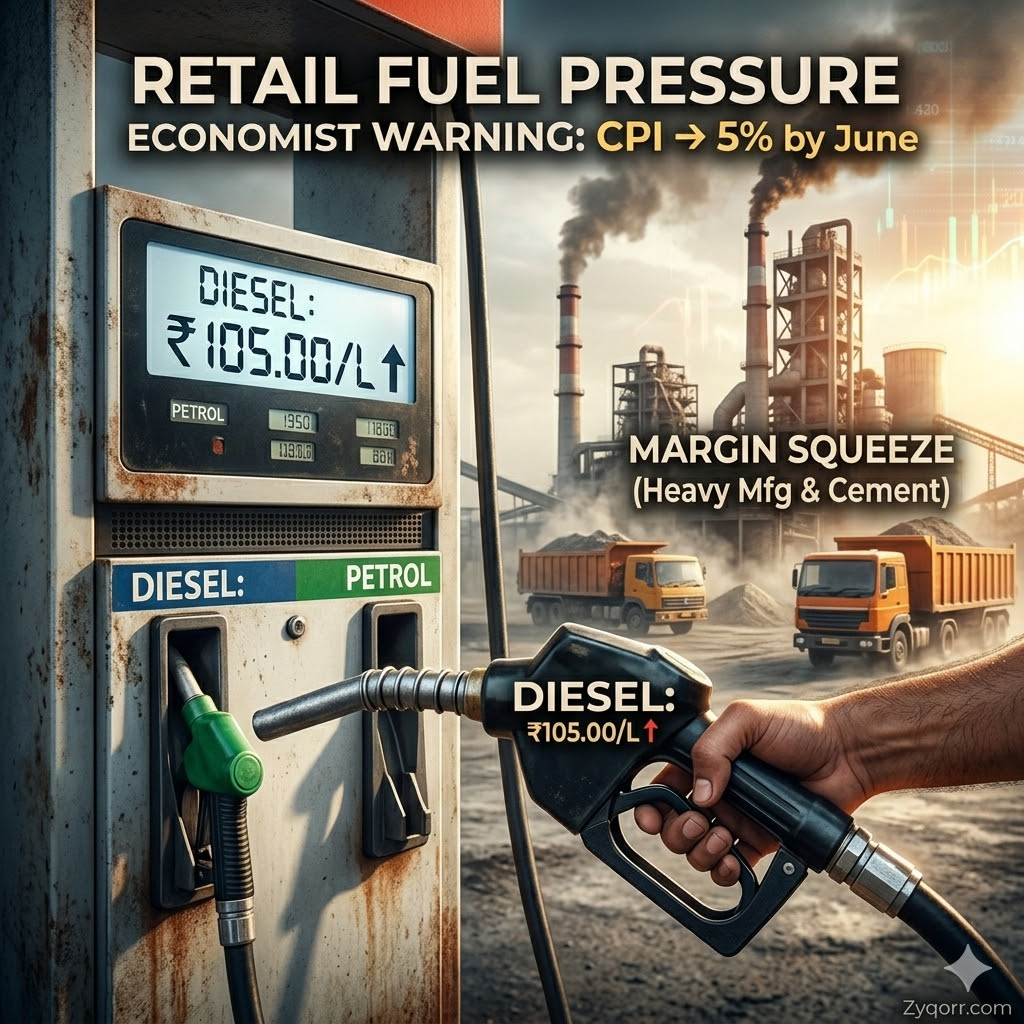
A dominant theme disrupting the Indian economic landscape is the resurgence of inflationary pressure. Recent rounds of retail petrol and diesel price hikes have sent ripples through the entire domestic supply chain.
Economists and data tracked by the Ministry of Statistics and Programme Implementation (MoSPI) are raising red flags, warning that India’s consumer inflation (CPI) could accelerate toward the critical 5% mark by June. This is not merely a theoretical macroeconomic concern; it has immediate, tangible impacts on corporate balance sheets:
- Heavy Manufacturing: Reliant on constant energy inputs and logistics, manufacturing firms face a severe margin squeeze.
- Cement and Infrastructure: Highly dependent on freight and raw material transport, the cement industry is uniquely vulnerable to diesel price hikes, forcing them to choose between absorbing costs or passing them onto a price-sensitive consumer base.
Corporate Actions: The Coal India OFS

Despite the broader market slump characterizing the Indian economic landscape, the Government of India is moving forward with strategic divestments, capitalizing on the underlying stability of state-run monopolies.
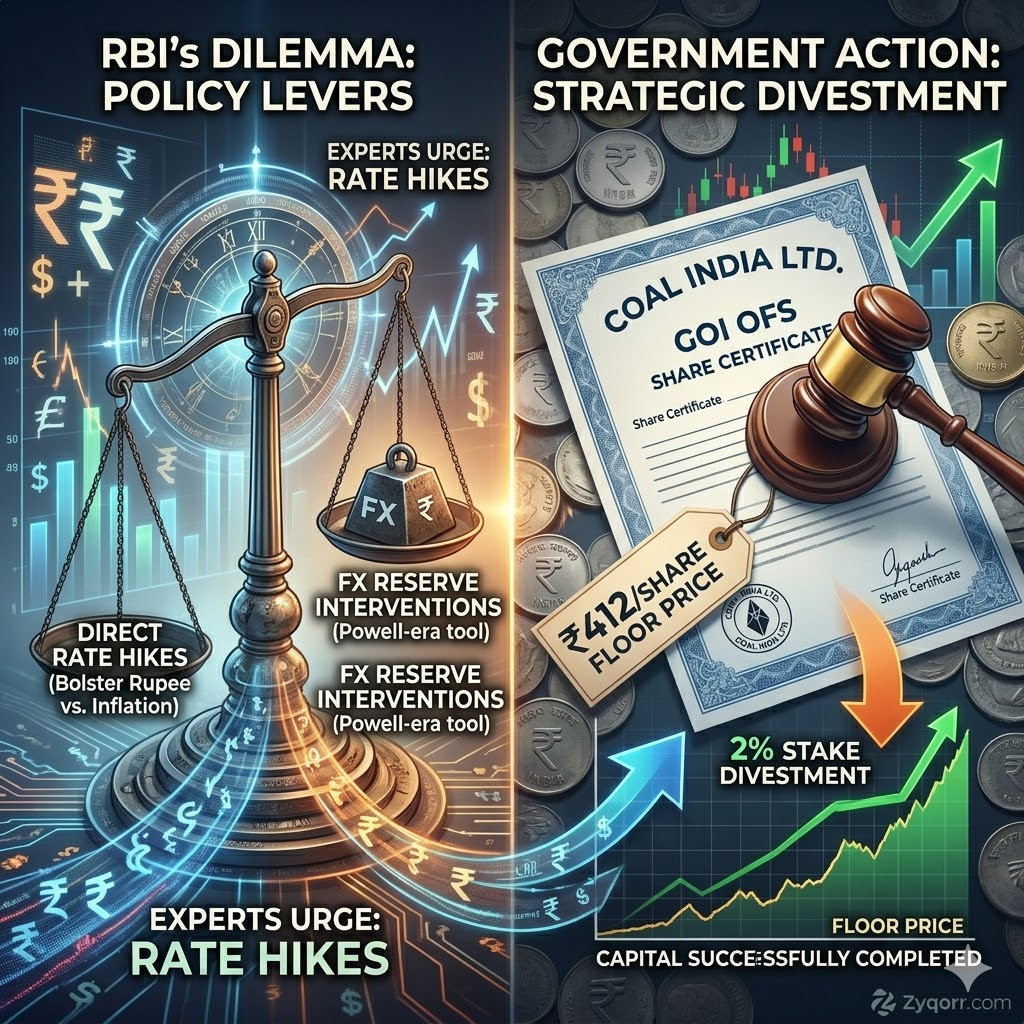
Guided by the Department of Investment and Public Asset Management (DIPAM), the government has initiated an Offer For Sale (OFS) to divest a 2% stake in Coal India Limited. The floor price has been set at an attractive ₹412 per share.
What this means: For the government, it is a move to raise crucial capital to meet fiscal deficit targets and fund infrastructure pipelines. For investors, the ₹412 floor price provides a potentially discounted entry point into a high-dividend-yielding PSU (Public Sector Undertaking), especially attractive in a volatile, inflationary market.
Policy Debates: The RBI’s Dilemma
Perhaps the most critical narrative defining the Indian economic landscape right now is unfolding at the Reserve Bank of India (RBI). The Indian Rupee has faced persistent downward pressure, leading to intense debates among senior financial experts regarding the central bank’s next move.
Historically, the RBI has heavily relied on foreign exchange (FX) reserve interventions—selling dollars to buy Rupees—to stabilize the currency. However, experts are now publicly urging the RBI to consider direct interest rate hikes.
- The Argument for Rate Hikes: Hiking the repo rate would attract foreign bond investors seeking higher yields, naturally bolstering the Rupee. It would also directly combat the approaching 5% inflation mark.
- The Risk: Raising rates in an environment where manufacturing margins are already squeezed by fuel costs could stifle corporate growth and exacerbate the stock market correction.
Practical Examples for Investors
Navigating this complex Indian economic landscape requires pivoting from aggressive growth to defensive value strategies.
- Participating in the OFS: A retail investor seeking stability might allocate capital to the Coal India OFS at the ₹412 floor price. Even if broader index growth stalls, the company’s strong dividend track record provides a reliable cash flow buffer against inflation.
- Sector Rotation: Astute fund managers are actively reducing exposure to logistics-heavy sectors (like cement and traditional manufacturing) due to diesel price hikes. Instead, they are rotating into IT services, which earn in stronger US Dollars and benefit from a depreciating Rupee, naturally hedging against local inflation.
Also Read: How the Stock Market Works (Simple Explanation)
The Balanced View: India’s Current Economic Climate
To maintain a strategic overview, here is a balanced breakdown of the current Indian economic landscape:
| Economic Driver | The Pros (Bullish Factors) | The Cons (Bearish Risks) |
| Market Valuations | The SENSEX correction (down to 76,009) cools off overheated mid-cap valuations, offering better entry points. | Capital outflows show a clear preference for global tech over domestic assets. |
| Corporate Actions | Government OFS (Coal India at ₹412) offers high-yield opportunities for defensive portfolios. | Divestment saps liquidity from the secondary market, temporarily depressing broader indices. |
| RBI & Inflation | The RBI possesses massive FX reserves to prevent a catastrophic Rupee crash. | 5% inflation and potential rate hikes threaten to severely squeeze heavy industry profit margins. |
Conclusion
The Indian economic landscape is fundamentally recalibrating. The SENSEX’s drop to 76,009.70 is a symptom of broader structural challenges, primarily driven by rising fuel costs, localized capital outflows, and the looming threat of 5% inflation. As the RBI weighs the delicate balance between interest rate hikes and FX interventions to save the Rupee, domestic investors must adopt a highly defensive posture. By focusing on value opportunities like the Coal India OFS and avoiding sectors highly sensitive to logistics costs, market participants can successfully weather this period of divergence in the Indian economic landscape.
Financial Disclaimer: The content provided in this article on Zyqorr.com is strictly for educational and informational purposes and does not constitute financial, investment, legal, or tax advice. Market conditions are highly volatile, and past performance is not indicative of future results. Always conduct independent due diligence and consult with a SEBI-registered financial advisor before making any investment decisions.
Frequently Asked Questions (FAQs)
1. Why is the Indian market dropping while global tech stocks are rising?
Global markets are currently driven by a concentrated boom in artificial intelligence and semiconductor manufacturing. India’s indices are more heavily weighted toward traditional banking, manufacturing, and consumer goods. Rising domestic inflation and localized profit-booking by foreign investors have caused the broader Indian economic landscape to diverge and correct.
2. How do petrol and diesel price hikes affect cement companies?
Cement is a high-volume, low-value commodity. A significant portion of its total cost comes from transportation and logistics. When diesel prices rise, freight costs spike immediately, directly eating into the profit margins of cement manufacturers unless they can pass the cost on to consumers.
3. What is an Offer For Sale (OFS), and why is Coal India doing it?
An OFS is a mechanism where promoters (in this case, the Government of India) sell their existing shares directly to the public through the stock exchange. The government is selling a 2% stake in Coal India to raise capital for public spending and to meet its annual divestment targets.
4. Why are experts asking the RBI to raise interest rates to save the Rupee?
When a central bank raises interest rates, it offers higher returns on domestic government bonds. This attracts foreign investors who must buy Rupees to purchase those bonds. The increased demand for the Rupee strengthens its value against foreign currencies like the US Dollar.