Table of Contents
Introduction
Cryptocurrency trading has grown rapidly over the past decade, attracting everyone from curious beginners to professional investors. The rise of digital assets like Bitcoin and Ethereum has transformed the way people think about money, investing, and financial technology. Unlike traditional stock markets, the crypto market operates 24 hours a day, seven days a week, giving traders the flexibility to buy and sell at any time from anywhere in the world.
Many people are drawn to crypto trading because of its accessibility and potential opportunities. You can start with a relatively small amount of money, open an account on a reputable exchange, and begin trading within minutes. At the same time, cryptocurrency prices can be highly volatile, which means the market offers both the possibility of significant gains and the risk of substantial losses.
If you are completely new to cryptocurrency, this beginner’s guide is for you. You do not need a finance degree or previous trading experience to understand the basics. This article explains how crypto trading works in simple language, without unnecessary technical jargon.
By the end of this guide, you will understand:
- What cryptocurrency is and how it works
- What crypto trading means
- How to place your first trade
- Common order types and trading terms
- The main benefits and risks of crypto trading
- Essential risk management tips for beginners
Whether you are interested in trading Bitcoin, Ethereum, or other digital assets, this guide will help you build a solid foundation and make more informed decisions as you begin your crypto
Author Experience
As an active trader and market researcher, I have spent years studying and trading across multiple financial markets, including cryptocurrencies, stocks, forex, and commodities. One of the most important lessons I have learned is that successful trading is not about finding a “perfect” strategy or predicting every market move. It is about managing risk, controlling emotions, and following a consistent trading plan.
In my experience, many beginners focus heavily on profit potential while underestimating the importance of capital preservation. They may overtrade, use too much leverage, or enter positions without a clear stop-loss. These mistakes can lead to avoidable losses and frustration.
The traders who tend to improve over time are those who:
- Start with small position sizes
- Keep detailed trading journals
- Review both winning and losing trades
- Focus on process rather than short-term outcomes
- Continuously invest in their education
This guide is designed to simplify the fundamentals of crypto trading and provide practical, beginner-friendly insights based on real trading principles. Whether you are exploring Bitcoin for the first time or building your own trading strategy, the goal is to help you develop a disciplined and informed approach to the market.
During one period of heightened volatility in Bitcoin, I was reminded that protecting capital is more important than chasing every market move. That experience reinforced the value of disciplined position sizing and predefined stop-loss levels.
For more educational articles, market insights, and trading resources, visit Zyqorr.com.
What Is Cryptocurrency?
Cryptocurrency is a type of digital or virtual currency that exists entirely online. Unlike physical money such as coins and banknotes, cryptocurrencies are stored electronically and can be used to transfer value between people over the internet.
The word “crypto” comes from cryptography, which is the technology used to secure transactions and control the creation of new units. This cryptographic security helps protect the network from fraud and unauthorized changes.
How Cryptocurrency Differs from Traditional Money
Traditional currencies such as the Indian Rupee (INR), U.S. Dollar (USD), and Euro (EUR) are issued and regulated by central banks and governments. These currencies are known as fiat currencies.
Cryptocurrencies are different because they are generally decentralized. This means they operate on distributed computer networks rather than being controlled by a single authority such as a bank or government.
Here are some key differences:
| Traditional Money | Cryptocurrency |
| Issued by central banks | Created and maintained by decentralized networks |
| Transactions often go through banks | Transactions can occur directly between users |
| Banking hours may apply | Markets operate 24/7 |
| Physical and digital forms | Fully digital |
| Government-backed | Value determined by market demand and adoption |
What Is Blockchain Technology?
Most cryptocurrencies run on blockchain technology.
A blockchain is a digital ledger that records all transactions across a network of computers. Each group of transactions is stored in a “block,” and each block is linked to the previous one, forming a chronological chain.
Because the ledger is distributed across many computers, it is difficult to alter past records without consensus from the network. This design improves transparency and security.
In simple terms, blockchain works like a shared online record book that anyone can verify, but no single person can change unilaterally.
Popular Examples of Cryptocurrencies
Bitcoin
The first and most widely recognized cryptocurrency. Bitcoin was introduced in 2009 and is often referred to as digital gold.
Ethereum
A blockchain platform that supports smart contracts and decentralized applications (dApps), in addition to its native cryptocurrency, Ether.
Solana
Known for fast transaction processing and relatively low fees, making it popular for decentralized finance (DeFi) and NFT applications.
Ripple
A digital asset designed to facilitate cross-border payments and improve settlement efficiency for financial institutions.
Why Cryptocurrencies Matter
Cryptocurrencies have introduced new ways to transfer value, build decentralized applications, and access global financial markets. They are also highly volatile, which is one reason traders are attracted to them.
Understanding what cryptocurrency is and how blockchain technology works is an important first step before learning how crypto trading works.
trading journey.
What Is Crypto Trading?
Crypto trading is the process of buying and selling cryptocurrencies in an attempt to profit from changes in their prices. Just like traders buy and sell stocks, currencies, or commodities, crypto traders aim to purchase a digital asset at one price and sell it later at a higher price.
For example, if you buy Bitcoin at $100,000 and sell it at $105,000, your gross profit is $5,000 per Bitcoin before trading fees and taxes.
Crypto trading can involve popular digital assets such as:
- Bitcoin
- Ethereum
- Solana
- Ripple
Because cryptocurrency prices can move significantly over short periods, traders look for opportunities to benefit from both upward and downward price movements.
Investing vs. Trading: What’s the Difference?
Although the terms are sometimes used interchangeably, investing and trading are different approaches.
Investing
Investing typically involves buying a cryptocurrency and holding it for months or years based on the belief that its long-term value may increase.
Example:
- Buying Bitcoin and holding it for several years.
Trading
Trading focuses on shorter-term price movements. A trade may last minutes, hours, days, or weeks.
Example:
- Buying Ethereum during a pullback and selling after a short-term rally.
Quick Comparison
| Investing | Trading |
| Long-term approach | Short- to medium-term approach |
| Fewer transactions | More frequent transactions |
| Based on long-term thesis | Based on price action and timing |
| Requires patience | Requires active monitoring and discipline |
Both approaches involve risk, but trading generally demands more time, planning, and emotional control.
Understanding “Buy Low, Sell High”
The core idea behind trading is simple: buy at a lower price and sell at a higher price.
Example
- You buy 1 Ethereum at $2,500.
- The price rises to $2,700.
- You sell your position.
- Gross profit = $200 (before fees and taxes).
If the price falls after you buy, you may incur a loss if you sell below your entry price.
Can Traders Profit in Falling Markets?
On some platforms, traders can use advanced products such as futures or margin trading to speculate on falling prices. These products carry higher risk and are generally not recommended for beginners until they understand leverage and risk management.
Why People Trade Crypto
Crypto trading appeals to many market participants because:
- The market operates 24/7.
- Prices can be highly volatile.
- Many exchanges allow relatively small starting amounts.
- A wide range of tradable assets is available.
However, volatility increases risk as well as opportunity.
Key Takeaway
Crypto trading is the practice of buying and selling digital assets such as Bitcoin and Ethereum to benefit from price changes. Unlike long-term investing, trading focuses on shorter-term opportunities and requires a clear strategy, disciplined risk management, and an understanding that losses are possible.
How Crypto Trading Works: Step-by-Step
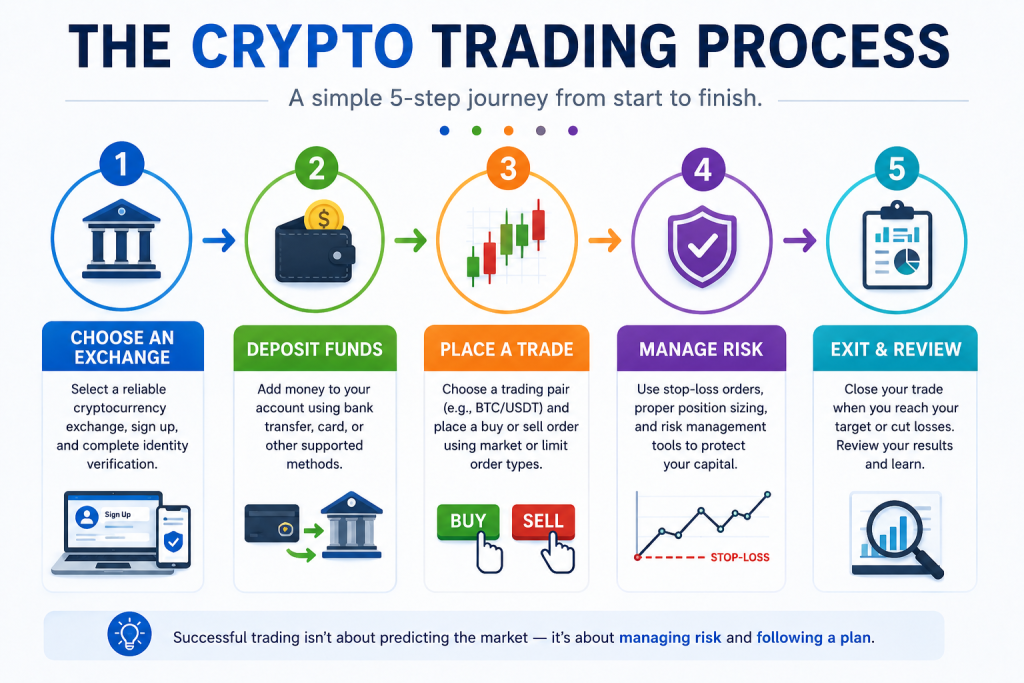
If you are new to cryptocurrency, the trading process may seem complicated at first. In reality, the basic workflow is straightforward: choose an exchange, fund your account, place a trade, and manage your risk.
Here is a simple step-by-step explanation of how crypto trading works.
Step 1: Choose a Crypto Exchange
A crypto exchange is an online platform where you can buy, sell, and store cryptocurrencies. It acts as a marketplace that matches buyers and sellers.
Popular cryptocurrency exchanges include:
When selecting an exchange, consider:
- Security features
- Trading fees
- Supported cryptocurrencies
- Deposit and withdrawal methods
- Regulatory status in your country
- Ease of use for beginners
Choose a reputable platform and review the terms, fees, and available features before opening an account.
Step 2: Create and Verify Your Account
After choosing an exchange, sign up with your email address or mobile number and create a strong password.
Most regulated exchanges require identity verification, commonly known as KYC (Know Your Customer). You may need to provide:
- Government-issued ID
- Selfie or facial verification
- Proof of address in some cases
To improve account security, enable:
- Two-factor authentication (2FA)
- Withdrawal whitelists, if available
- Anti-phishing codes
These steps help protect your funds from unauthorized access.
Step 3: Deposit Funds
Once your account is verified, you can add funds.
Common deposit methods include:
- Bank transfer
- UPI (where supported)
- Debit or credit card
- Depositing cryptocurrency from another wallet
Some traders deposit fiat currency (such as INR or USD), while others transfer stablecoins such as USDT to trade.
Step 4: Choose a Trading Pair
A trading pair shows which asset you are buying and what you are using to pay for it.
Examples:
- Bitcoin/USDT
- Ethereum/USDT
If you buy BTC/USDT, you are purchasing Bitcoin using Tether (USDT), a U.S. dollar-pegged stablecoin.
Step 5: Place an Order
After selecting a trading pair, choose the type of order you want to place.
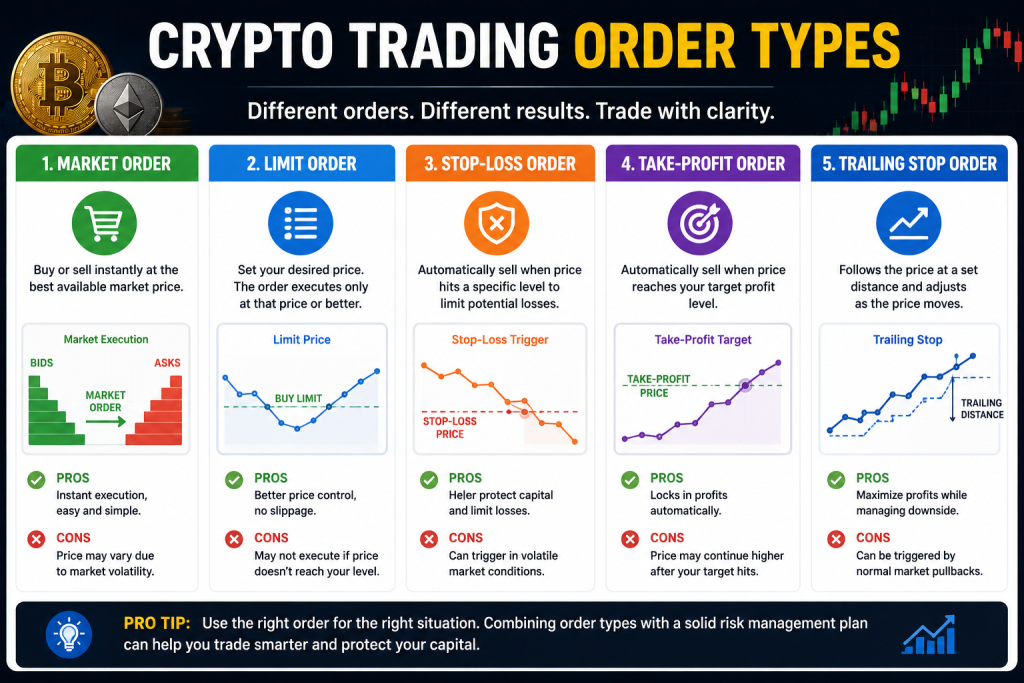
Market Order
Executes immediately at the best available market price.
Best for:
- Beginners
- Fast execution
Limit Order
Allows you to specify the exact price at which you want to buy or sell.
Best for:
- Entering at a specific price
- More control over execution
Stop-Loss Order
Automatically closes a trade if the price moves against you to a predefined level.
Best for:
- Managing risk
- Limiting losses
Step 6: Monitor Your Trade
After your order is executed, monitor your position.
Most exchanges display:
- Entry price
- Current market price
- Unrealized profit or loss (P&L)
Risk management tools commonly used by traders:
- Stop-loss orders to limit downside
- Take-profit orders to lock in gains
Monitoring helps you follow your trading plan and avoid emotional decisions.
Step 7: Close the Trade
When your target is reached or your analysis changes, you can close the trade by selling the cryptocurrency.
Example:
- Buy Bitcoin at $100,000
- Sell at $105,000
- Gross profit: $5,000 per BTC before fees and taxes
If the market moves against you, closing the trade may limit further losses.
Simple Example of a Crypto Trade
- Deposit $1,000 into your exchange account.
- Buy Ethereum using the ETH/USDT pair.
- Set a stop-loss below your entry price.
- Set a take-profit target.
- Sell when your target is reached or if your stop-loss is triggered.
This is the basic process followed by many traders.
Key Takeaway
Crypto trading follows a simple sequence:
- Choose a reputable exchange.
- Verify your account.
- Deposit funds.
- Select a trading pair.
- Place an order.
- Monitor your position.
- Close the trade.
Once you understand these steps, you can begin learning more advanced topics such as chart analysis, trading strategies, and risk management.
Simple Real-Life Example of a Crypto Trade
One of the easiest ways to understand crypto trading is to look at a simple example.
Imagine you believe the price of Bitcoin is likely to rise, so you decide to buy one Bitcoin at $100,000.
A few days later, the market moves in your favor and the price of Bitcoin increases to $105,000. You decide to sell your position and lock in the gain.
Profit Calculation (Before Fees)
| Trade Action | Price |
| Buy Bitcoin | $100,00 |
| Sell Bitcoin | $105,00 |
| Gross Profit | $5,000 |
Formula Used
Profit = Selling Price – Buying Price
In this example:
$105,000 – $100,000 = $5,000
Your gross profit is $5,000 before trading fees, taxes, and any funding costs.
What If the Price Falls?
If Bitcoin drops to $95,000 and you sell at that price, the result is:
$95,000 – $100,000 = -$5,000
You would realize a $5,000 loss before fees.
Trading Fractional Bitcoin
You do not need to buy a full Bitcoin. Most exchanges allow you to purchase a fraction.
For example, if you buy 0.01 BTC:
- Cost at $100,000 = $1,000
- Value at $105,000 = $1,050
- Gross profit = $50 before fees
Key Takeaway
This example illustrates the basic principle of crypto trading: buy at one price and sell at another. If the selling price is higher than your purchase price, you generate a profit. If it is lower, you incur a loss. Managing risk and understanding fees are essential parts of successful trading.
Understanding Trading Fees
Trading fees are one of the most overlooked costs in cryptocurrency trading. Even if you make profitable trades, fees can reduce your returns over time—especially if you trade frequently.
Before placing any trade, it is important to understand the different types of fees charged by crypto exchanges.
Maker and Taker Fees
Most cryptocurrency exchanges use a maker-taker fee model.
Maker Fees
A maker fee applies when you place an order that adds liquidity to the market, typically a limit order that is not filled immediately.
Example:
- You place a buy limit order for Bitcoin at $100,000.
- The current market price is $101,000.
- Your order sits on the order book until the market reaches your price.
Because your order adds liquidity, you are considered a market maker.
Taker Fees
A taker fee applies when you place an order that removes liquidity from the market, such as a market order or a limit order that executes immediately.
Example:
- You submit a market order to buy Ethereum at the current price.
- Your order is matched instantly with existing sell orders.
Because you remove liquidity, you are considered a market taker.
Typical Fee Structure
Maker fees are often lower than taker fees, but the exact rates vary by exchange and trading volume.
| Fee Type | Description | Typical Cost Range* |
| Maker Fee | Adds liquidity | Lower |
| Taker Fee | Removes liquidity | Slightly higher |
*Actual fee rates vary by platform and may change over time.
Deposit Fees
Some exchanges charge fees when you add funds to your account, while others offer free deposits for certain payment methods.
Possible deposit methods include:
- Bank transfer
- UPI (where supported)
- Debit or credit card
- Cryptocurrency transfers
Card purchases may involve higher costs than bank transfers.
Withdrawal Fees
When you withdraw funds, exchanges may charge:
- A flat cryptocurrency network fee
- An exchange processing fee
- Currency conversion charges in some cases
For example, withdrawing Bitcoin to a private wallet requires paying a blockchain network fee.
How Fees Affect Profitability
Fees can materially reduce your net returns.
Example Without Fees
- Buy Bitcoin at $100,000
- Sell at $105,000
- Gross profit = $5,000
Example With Fees
Assume:
- Buy fee = $50
- Sell fee = $50
Net Profit = $5,000 – $50 – $50 = $4,900
Your net profit becomes $4,900 before taxes.
If your trade profit is small, fees can consume a meaningful portion of your gains.
Why Frequent Traders Should Pay Attention to Fees
High-frequency traders may place many trades each week. Even modest fees can accumulate and significantly affect long-term performance.
Many exchanges offer fee discounts for:
- Higher trading volumes
- Holding the exchange’s native token
- Referral or VIP programs
Always review the current fee schedule on your chosen exchange before trading.
Tips to Reduce Trading Costs
- Compare fee structures across exchanges.
- Use limit orders when appropriate.
- Avoid overtrading.
- Consider total costs, including spreads and withdrawal charges.
- Review network fees before transferring funds.
Key Takeaway
Trading fees are a normal part of crypto trading, but they directly affect your profitability. Understanding maker fees, taker fees, deposit fees, and withdrawal fees can help you estimate your true net returns and make more informed trading decisions.
Types of Crypto Trading
There are several ways to trade cryptocurrencies, and each approach comes with different levels of complexity and risk. Understanding the main types of crypto trading can help you choose the method that best matches your experience level and risk tolerance.
For most beginners, spot trading is the simplest and lowest-risk starting point.
Spot Trading
Spot trading involves buying and selling actual cryptocurrencies at the current market price.
When you purchase a coin through spot trading, you own the asset directly. For example, if you buy Bitcoin on the spot market, the Bitcoin is credited to your exchange wallet or personal wallet.
Example of Spot Trading
- Buy 0.01 Bitcoin at $100,000.
- Total cost = $1,000.
- Sell when the price rises to $105,000.
- Gross profit = $50 before fees.
Advantages of Spot Trading
- Easy to understand.
- No borrowing or leverage required.
- Lower risk compared with leveraged products.
- Suitable for beginners.
Risks of Spot Trading
- Asset prices can decline significantly.
- Capital remains exposed to market volatility.
Margin Trading
Margin trading allows you to borrow funds from an exchange to increase your position size.
For example, if you have $1,000 and use 5x leverage, you can control a $5,000 position.
Example of Margin Trading
- Your capital: $1,000.
- Borrowed funds: $4,000.
- Total position size: $5,000.
If the trade moves in your favor, gains are amplified. If the market moves against you, losses are also magnified.
Risks of Margin Trading
- Rapid losses.
- Interest costs on borrowed funds.
- Possibility of liquidation if losses exceed maintenance requirements.
Margin trading is generally more suitable for experienced traders who understand leverage and risk management.
Futures Trading
Futures trading involves buying or selling contracts based on the price of a cryptocurrency rather than purchasing the asset directly.
These contracts allow traders to speculate on both rising and falling prices.
Example
You may open a futures position on Bitcoin without owning actual Bitcoin.
Advantages of Futures Trading
- Ability to profit from upward or downward moves.
- Access to leverage.
- Useful for hedging existing positions.
Risks of Futures Trading
- High volatility.
- Funding costs.
- Liquidation risk.
- Greater complexity.
Because leverage can increase losses quickly, futures trading is considered high risk.
Day Trading vs. Swing Trading
These terms describe how long a trader typically holds a position.
Day Trading
Day traders open and close positions within the same trading day.
Characteristics:
- Short holding periods.
- Frequent decision-making.
- Requires close monitoring.
Swing Trading
Swing traders hold positions for several days or weeks to capture broader market moves.
Characteristics:
- Longer holding periods.
- Less screen time than day trading.
- Focus on larger price swings.
Comparison
| Trading Style | Typical Holding Period | Suitable For |
| Day Trading | Minutes to hours | Active traders |
| Swing Trading | Several days to weeks | Traders with limited daily screen time |
Which Type of Crypto Trading Is Best for Beginners?
For most beginners, spot trading is the most straightforward way to start because:
- You own the underlying asset.
- There is no leverage.
- The mechanics are easier to understand.
After gaining experience, some traders explore swing trading, margin, or futures, but these approaches require a stronger understanding of risk.
Key Takeaway
The main types of crypto trading include:
- Spot Trading: Buying and selling actual cryptocurrencies.
- Margin Trading: Borrowing funds to increase exposure.
- Futures Trading: Trading contracts based on price movements.
- Day Trading: Opening and closing positions within one day.
- Swing Trading: Holding positions for several days or weeks.
If you are new to crypto, starting with spot trading and focusing on risk management is often the most practical approach.
Key Terms Every Beginner Should Know
Before you start trading cryptocurrencies, it is important to understand the basic terminology used on trading platforms. These terms appear frequently on exchanges, charts, and educational resources.
Learning these concepts will help you make more informed trading decisions and better understand how the market works.
Bid
The bid is the highest price a buyer is currently willing to pay for a cryptocurrency.
Example:
- If the highest bid for Bitcoin is $100,000, buyers are willing to purchase Bitcoin at that price.
Think of the bid as the best current buying offer in the market.
Ask
The ask (also called the offer price) is the lowest price a seller is willing to accept.
Example:
- If the lowest ask for Bitcoin is $100,050, sellers are willing to sell Bitcoin at that price.
Think of the ask as the best current selling offer.
Spread
The spread is the difference between the bid and the ask price.
Spread = Ask Price – Bid Price
Example:
- Bid = $100,000
- Ask = $100,050
- Spread = $50
A smaller spread usually indicates a more efficient and liquid market.
Liquidity
Liquidity refers to how easily you can buy or sell an asset without significantly affecting its price.
Highly liquid markets:
- Have many buyers and sellers.
- Offer tighter spreads.
- Allow faster order execution.
Major cryptocurrencies such as Bitcoin and Ethereum typically have higher liquidity than smaller coins.
Volatility
Volatility measures how much and how quickly a price moves.
Cryptocurrencies are known for elevated volatility compared with many traditional assets.
Example:
- A coin rises 10% in one day.
- The same coin falls 8% the next day.
Higher volatility can create opportunities, but it also increases risk.
Leverage
Leverage allows traders to control a larger position using a smaller amount of capital.
Example:
- With $1,000 and 10x leverage, you can control a $10,000 position.
Leverage magnifies both gains and losses and can result in rapid liquidation if the market moves against your position.
Stop-Loss
A stop-loss order automatically exits a trade when the price reaches a predefined level.
Purpose:
- Limit downside risk.
- Help enforce discipline.
Example:
- Buy Bitcoin at $100,000.
- Set a stop-loss at $97,000.
If the market falls to $97,000, the stop-loss order may trigger and close the position.
Take-Profit
A take-profit order automatically closes a trade when a target price is reached.
Purpose:
- Lock in gains.
- Reduce emotional decision-making.
Example:
- Buy Bitcoin at $100,000.
- Set a take-profit at $105,000.
If the market reaches $105,000, the order may execute and realize the gain.
Quick Summary Table
| Term | Simple Meaning |
| Bid | Highest price a buyer is willing to pay |
| Ask | Lowest price a seller is willing to accept |
| Spread | Difference between bid and ask |
| Liquidity | Ease of buying or selling |
| Volatility | Degree of price movement |
| Leverage | Borrowed exposure to increase position size |
| Stop-Loss | Order to limit losses |
| Take-Profit | Order to lock in gains |
Key Takeaway
These core terms form the foundation of crypto trading. Understanding bid, ask, spread, liquidity, volatility, leverage, stop-loss, and take-profit will make it easier to navigate trading platforms and build a disciplined approach to managing risk.
Benefits of Crypto Trading
Cryptocurrency trading has attracted millions of participants worldwide because it offers features that differ from traditional financial markets. While trading always involves risk, the crypto market provides several advantages that make it appealing to beginners and experienced traders alike.
1. 24/7 Market Access
Unlike stock markets that operate only during specific hours, cryptocurrency markets are open 24 hours a day, 7 days a week.
This means you can trade:
- Early in the morning
- Late at night
- On weekends
- During public holidays
For people with full-time jobs or other commitments, this flexibility can be a significant advantage.
2. High Volatility Creates Opportunities
Cryptocurrencies are known for substantial price movements.
Assets such as Bitcoin, Ethereum, and Solana can experience meaningful price changes within a single day.
For traders, volatility can create opportunities to:
- Capture short-term price moves
- Trade breakouts and reversals
- Use different strategies across timeframes
However, higher volatility also increases the risk of loss, so risk management remains essential.
3. Global Accessibility
Crypto trading is available to people in many countries with an internet connection and access to a supported exchange.
Compared with some traditional markets, opening a crypto trading account is often faster and more accessible.
Common requirements include:
- Email address or mobile number
- Identity verification (KYC)
- Deposit funds
This accessibility has helped cryptocurrency become a global market.
4. Low Entry Barriers
You do not need a large amount of capital to start trading.
Most exchanges allow users to buy fractions of cryptocurrencies.
Example:
- You can buy a small portion of Bitcoin rather than purchasing an entire coin.
This makes it possible for beginners to start with modest amounts while they learn.
5. Wide Range of Tradable Assets
The cryptocurrency market includes thousands of digital assets, including:
- Bitcoin
- Ethereum
- Solana
- Ripple
Traders can focus on established assets or research newer projects, depending on their goals and risk tolerance.
6. Advanced Tools and Analytics
Many exchanges and charting platforms offer:
- Real-time price charts
- Technical indicators
- Alerts
- Stop-loss and take-profit orders
Tools from platforms such as TradingView can help traders analyze markets more effectively.
Key Takeaway
Crypto trading offers several advantages, including:
- 24/7 market availability
- Volatility-driven opportunities
- Global access
- Low capital requirements
- A broad range of tradable assets
- Powerful analytical tools
These features make cryptocurrency trading accessible and flexible, but they do not eliminate risk. A disciplined approach and strong risk management remain essential for long-term success.
Risks of Crypto Trading
While cryptocurrency trading offers exciting opportunities, it also involves significant risks. Understanding these risks is essential before committing real money to the market.
A balanced approach to trading means recognizing that potential rewards are accompanied by the possibility of losses.
1. Price Volatility
Cryptocurrency prices can move rapidly in short periods.
Assets such as Bitcoin and Ethereum may experience sharp gains or declines within hours.
Example:
- A coin rises 10% in one day.
- The same coin falls 15% the next day.
This volatility creates trading opportunities, but it can also lead to substantial losses if positions are not managed carefully.
2. Security Risks
Although blockchain technology is designed to be secure, users and exchanges remain vulnerable to operational risks.
Examples include:
- Phishing attacks
- Weak passwords
- Compromised devices
- Exchange outages or breaches
Ways to improve security:
- Use strong, unique passwords.
- Enable two-factor authentication (2FA).
- Verify website URLs before logging in.
- Consider using a hardware wallet for long-term holdings.
Security practices are an important part of protecting your capital.
3. Regulatory Uncertainty
Cryptocurrency regulations continue to evolve around the world.
Changes in laws or policies can affect:
- Exchange availability
- Tax treatment
- Trading restrictions
- Reporting requirements
Before trading, it is wise to understand the rules that apply in your jurisdiction and consult a qualified tax or legal professional if needed.
4. Emotional Decision-Making
Psychology plays a major role in trading performance.
Common emotional mistakes include:
- FOMO (fear of missing out)
- Panic selling
- Revenge trading after losses
- Overconfidence after wins
Emotional decisions can lead to inconsistent results and unnecessary risk.
Using a written trading plan and predefined stop-loss levels can help improve discipline.
5. Leverage Risk
If you use margin or futures trading, leverage can magnify losses as well as gains.
A relatively small adverse price move may result in:
- Large losses
- Margin calls
- Forced liquidation
Beginners often benefit from learning with spot trading before considering leveraged products.
6. Liquidity Risk
Some smaller cryptocurrencies may have limited trading volume.
Low liquidity can lead to:
- Wider spreads
- Slippage
- Difficulty exiting positions at expected prices
This is one reason many beginners focus on more established assets such as Bitcoin and Ethereum.
7. Technology and Operational Risk
Crypto exchanges and blockchain networks can experience:
- Temporary outages
- Delayed withdrawals
- Network congestion
- Execution issues
These events may affect your ability to enter or exit trades when planned.
Key Takeaway
The main risks of crypto trading include:
- Price volatility
- Security threats
- Regulatory uncertainty
- Emotional decision-making
- Leverage-related losses
- Liquidity constraints
- Operational disruptions
Understanding these risks can help you approach the market more realistically and develop a disciplined trading plan. Never trade money you cannot afford to lose, and prioritize risk management over the pursuit of quick profits.
Basic Risk Management Tips
Risk management is one of the most important aspects of successful crypto trading. Even experienced traders have losing trades. The goal is not to avoid losses entirely, but to keep them small enough so that no single trade significantly damages your account.
By controlling risk, you improve your ability to stay in the market long enough to learn and refine your strategy.
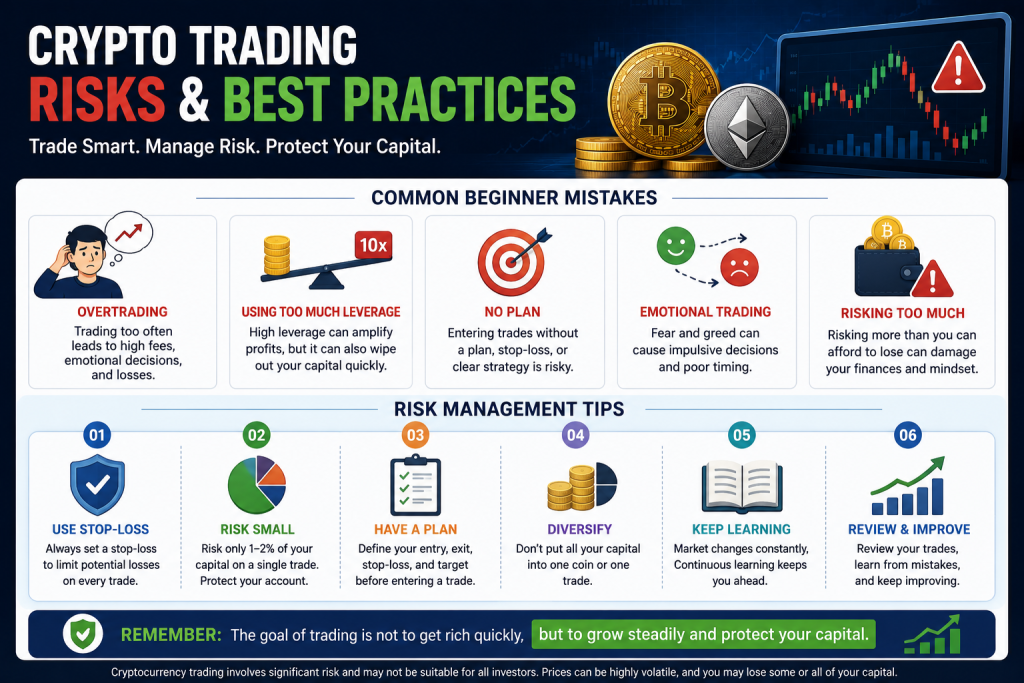
1. Never Risk More Than 1–2% Per Trade
A common guideline is to risk only a small portion of your trading capital on any single trade.
For example:
- Trading account size: $10,000
- Maximum risk per trade: 1%
- Maximum acceptable loss: $100
$10,000 x 1% = $100
This approach helps protect your account from large drawdowns during losing streaks.
2. Always Use Stop-Loss Orders
A stop-loss order automatically exits a trade if the market reaches a predefined price.
Benefits of using a stop-loss:
- Limits potential losses
- Reduces emotional decision-making
- Helps enforce discipline
Example:
- Buy Bitcoin at $100,000
- Set a stop-loss at $98,000
If the price falls to $98,000, the order may close the trade and limit the loss.
3. Avoid Over-Leveraging
Leverage increases both potential gains and potential losses.
Example:
- Using 20x leverage means a 5% adverse move can significantly impact your position and may trigger liquidation, depending on the platform’s margin rules.
Many beginners underestimate how quickly leveraged positions can lose value. Starting with spot trading or low leverage can reduce this risk.
4. Diversify Your Exposure
Avoid concentrating all of your capital in a single asset or strategy.
Diversification may include:
- Trading more than one cryptocurrency
- Holding a portion of capital in cash or stablecoins
- Using different timeframes or strategies
Diversification does not eliminate risk, but it can reduce dependence on one position.
5. Keep a Trading Journal
A trading journal helps you track:
- Entry and exit prices
- Position size
- Reasons for taking the trade
- Emotions and observations
- Lessons learned
Reviewing your trades over time can help identify patterns and improve decision-making.
6. Maintain a Favorable Risk-to-Reward Ratio
Many traders seek setups where the potential reward is larger than the potential risk.
Example:
- Risk: $100
- Potential reward: $300
Risk-to-Reward Ratio = 1:3
A favorable risk-to-reward ratio can help offset inevitable losing trades.
7. Accept That Losses Are Part of Trading
No strategy wins on every trade.
Professional traders focus on:
- Following their process
- Managing risk consistently
- Evaluating performance over many trades
Small, controlled losses are a normal cost of participating in the market.
Key Takeaway
Basic risk management principles include:
- Risking only 1–2% of your capital per trade
- Using stop-loss orders
- Avoiding excessive leverage
- Diversifying exposure
- Keeping a detailed trading journal
- Maintaining favorable risk-to-reward setups
These practices can help you protect your capital and build a more disciplined approach to crypto trading.
Best Cryptocurrencies for Beginners

If you are just starting your crypto trading journey, it often makes sense to focus on well-established cryptocurrencies with strong liquidity, large market capitalization, and broad exchange support.
While no cryptocurrency is risk-free, beginner-friendly assets tend to have:
- Higher trading volume
- Better liquidity
- More educational resources
- Wider adoption
Here are three widely followed cryptocurrencies that many beginners choose to study first.
Bitcoin
Bitcoin is the first and most recognized cryptocurrency.
Created in 2009, Bitcoin is often referred to as “digital gold” because many investors view it as a store of value.
Why Beginners Start with Bitcoin
- Largest cryptocurrency by market capitalization
- High liquidity and global recognition
- Supported by nearly all major exchanges
- Extensive educational content available
Things to Consider
- Price can still be highly volatile
- A full Bitcoin is expensive, but fractional purchases are possible
Bitcoin is commonly the first cryptocurrency beginners research and trade.
Ethereum
Ethereum is the second-largest cryptocurrency by market capitalization and powers a large ecosystem of decentralized applications.
Its blockchain supports:
- Smart contracts
- Decentralized finance (DeFi)
- NFTs
- Blockchain-based applications
Why Beginners Consider Ethereum
- Strong adoption and developer ecosystem
- High liquidity
- Widely available on major exchanges
Things to Consider
- Transaction costs can vary depending on network activity
- Price remains volatile
Ethereum is often studied alongside Bitcoin because of its central role in the crypto ecosystem.
Solana
Solana is a blockchain platform designed for fast transaction processing and relatively low fees.
It has become popular among developers and traders involved in DeFi and NFTs.
Why Some Beginners Explore Solana
- Fast transaction speeds
- Lower fees compared with some networks
- Growing ecosystem
Things to Consider
- Greater relative risk compared with more established assets
- Price can be volatile
Solana may appeal to beginners who want exposure beyond Bitcoin and Ethereum.
Why Start with Large-Cap Cryptocurrencies?
Many beginners prefer established cryptocurrencies because they typically offer:
- Better liquidity
- Narrower spreads
- Greater market transparency
- More reliable educational resources
These characteristics can make the trading experience easier to understand.
Important Reminder
Popularity does not guarantee future performance. All cryptocurrencies can experience significant price swings, and past performance does not ensure future results.
Before buying any digital asset:
- Research the project thoroughly.
- Understand the risks.
- Invest only what you can afford to lose.
Key Takeaway
Three commonly studied cryptocurrencies for beginners are:
- Bitcoin
- Ethereum
- Solana
These assets are widely traded, highly liquid, and supported by many exchanges, making them practical starting points for learning how cryptocurrency markets work.
Tools and Resources for Crypto Traders
Successful crypto trading is not just about choosing the right coins. It also involves using reliable tools to analyze price charts, research projects, track market data, and continue learning.
Below are some of the most useful resources for beginners and experienced traders.
TradingView – Advanced Charting and Technical Analysis
TradingView is one of the most widely used charting platforms in the financial industry.
It allows traders to:
- View real-time price charts
- Use technical indicators such as RSI, MACD, and Moving Averages
- Draw trendlines and support/resistance zones
- Set price alerts
- Follow ideas shared by other traders
Whether you trade Bitcoin, Ethereum, or other assets, TradingView is a valuable analysis tool.
CoinMarketCap – Market Data and Rankings
CoinMarketCap provides real-time information on thousands of cryptocurrencies.
You can use it to track:
- Current prices
- Market capitalization
- 24-hour trading volume
- Circulating supply
- Historical performance
- Exchange listings
It is a useful starting point for understanding how different cryptocurrencies compare.
CoinGecko – Cryptocurrency Research
CoinGecko offers comprehensive market data and project-level insights.
Features include:
- Price and volume statistics
- Project descriptions
- Community and developer metrics
- Links to official websites and whitepapers
Many traders use CoinGecko as part of their research process.
Zyqorr.com – Educational Content for Traders
Zyqorr.com is your educational platform for learning about:
- Crypto trading
- Forex and stock markets
- Technical analysis
- Risk management
- Trading psychology
- AI tools for traders
The goal is to provide practical, beginner-friendly content to help traders build knowledge and discipline over time.
Additional Useful Resources
Other tools that may be helpful include:
- Exchange fee pages
- Economic calendars
- Trading journals
- Portfolio trackers
- Security tools such as password managers and hardware wallets
Key Takeaway
Reliable tools can make a meaningful difference in your trading process. Some of the most useful resources include:
- TradingView for charting and technical analysis
- CoinMarketCap for market data
- CoinGecko for project research
- Zyqorr.com for educational content
Using these tools can help you analyze markets, conduct research, and continue developing your trading skills.
Common Beginner Mistakes to Avoid
Most new traders make mistakes in the beginning. That is a normal part of the learning process. The key is to recognize common pitfalls early and build habits that protect your capital.
Below are some of the most frequent mistakes beginners make when trading cryptocurrencies.
1. Trading Without a Plan
Entering trades without a clear strategy is one of the most common errors.
A trading plan should define:
- Entry criteria
- Stop-loss level
- Profit target
- Position size
- Risk-to-reward ratio
Without a plan, decisions are often driven by emotions rather than logic.
Example: Buying Bitcoin simply because the price is moving higher, without knowing where to exit.
2. Chasing Pumps
“Chasing a pump” means buying after a cryptocurrency has already risen sharply because of excitement or fear of missing out (FOMO).
This can be risky because:
- Prices may reverse quickly.
- Late buyers may enter near short-term highs.
- Volatility can increase significantly.
A more disciplined approach is to wait for a planned setup rather than reacting impulsively.
3. Ignoring Trading Fees
Many beginners focus only on price movements and overlook fees.
Costs can include:
- Maker and taker fees
- Deposit fees
- Withdrawal fees
- Network fees
Frequent trading can cause these expenses to add up and reduce net profitability.
Always factor fees into your trade planning.
4. Using Too Much Leverage
Leverage can amplify gains, but it also magnifies losses.
A small adverse price move may lead to:
- Large losses
- Liquidation
- Emotional stress
Beginners often benefit from learning through spot trading before considering leveraged products.
5. Investing Money You Cannot Afford to Lose
Cryptocurrency markets are highly volatile.
Only use capital that you can afford to lose without affecting essential expenses such as:
- Rent
- Food
- Bills
- Emergency savings
Using borrowed money or funds needed for daily life increases financial and emotional pressure.
6. Overtrading
Taking too many trades can lead to:
- Higher fees
- Reduced focus
- Emotion-driven decisions
Quality is usually more important than quantity.
7. Neglecting Risk Management
Failing to use stop-loss orders or risking too much on one trade can damage an account quickly.
Consistent risk management is often more important than finding the “perfect” entry.
8. Not Keeping a Trading Journal
Without a record of past trades, it becomes difficult to identify:
- Strengths
- Mistakes
- Recurring emotional patterns
A journal can accelerate learning and improve decision-making.
Key Takeaway
Common beginner mistakes include:
- Trading without a plan
- Chasing pumps
- Ignoring fees
- Using excessive leverage
- Investing money you cannot afford to lose
- Overtrading
- Skipping risk management
- Failing to keep a trading journal
Avoiding these mistakes can help you protect your capital and build a more disciplined approach to crypto trading.
Also Read: What is Cryptocurrency? Beginner’s Guide (2026) – Everything You Need to Know
Frequently Asked Questions (FAQ)
Is Crypto Trading Legal?
Cryptocurrency trading is legal in many countries, but regulations vary by jurisdiction and may change over time.
Before opening an account, you should:
- Check the laws and tax rules in your country.
- Use exchanges that are authorized to serve users in your region.
- Maintain records of your transactions for tax reporting purposes.
Because regulations evolve, consult official government sources or a qualified legal or tax professional if you need guidance specific to your situation.
How Much Money Do I Need to Start?
You can start crypto trading with a relatively small amount of money.
Many exchanges allow you to buy fractions of cryptocurrencies, so you do not need to purchase a full Bitcoin or Ethereum.
Some beginners choose to start with modest amounts while they learn how the market works and practice risk management.
Only trade capital you can afford to lose.
Can Beginners Make Money in Crypto?
It is possible for beginners to make money, but there is also a meaningful risk of losses.
Trading outcomes depend on:
- Market conditions
- Risk management
- Discipline
- Experience
New traders often benefit from focusing on education and consistency rather than expecting quick profits.
There are no guaranteed returns in crypto trading.
What Is the Safest Exchange?
No exchange can eliminate risk entirely, but many traders prefer established platforms with:
- Strong security practices
- Regulatory compliance where applicable
- Proof of reserves or transparency initiatives
- Good reputation and customer support
Examples of widely used exchanges include:
Always conduct your own due diligence before choosing an exchange.
Is Crypto Trading Risky?
Yes. Cryptocurrency trading is inherently risky.
Major risks include:
- High price volatility
- Security threats
- Regulatory changes
- Emotional decision-making
- Leverage-related losses
Because prices can move rapidly, you may lose part or all of your trading capital.
Using stop-loss orders and sound position sizing can help manage risk, but they do not eliminate it.
Key Takeaway
Crypto trading is accessible to beginners, but it requires education, discipline, and a realistic understanding of risk. Start small, focus on learning, and prioritize capital preservation over the pursuit of quick profits.
Final Thoughts
Crypto trading may seem complex at first, but the core concept is straightforward: you buy a cryptocurrency such as Bitcoin or Ethereum, monitor price movements, and sell when you decide to take a profit or limit a loss.
In this guide, you learned:
- What cryptocurrency is and how blockchain technology works
- How crypto trading works step by step
- Common order types and key trading terms
- The benefits and risks of crypto trading
- Practical risk management techniques
- Useful tools and resources for traders
If you are a beginner, there is no need to start with large amounts of capital. Many successful traders begin with small positions while they focus on learning how markets behave and how to manage risk effectively.
The most important objective in the early stages is not maximizing profits. It is building knowledge, developing discipline, and protecting your trading capital.
Remember these core principles:
- Start small.
- Use stop-loss orders.
- Risk only a small percentage of your capital per trade.
- Keep a trading journal.
- Continue learning and refining your approach.
Crypto markets offer opportunities, but they also involve significant uncertainty and volatility. Traders who approach the market with patience, realistic expectations, and disciplined risk management are generally better positioned to navigate both winning and losing periods.
Keep learning, stay objective, and focus on consistency over time.
For more beginner-friendly trading education, market insights, and practical guides, visit Zyqorr.com.
Risk Disclaimer
Cryptocurrency trading involves substantial risk and may not be suitable for every investor. Digital assets such as Bitcoin, Ethereum, and other cryptocurrencies can experience extreme price volatility, and it is possible to lose some or all of your invested capital.
The information provided in this article is for educational and informational purposes only and should not be considered financial, investment, legal, or tax advice. Nothing in this content constitutes a recommendation to buy, sell, or hold any cryptocurrency or other financial instrument.
Before making any investment or trading decision, consider your financial objectives, level of experience, and risk tolerance. If necessary, consult a qualified financial advisor, tax professional, or legal expert who can provide guidance tailored to your individual circumstances.
Past performance is not indicative of future results. Always conduct your own research and never invest money you cannot afford to lose.