Learn Trading: Getting Started – A Beginner’s Guide to Financial Markets
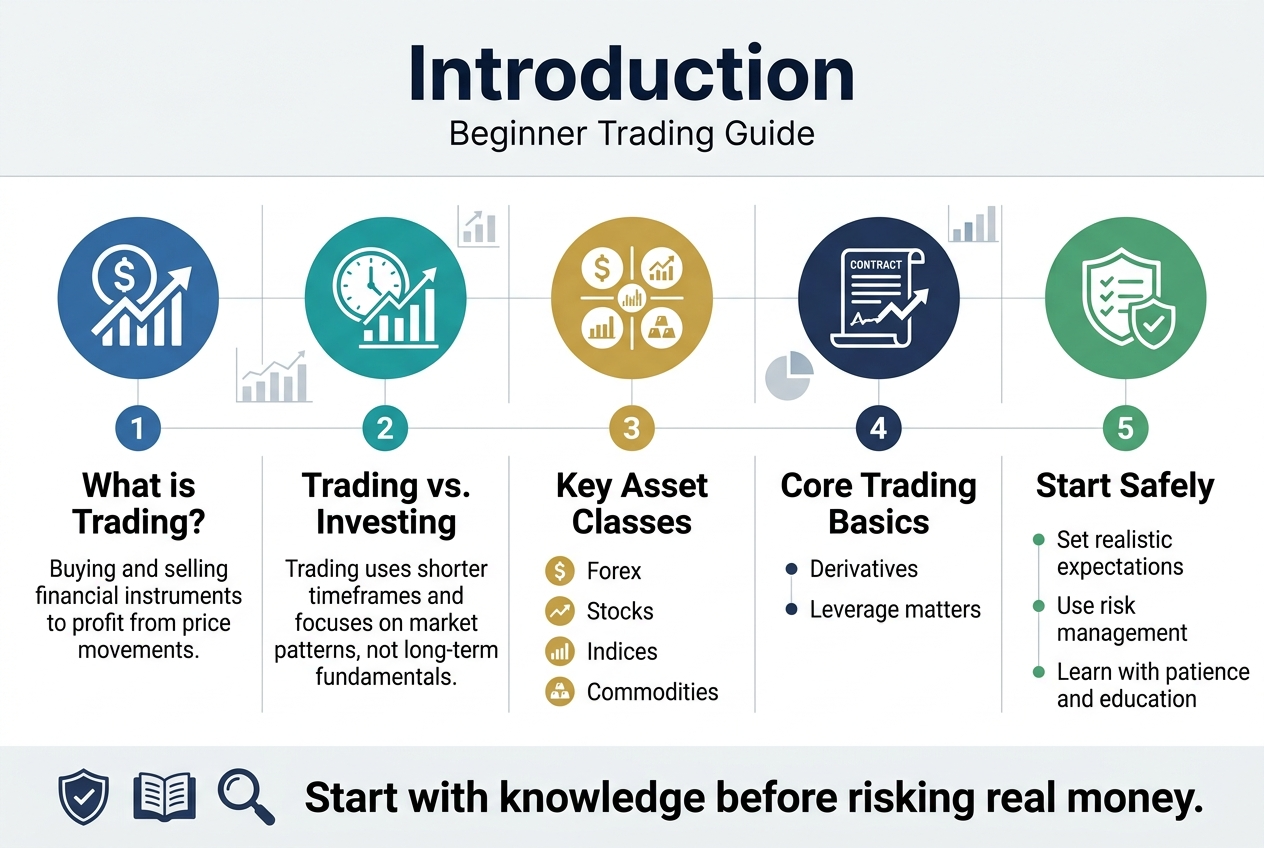
The financial markets can seem intimidating at first, but understanding the basics is your first step toward becoming a confident trader. This beginner trading guide is designed for anyone who wants to learn trading basics without getting overwhelmed by complex jargon or unrealistic promises.
Trading simply means buying and selling financial instruments to profit from price movements. Unlike long-term investing, trading often involves shorter timeframes and focuses on market patterns rather than company fundamentals. With the right approach, beginners can start learning how financial markets work while managing their risk effectively.
In this comprehensive guide, we’ll walk through the essential asset classes for new traders, including forex, stocks, indices, and commodities, so you know where to focus your attention first. We’ll also cover trading fundamentals like how derivatives work and why leverage matters, giving you a solid foundation to build upon. Finally, we’ll help you set realistic trading expectations and show you how to start trading safely with proper risk management strategies.
Getting started doesn’t have to be complicated, but it does require patience, education, and a clear understanding of what you’re getting into before you risk real money.
Understanding Trading Fundamentals
What Trading Means and How It Works
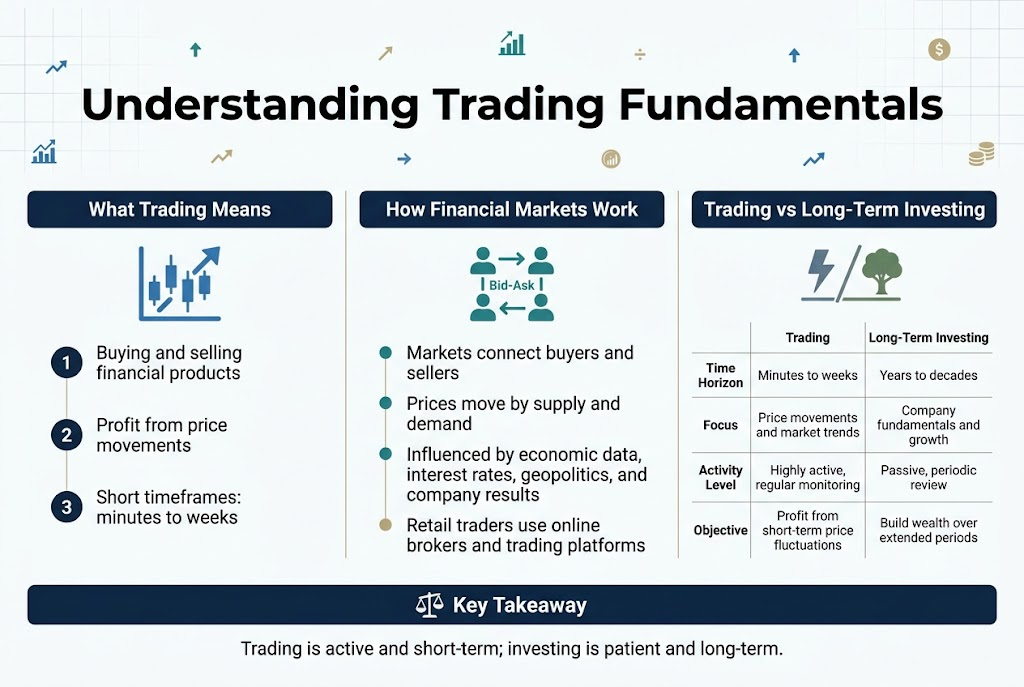
Trading is the act of buying and selling financial products to make a profit from price movements. This fundamental concept forms the backbone of modern financial markets and represents an active approach to generating returns through strategic market participation.
Unlike traditional investing approaches, trading often involves shorter timeframes, ranging from minutes and hours to days or weeks. This compressed timeline requires traders to develop a keen understanding of market dynamics and maintain constant awareness of price fluctuations. The core objective remains consistent: capitalize on price movements to generate profits through well-timed buy and sell decisions.
Successful traders focus on multiple analytical approaches including market trends, price patterns, economic news, and technical analysis. This multi-faceted approach enables them to identify potential opportunities and make informed decisions about when to enter or exit positions. The combination of these analytical tools creates a comprehensive framework for understanding market behavior and predicting potential price movements.
How Financial Markets Connect Buyers and Sellers
Financial markets serve as sophisticated platforms that connect buyers and sellers of assets, with prices moving dynamically based on supply and demand principles. This connection mechanism ensures efficient price discovery and provides liquidity for market participants seeking to trade various financial instruments.
Markets are continuously influenced by multiple factors including economic data releases, interest rate decisions, geopolitical events, and company performance metrics. These influences create constant price fluctuations that present opportunities for traders to profit from market movements.
Retail traders access these markets through online brokers or specialized trading platforms, allowing them to speculate on price changes without necessarily owning the underlying asset. This accessibility has democratized trading, enabling individual investors to participate in global markets previously reserved for institutional players.
Key Differences Between Trading and Long-Term Investing
The distinction between trading and long-term investing represents two fundamentally different approaches to wealth building through financial markets. Understanding these differences is crucial for beginners developing their market strategy.
| Aspect | Trading | Long-Term Investing |
|---|---|---|
| Time Horizon | Minutes to weeks | Years to decades |
| Focus | Price movements and market trends | Company fundamentals and growth |
| Activity Level | Highly active, regular monitoring | Passive, periodic review |
| Objective | Profit from shorter-term price fluctuations | Build wealth over extended periods |
Investing generally focuses on building wealth over time by holding assets for years or decades, prioritizing company fundamentals and long-term growth potential. This approach requires patience and conviction in the underlying value of selected investments.
Trading, conversely, is more active and short-term, aiming to profit from smaller price movements. This approach requires regular market monitoring, clear risk management protocols, and a strong understanding of market behavior patterns. Traders must develop the discipline to act quickly on opportunities while maintaining strict risk controls.
The choice between trading and investing depends on individual goals, risk tolerance, and time commitment capabilities. Both approaches have merit, but they require different skill sets, mindsets, and dedication levels to execute successfully.
Essential Asset Classes for New Traders
Foreign Exchange (Forex) Currency Trading
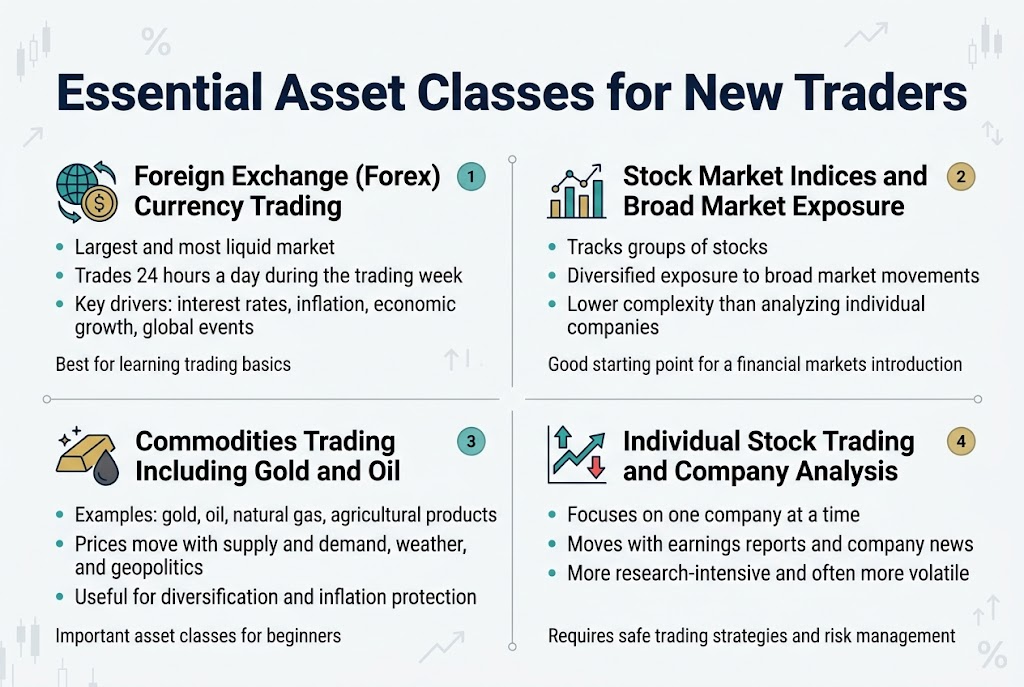
Forex (FX) involves buying one currency and selling another, representing the largest and most liquid financial market in the world. This market operates 24 hours a day during the trading week, making it an attractive option for those learning trading basics as part of their beginner trading guide journey. The continuous nature of forex trading allows new traders to practice and develop their skills across different market sessions.
Currency prices are significantly affected by several key economic factors including interest rates, inflation, economic growth, and global events. Understanding these fundamental drivers is essential for anyone following a beginner investment guide, as they directly impact currency valuations and create trading opportunities in the foreign exchange market.
Stock Market Indices and Broad Market Exposure
Indices monitor the performance of a group of stocks, providing exposure to broader market movements rather than focusing on individual companies. This approach offers trading for beginners an excellent way to gain diversified market exposure while reducing the complexity of analyzing individual securities. Index trading allows new traders to participate in overall market trends without requiring extensive research into specific companies.
For those seeking a financial markets introduction, indices serve as an ideal starting point due to their inherent diversification and reduced volatility compared to individual stocks. They provide a clearer picture of market sentiment and economic health across entire sectors or economies.
Commodities Trading Including Gold and Oil
Commodities include assets such as gold, oil, natural gas, and agricultural products, with their prices often affected by supply and demand dynamics, weather conditions, and geopolitical developments. These fundamental factors make commodities an important asset classes for beginners to understand, as they respond to different market forces than traditional financial securities.
Commodities are commonly used to diversify trading strategies, providing portfolio balance and potential protection against inflation. The tangible nature of these assets offers traders exposure to real-world economic factors and global supply chains.
Individual Stock Trading and Company Analysis
Stock trading involves speculating on the price movements of individual companies, with prices reacting to earnings reports, company announcements, and wider market sentiment. This form of trading requires more intensive research and analysis compared to other asset classes, making it crucial for those following safe trading strategies to thoroughly understand company fundamentals before investing.
Stock trading can be more volatile, particularly around major news events such as earnings releases or significant corporate announcements. This volatility presents both opportunities and risks for new traders, emphasizing the importance of proper risk management and thorough preparation when engaging with individual equity markets.
Trading Mechanisms and Derivatives
Understanding Derivatives and How They Work
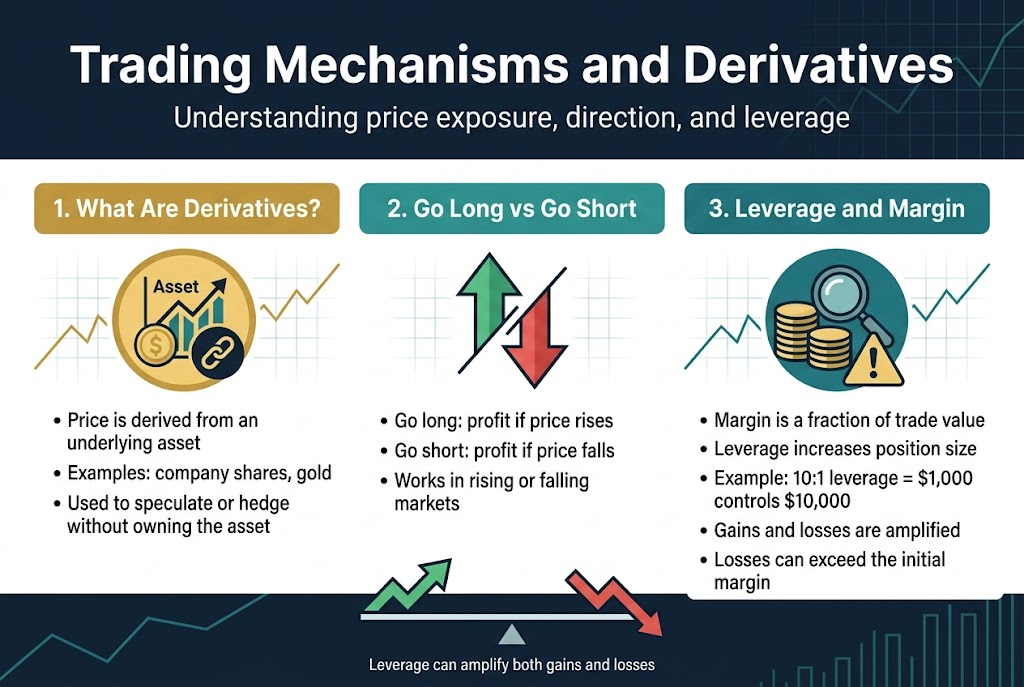
Financial instruments used to trade on an asset’s price movements are known as ‘derivatives’. These sophisticated trading tools have become fundamental components of modern financial markets, offering traders alternative ways to engage with various assets without directly owning them.
A derivative’s price is ‘derived’ from the price of the underlying asset, such as a company share or an ounce of gold. This relationship means that when the underlying asset’s price fluctuates, the derivative’s value changes correspondingly. For beginners learning trading basics, understanding this connection is crucial as it forms the foundation of how derivatives function in financial markets.
Derivatives essentially allow traders to speculate on price movements or hedge existing positions without the need to purchase the actual underlying asset. This characteristic makes them particularly attractive for those looking to diversify their trading strategies or access markets that might otherwise be difficult or expensive to enter directly.
Going Long vs Short for Profit Opportunities
With derivatives trading, you can ‘go long’ (make a profit if the market’s price rises) or ‘go short’ (make a profit if the market’s price falls), as long as your prediction is correct. This dual-direction capability represents one of the most significant advantages of derivatives trading for beginners entering financial markets.
When you go long, you’re essentially betting that the asset’s price will increase over time. Conversely, going short means you’re predicting that the asset’s price will decrease. This flexibility allows for profit opportunities from both upward and downward market movements, providing traders with strategic options regardless of market conditions.
This bidirectional profit potential is particularly valuable during volatile market periods or economic uncertainty, where traditional buy-and-hold strategies might face challenges. For those developing safe trading strategies, understanding both long and short positions enables more comprehensive risk management approaches.
Leverage and Margin Trading Benefits and Risks
Leverage means putting down a fraction of the total value of your trade as a deposit, known as ‘margin’. This mechanism is one of the most powerful yet dangerous tools available in derivatives trading, requiring careful consideration for anyone developing a beginner trading guide approach.
Leverage can stretch your capital further, allowing you to open large positions for a smaller initial amount. For example, with 10:1 leverage, a trader could control a $10,000 position with just $1,000 in margin. This amplification effect can significantly enhance potential returns when trades move in the predicted direction.
However, total profits or losses with leverage are calculated based on the full position’s value, not just the margin paid, meaning you can make or lose far more than your initial margin, indicating a built-in risk. This characteristic makes leverage a double-edged sword that can amplify both gains and losses proportionally.
The risk inherent in leveraged trading cannot be overstated. While it offers the potential for substantial profits, it equally presents the possibility of significant losses that can exceed the initial investment. For beginners learning trading fundamentals, understanding this risk-reward dynamic is essential before engaging with leveraged products.
Setting Realistic Trading Expectations
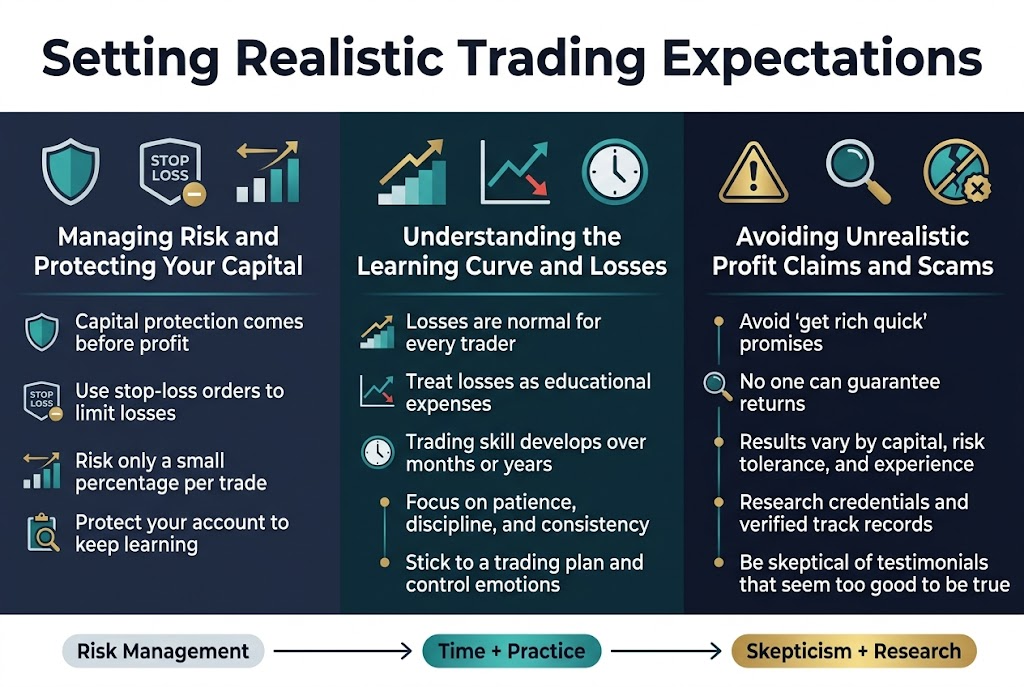
Managing Risk and Protecting Your Capital
Risk management serves as the foundation of successful trading, particularly for those following a beginner trading guide. Capital protection should take priority over profit generation, as preserving your trading account allows you to continue learning and developing your skills. Successful traders understand that protecting capital is not just about avoiding losses—it’s about creating sustainable trading practices that enable long-term participation in financial markets.
Stop-loss orders represent one of the most critical tools for risk management. These automated orders close your position when the market moves against you by a predetermined amount, limiting potential losses before they become devastating. Position sizing is equally important, as it determines how much capital you risk on each trade. Professional traders typically risk only a small percentage of their total capital on any single trade, ensuring that even a series of losses won’t eliminate their ability to continue trading.
Understanding the Learning Curve and Losses
Trading for beginners involves accepting that losses are a normal and inevitable part of the learning process. Every trader, regardless of their eventual success, experiences losses during their journey. This reality requires a fundamental shift in mindset—viewing losses not as failures, but as educational expenses that contribute to your trading education.
The learning curve in trading demands significant time, discipline, and ongoing education. Unlike other skills where progress might be immediately apparent, trading proficiency develops gradually through consistent practice and continuous learning. Beginners must understand that becoming proficient requires months or even years of dedicated effort. This timeline includes learning technical analysis, understanding market psychology, developing emotional control, and refining trading strategies through real market experience.
Patience and consistency prove far more valuable than attempting to achieve quick profits. The most successful traders focus on developing reliable processes rather than chasing immediate returns. This approach requires emotional control and the discipline to stick to predetermined trading plans, even when market conditions seem to offer tempting opportunities outside your strategy.
Avoiding Unrealistic Profit Claims and Scams
The trading industry unfortunately attracts numerous individuals and organizations making unrealistic profit claims. Beginners must exercise extreme caution when encountering advertisements or courses promising guaranteed returns or “get rich quick” schemes. Legitimate trading requires substantial skill development, thorough preparation, and exceptional emotional control—none of which can be achieved overnight or through simple formulas.
Trading results vary dramatically between individuals based on factors including available capital, risk tolerance, time commitment, and natural aptitude for market analysis. What works for one trader may not work for another, making it impossible for anyone to guarantee specific profit percentages or timeframes for success.
Safe trading strategies begin with realistic expectations and skepticism toward extraordinary claims. Before committing to any educational program or trading system, research the provider’s credentials, look for verified track records, and be wary of testimonials that seem too good to be true. Remember that successful trading is a skill that develops over time through education, practice, and experience—not through shortcuts or secret formulas.
Getting Started with Trading Safely
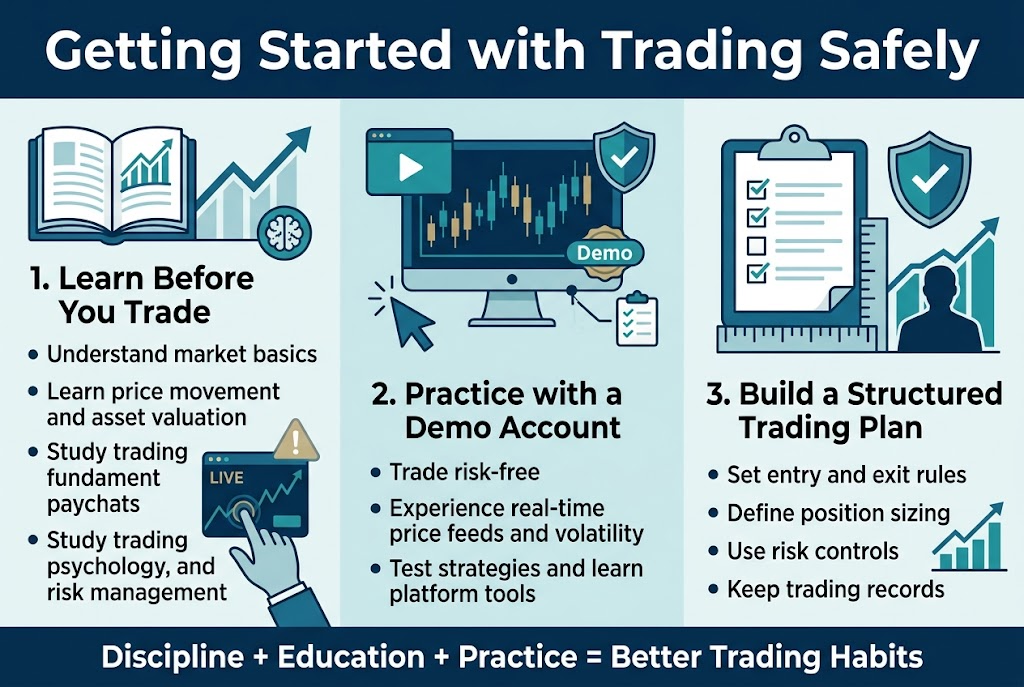
Importance of Education Before Live Trading
Now that we have covered the fundamental aspects of trading and market mechanisms, it’s crucial to understand that education should come before live trading. This principle forms the cornerstone of successful trading for beginners seeking to build a sustainable trading career.
Learning how markets work represents a crucial first step that cannot be overlooked. Many novice traders make the critical error of jumping into live markets without understanding basic market dynamics, price movements, or the factors that drive asset valuations. This foundational knowledge serves as the bedrock upon which all successful trading strategies are built.
The temptation to start trading immediately with real money is understandable, especially when markets appear to be moving favorably. However, rushing into live trading without proper education often leads to costly mistakes that could have been easily avoided through dedicated learning. Understanding trading fundamentals, market psychology, and risk management principles before risking real capital is essential for long-term success.
Using Demo Accounts for Practice
With this educational foundation in mind, practising trading with a free demo account is highly recommended for all beginners. Demo accounts provide an invaluable opportunity to apply theoretical knowledge in a risk-free environment, allowing new traders to experience real market conditions without the financial consequences.
Using demo accounts for practice can help build confidence and reduce avoidable mistakes that commonly plague inexperienced traders. These practice environments replicate live market conditions, including real-time price feeds, order execution, and market volatility, providing an authentic trading experience without financial risk.
The benefits of demo trading extend beyond simple practice. It allows beginners to test different trading strategies, understand platform functionality, and develop muscle memory for executing trades efficiently. This hands-on experience proves invaluable when transitioning to live trading, as traders have already familiarized themselves with the mechanics and emotional aspects of trade execution.
Developing a Structured Trading Approach
Previously, we’ve established the importance of education and practice, but developing a structured trading approach can make a significant difference in navigating fast-moving financial markets. This systematic approach involves creating clear rules, procedures, and guidelines that govern every aspect of your trading activities.
Approaching trading with discipline rather than speculation distinguishes successful traders from those who treat markets like gambling. A structured approach includes defining entry and exit criteria, establishing position sizing rules, setting risk management parameters, and maintaining detailed trading records for continuous improvement.
This disciplined framework helps traders remain objective during volatile market conditions and prevents emotional decision-making that often leads to poor trading outcomes. By following a predetermined set of rules and procedures, beginner traders can maintain consistency in their approach while building the habits necessary for long-term trading success.
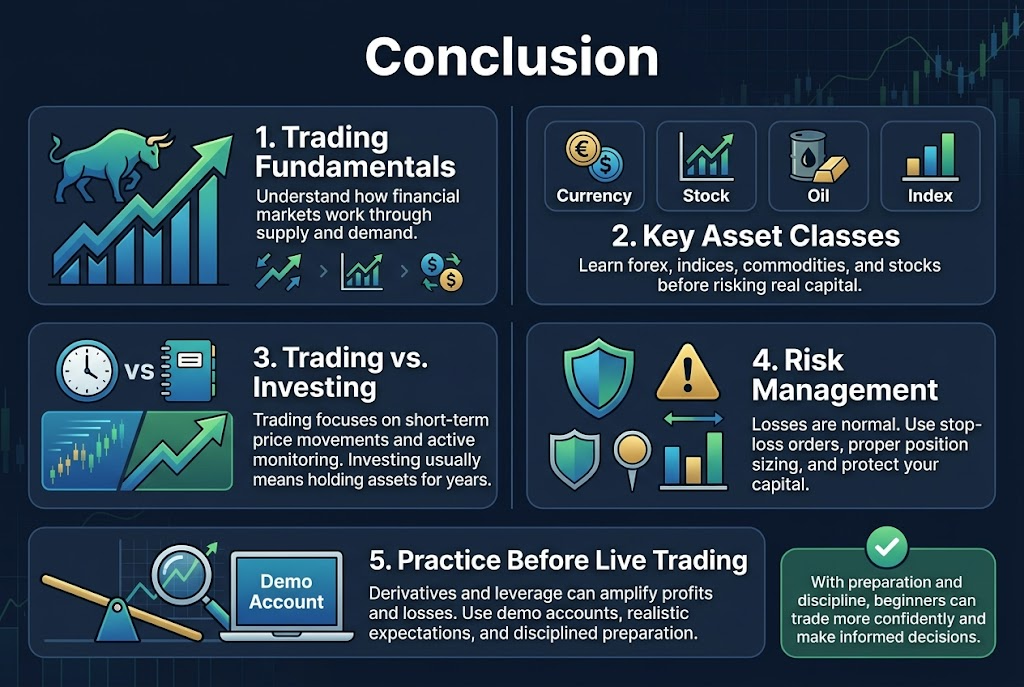
Trading offers genuine opportunities in today’s financial markets, but success requires understanding the fundamentals, managing expectations, and approaching it with discipline. From grasping how financial markets operate through supply and demand to learning about key asset classes like forex, indices, commodities, and stocks, beginners need a solid foundation before risking real capital. The distinction between trading and long-term investing is crucial – trading focuses on shorter-term price movements and requires active market monitoring, while investing typically involves holding assets for years.
Risk management should be at the center of every trading strategy. Losses are a normal part of the learning process, and protecting capital through tools like stop-loss orders and proper position sizing is essential. Remember that trading with derivatives and leverage can amplify both profits and losses, making education and practice on demo accounts invaluable before transitioning to live trading. With the right preparation, realistic expectations, and structured approach, beginners can navigate financial markets more confidently and make informed trading decisions.