Table of Contents
Introduction
Understanding spot vs futures trading in crypto is essential for anyone entering the cryptocurrency market. The cryptocurrency market offers several ways to trade digital assets, but the two most common methods are spot and futures trading. While both allow traders to profit from price movements in cryptocurrencies such as Bitcoin and Ethereum, they work very differently in terms of ownership, leverage, and risk.
In spot trading, you buy and own the actual cryptocurrency. If you purchase one Bitcoin, that asset belongs to you and can be held in your exchange account or transferred to a private wallet. Spot trading is straightforward and is often the starting point for beginners and long-term investors.
Futures trading, on the other hand, involves trading contracts that track the price of a cryptocurrency without requiring you to own the underlying asset. Futures contracts allow traders to use leverage, which means controlling a larger position with a smaller amount of capital. While this can increase potential returns, it also significantly increases risk, including the possibility of liquidation.
Understanding the difference between spot and futures trading is essential before risking real money. Many beginners are attracted to futures trading because of the potential for amplified profits, but they often underestimate the complexity and emotional pressure that comes with leverage. Others assume spot trading is always less profitable, without realizing that it offers a simpler and more sustainable way to build experience.
One of the most common beginner questions is: Should I start with spot trading or futures trading? The answer depends on your goals, risk tolerance, and trading experience.
In this guide, you’ll learn:
- What spot trading and futures trading mean in crypto
- The key differences between the two methods
- The advantages and disadvantages of each
- Real-world examples of how profits and losses differ
- Which trading approach is generally better for beginners
By the end of this article, you’ll have a clear understanding of how spot and futures markets work and which one aligns best with your trading style and financial goals.
Author Experience
As an active trader, I have spent years studying both spot and futures markets across cryptocurrencies, stocks, and other financial instruments. My experience with crypto trading began with spot positions in major assets such as Bitcoin and Ethereum, which helped me understand market behavior, volatility, and the importance of patience and risk management.
As my trading knowledge expanded, I started using futures markets to explore more advanced strategies, including leverage, hedging, short selling, and position sizing. Trading futures taught me how quickly gains and losses can be magnified and reinforced the importance of using stop-loss orders, controlling leverage, and maintaining emotional discipline.
Through both profitable trades and costly mistakes, I learned that success in trading depends less on finding a “perfect strategy” and more on managing risk consistently and following a well-tested plan.
This guide is based on practical, real-world trading experience and is written to help beginners understand the core differences between spot and futures trading. The goal is to explain these concepts in a simple and balanced way so you can choose the trading approach that best fits your experience level, risk tolerance, and financial goals.
Disclaimer: This article is for educational purposes only and should not be considered financial advice. Always conduct your own research and trade only with capital you can afford to lose.
What Is Spot Trading in Crypto?
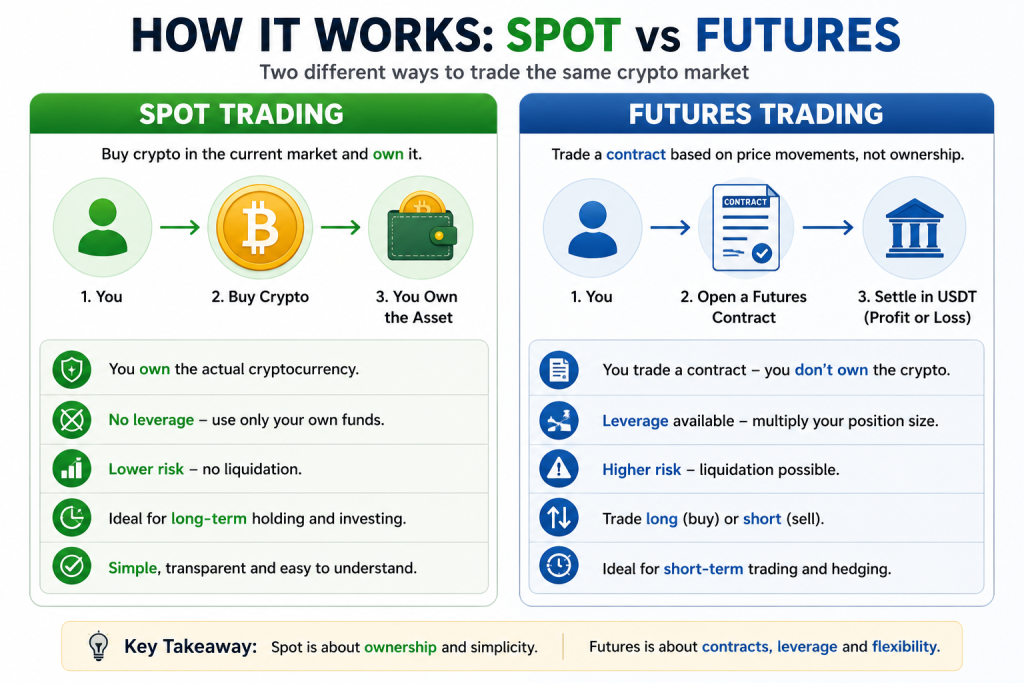
Spot trading is the most straightforward way to buy and sell cryptocurrencies. In a spot trade, you purchase the actual digital asset at the current market price, and ownership is transferred to you immediately. The term “spot” refers to the fact that the transaction is settled on the spot, meaning you directly own the cryptocurrency once the order is executed.
For example, if you buy ₹50,000 worth of Bitcoin on a crypto exchange, you receive the equivalent amount of Bitcoin in your account. If the price of Bitcoin rises, the value of your holdings increases. If the price falls, the value decreases. The same principle applies to other cryptocurrencies such as Ethereum.
Unlike futures trading, spot trading does not involve leverage, margin, or liquidation. You are using your own capital to purchase the asset, which makes the process easier to understand and generally less risky for beginners.
How Spot Trading Works
When you place a buy order in the spot market:
- You pay the full value of the asset.
- The cryptocurrency is credited to your exchange account.
- You can hold it as long as you want.
- You may transfer it to a personal wallet for additional security.
- You profit if the price rises and lose value if the price falls.
For example:
- You buy 1 ETH at $2,000.
- If ETH rises to $2,500, your unrealized profit is $500.
- If ETH drops to $1,800, your unrealized loss is $200.
Because you own the asset directly, there is no expiration date or forced liquidation.
Common Examples of Spot Trading
Spot trading is widely used to buy leading cryptocurrencies such as:
- Bitcoin
- Ethereum
- Solana
- Ripple
Investors often accumulate these assets during market pullbacks and hold them for months or years.
Typical Use Cases of Spot Trading
Long-Term Investing
Many investors buy cryptocurrencies they believe will appreciate over time and hold them for the long term. This strategy is often called “buy and hold.”
Swing Trading
Traders may buy a coin and hold it for several days or weeks to capture medium-term price movements.
Holding Assets in a Wallet
Since you own the cryptocurrency, you can move it from the exchange to a private wallet for greater control and security.
Portfolio Diversification
Spot trading allows investors to build a diversified portfolio of multiple crypto assets without using leverage.
Advantages of Spot Trading
- Direct ownership of the cryptocurrency
- No liquidation risk
- No funding fees
- Simpler and easier to understand
- Suitable for beginners and long-term investors
Disadvantages of Spot Trading
- Requires full capital upfront
- Lower capital efficiency compared with leveraged products
- Limited ability to profit from falling markets
My Experience with Spot Trading
Spot trading was my entry point into the crypto market. It helped me understand price action, support and resistance, and the emotional aspects of market fluctuations without the pressure of leverage. For most beginners, spot trading provides a practical way to gain experience while keeping risk more manageable.
In short, spot trading means buying and owning the actual cryptocurrency. It is the simplest and most beginner-friendly way to participate in the crypto market and build a foundation before exploring more advanced products such as futures contracts.
What Is Futures Trading in Crypto?
Futures trading is an advanced form of trading that allows you to speculate on the future price movement of a cryptocurrency without actually owning the underlying asset. Instead of buying the coin itself, you trade a contract whose value is linked to the price of the cryptocurrency.
For example, when you open a Bitcoin futures position, you do not own Bitcoin. You are simply entering into an agreement that gains or loses value based on how the market price of Bitcoin moves.
This type of trading is popular among short-term traders because it offers additional flexibility, including the ability to use leverage and profit from both rising and falling markets.
How Crypto Futures Contracts Work
A crypto futures contract tracks the price of a cryptocurrency such as Bitcoin or Ethereum. When you open a futures position, you are betting on the direction of the market:
- Long Position: You expect the price to rise.
- Short Position: You expect the price to fall.
If the market moves in your favor, you make a profit. If the market moves against you, you incur a loss.
Unlike spot trading, you never take ownership of the actual coins unless the platform specifically offers physical settlement, which is uncommon for retail crypto traders.
Profit from Both Rising and Falling Markets
One major advantage of futures trading is the ability to trade in either direction.
Going Long
Suppose you believe Bitcoin will rise from $100,000 to $105,000. You can open a long position and profit if the price increases.
Going Short
Suppose you believe Bitcoin will fall from $100,000 to $95,000. You can open a short position and profit if the price declines.
This flexibility makes futures attractive for active traders and hedgers.
Understanding Leverage
Leverage allows you to control a larger position using a smaller amount of capital.
For example:
- Your account balance: $1,000
- Leverage used: 10x
- Total position size: $10,000
If the market moves 5% in your favor, your profit is calculated on the full $10,000 position, not just your $1,000 margin.
Leverage can significantly increase returns, but it also magnifies losses. A relatively small move against your position can result in losing most or all of your margin.
What Is Margin?
Margin is the capital you commit as collateral to open and maintain a leveraged position.
There are two common margin concepts:
- Initial Margin: The amount required to open the trade.
- Maintenance Margin: The minimum balance required to keep the position open.
If your account equity falls below the maintenance margin, the exchange may automatically close your position.
What Is Liquidation?
Liquidation occurs when your losses become large enough that the exchange closes your position to prevent further losses.
For example, if you use high leverage, even a small adverse move in price can trigger liquidation and wipe out your margin.
This is one of the biggest risks in futures trading and a common reason new traders lose money.
Funding Fees
Many crypto exchanges use perpetual futures contracts, which do not expire. These contracts include a mechanism called a funding fee.
Depending on market conditions:
- Long traders may pay short traders.
- Short traders may pay long traders.
These payments help keep the futures price aligned with the spot market price.
Typical Use Cases of Futures Trading
Futures trading is commonly used for:
- Short-term speculation
- Hedging spot holdings
- Trading with leverage
- Profiting from both bullish and bearish markets
Advantages of Futures Trading
- Ability to use leverage
- Opportunity to short sell
- Efficient use of capital
- Useful for hedging existing positions
Disadvantages of Futures Trading
- High risk of liquidation
- More complex than spot trading
- Funding fees can reduce profitability
- Greater emotional and psychological pressure
My Experience with Futures Trading
Futures trading taught me the importance of disciplined risk management. While leverage can accelerate gains, it can also magnify mistakes very quickly. I learned that lower leverage, strict stop-loss rules, and careful position sizing are essential for long-term survival.
Summary
Crypto futures trading allows you to speculate on price movements without owning the underlying cryptocurrency. It offers powerful tools such as leverage and short selling, but it also introduces significantly higher risk.
For beginners, it is generally wise to understand spot trading thoroughly before moving into futures markets.
Spot vs Futures Trading in Crypto: Quick Comparison Table
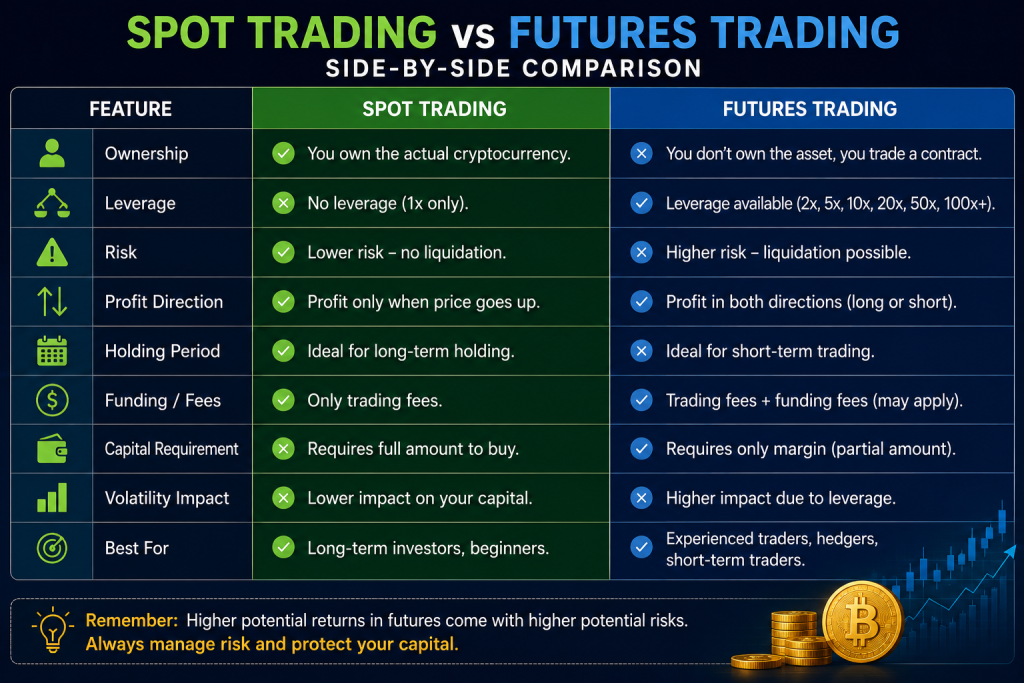
Before choosing between spot and futures trading, it helps to compare their core features side by side. The table below highlights the most important differences, including ownership, leverage, liquidation risk, and suitability for beginners. This spot vs futures trading in crypto comparison highlights how ownership, leverage, and risk differ between the two markets.
| Feature | Spot Trading | Futures Trading |
| Ownership of Asset | You buy and own the actual cryptocurrency, such as Bitcoin or Ethereum. | You trade a contract based on the asset’s price and do not own the underlying cryptocurrency. |
| Use of Leverage | No leverage by default. You pay the full value of the asset. | Yes. You can use leverage (e.g., 2x, 5x, 10x or higher) to control larger positions. |
| Liquidation Risk | No liquidation risk because you own the asset outright. | Yes. Positions can be liquidated if the market moves against you. |
| Ability to Short Sell | Generally not available in standard spot markets. | Yes. You can profit from both rising and falling markets. |
| Fees | Trading fees only; no funding fees. | Trading fees plus possible funding fees for perpetual contracts. |
| Risk Level | Lower relative risk and simpler structure. | Higher risk due to leverage and liquidation. |
| Capital Requirement | Requires full capital to buy the asset. | Requires only margin to open a larger position. |
| Suitable for Beginners | Yes. Ideal for learning and long-term investing. | Usually better suited to experienced traders. |
| Best For | Investors, swing traders, and beginners. | Active traders, hedgers, and advanced market participants. |
Key Takeaway
Spot trading is generally simpler and more beginner-friendly because you own the cryptocurrency and do not face liquidation risk. Futures trading offers advanced tools such as leverage and short selling, but it introduces significantly greater complexity and risk.
If you are new to crypto trading, starting with spot trading can help you build a strong foundation before considering leveraged futures positions.
Also Read: How Crypto Trading Works
Key Differences Between Spot and Futures Trading
Although both spot and futures trading allow you to participate in the cryptocurrency market, they differ significantly in how trades are executed, how risk is managed, and how profits and losses are generated. Understanding these differences is essential before deciding which market is right for you.
1 Ownership
The most fundamental difference is ownership.
In spot trading, you buy and own the actual cryptocurrency. For example, if you purchase Bitcoin, that Bitcoin becomes your asset. You can hold it indefinitely, transfer it to a private wallet, or use it in decentralized applications.
In futures trading, you do not own the cryptocurrency. Instead, you trade a contract that mirrors the price movement of the underlying asset.
Key Point:
Spot = ownership of the asset.
Futures = price exposure without ownership.
2 Leverage
Spot trading usually does not involve leverage. If you want to buy $1,000 worth of crypto, you need $1,000.
Futures trading allows you to use leverage, meaning you can control a larger position with a smaller amount of capital.
For example:
- $1,000 with 10x leverage = $10,000 position size.
Leverage can increase profits, but it also magnifies losses.
Key Point:
Spot uses your full capital. Futures allow amplified exposure through leverage.
3 Liquidation Risk
When trading spot, there is no liquidation risk because you own the asset outright. Your investment can decline in value, but the exchange will not force-close your position.
In futures trading, if the market moves significantly against your leveraged position, the exchange may liquidate the trade and your margin can be lost.
Key Point:
Spot positions are not liquidated. Futures positions can be liquidated.
4 Funding Fees
Spot traders generally pay only trading commissions when buying or selling.
Futures traders may also pay or receive funding fees, especially in perpetual contracts. These periodic payments help keep futures prices aligned with spot prices.
Depending on market conditions:
- Long traders may pay short traders.
- Short traders may pay long traders.
Over time, funding fees can meaningfully affect performance.
Key Point:
Spot has simpler fee structures; futures include additional funding costs.
5 Short Selling
Spot trading is primarily designed to profit when prices rise.
Futures trading enables both:
- Long positions to benefit from rising prices.
- Short positions to benefit from falling prices.
This makes futures more flexible in bearish market conditions.
Key Point:
Futures allow traders to profit in both directions.
6 Profit Potential
Spot trading offers gains that generally match the percentage move in the asset.
Example:
- Buy Ethereum at $2,000.
- Sell at $2,200.
- Profit = 10%.
In futures trading, leverage amplifies returns.
Example:
- Same 10% move with 5x leverage may produce an approximately 50% return on margin, before fees.
However, losses are magnified by the same mechanism.
Key Point:
Futures can generate larger percentage returns, but also larger percentage losses.
7 Emotional Pressure
Spot trading is typically less stressful because there is no liquidation and no need to manage leverage.
Futures trading often involves:
- Rapid profit and loss fluctuations
- Liquidation risk
- Funding costs
- Greater decision-making pressure
This can lead to impulsive behavior if a trader lacks a structured plan.
Key Point:
Futures trading demands stronger emotional discipline and risk control.
Summary of the Main Differences
| Factor | Spot Trading | Futures Trading |
| Ownership | Yes | No |
| Leverage | Usually No | Yes |
| Liquidation Risk | No | Yes |
| Funding Fees | No | Yes |
| Short Selling | Limited | Yes |
| Profit Potential | Moderate | Higher but riskier |
| Emotional Pressure | Lower | Higher |
My Perspective
Spot trading is an excellent way to build foundational skills and understand market behavior. Futures trading offers powerful tools, but it requires disciplined execution and robust risk management. For most beginners, developing consistency in spot trading first is a practical path before considering leveraged futures positions.
Advantages of Spot Trading
Spot trading remains the preferred starting point for many cryptocurrency investors because it is straightforward, transparent, and easier to manage than leveraged products. When you buy assets such as Bitcoin or Ethereum in the spot market, you own the actual coins and are not exposed to the additional complexities of margin or liquidation.
Below are the main advantages of spot trading.
Simpler Structure
Spot trading is easy to understand. You buy a cryptocurrency at the current market price and sell it later if you choose.
There are no advanced concepts such as:
- Leverage
- Margin requirements
- Funding fees
- Liquidation prices
This simplicity makes spot trading ideal for beginners who want to learn how the market works before exploring more complex instruments.
No Liquidation Risk
One of the biggest benefits of spot trading is that your position cannot be automatically liquidated by the exchange.
For example, if you buy Bitcoin and the price falls by 20%, the value of your holdings decreases, but you still own the asset. You can continue holding it as long as you want.
In contrast, a leveraged futures position may be force-closed after a relatively small adverse move.
Suitable for Long-Term Investors
Spot trading is well suited to investors who believe in the long-term potential of cryptocurrencies.
You can:
- Accumulate assets over time
- Hold them for months or years
- Transfer them to a personal wallet
- Participate in staking or decentralized finance opportunities, where available
This approach aligns with long-term investing strategies and reduces the need for constant monitoring.
Lower Stress and Emotional Pressure
Because spot trading does not involve leverage or liquidation, it is generally less stressful.
Traders and investors can focus on:
- Market research
- Portfolio allocation
- Long-term trends
rather than reacting to rapid fluctuations in leveraged profit and loss.
This lower-pressure environment often helps beginners develop better habits and more disciplined decision-making.
Full Ownership of the Asset
When you buy crypto in the spot market, the asset belongs to you. You can withdraw it to a private wallet and maintain direct control over your holdings.
This ownership provides flexibility and aligns with the core principle of cryptocurrency self-custody.
Easier Risk Management
In spot trading, the maximum amount at risk is generally the capital you invest. There is no borrowing involved in standard spot transactions.
This makes position sizing and overall risk management more intuitive.
My Experience with Spot Trading
Spot trading provided the foundation for my understanding of cryptocurrency markets. It allowed me to study price action, market cycles, and trading psychology without the additional pressure of leverage. For anyone starting out, spot trading offers a practical way to build experience while keeping risk more manageable.
Summary
The main advantages of spot trading include:
- Simple and beginner-friendly structure
- No liquidation risk
- Direct ownership of the cryptocurrency
- Suitable for long-term investing
- Lower emotional stress
- Straightforward risk management
For most beginners, spot trading is an effective way to gain experience and develop a disciplined approach before considering more advanced products such as futures contracts.
Disadvantages of Spot Trading
While spot trading is often the safest and simplest way to participate in the cryptocurrency market, it is not without limitations. Compared with futures trading, spot trading may require more capital and offers fewer ways to profit in certain market conditions.
Below are the main disadvantages of spot trading.
Requires Full Capital
In spot trading, you must pay the full value of the cryptocurrency you want to buy.
For example:
- If you want to purchase ₹1,00,000 worth of Bitcoin, you need the full ₹1,00,000 in your account.
- There is no built-in leverage in standard spot markets.
This means your capital efficiency is lower compared with futures trading, where a smaller margin deposit can control a larger position.
Limited Profit in Sideways Markets
Spot trading works best when prices trend upward.
If the market moves sideways for weeks or months, your capital may remain tied up without generating meaningful returns. Although some investors may earn yield through staking or lending, these are separate activities and involve additional considerations.
In contrast, active futures traders may be able to take advantage of both bullish and bearish price swings.
No Direct Profit from Falling Prices
In standard spot trading, profits generally come from buying low and selling high.
If you expect a cryptocurrency to decline, there is no simple way to benefit unless you use additional features such as:
- Margin borrowing
- Lending and borrowing protocols
- Derivatives such as futures or options
Without these tools, spot traders typically need to wait for better buying opportunities rather than profiting directly from downward moves.
Lower Capital Efficiency
Because you commit the full amount of capital to each purchase, your funds are less flexible.
For example:
- ₹50,000 invested in spot gives exposure to ₹50,000 of the asset.
- The same amount used as futures margin can provide larger exposure, depending on leverage.
This can be an advantage from a risk-control perspective, but it limits the potential return on capital.
Opportunity Cost
Capital tied up in long-term spot positions may not be available for other trades or investment opportunities.
This can matter when markets remain range-bound or when more attractive setups appear elsewhere.
Slower Growth Potential
Without leverage, returns generally match the percentage move in the asset.
For example:
- If Ethereum rises 10%, a spot position gains approximately 10% before fees.
While this approach is more conservative, traders seeking faster growth may view it as less attractive.
My Experience with Spot Trading
Spot trading taught me patience and helped me focus on market structure and risk management. However, I also learned that in flat or bearish markets, progress can feel slow because there are fewer opportunities to generate returns without using more advanced instruments.
Summary
The main disadvantages of spot trading include:
- Requires full capital to purchase assets
- Limited profit potential in sideways markets
- No straightforward way to profit from falling prices
- Lower capital efficiency
- Potential opportunity cost
- Slower account growth compared with leveraged strategies
Despite these limitations, spot trading remains one of the most practical ways for beginners to build experience and develop a disciplined approach to cryptocurrency investing.
Advantages of Futures Trading
Futures trading offers several powerful features that are not available in standard spot markets. For experienced traders, these tools can provide greater flexibility, improved capital efficiency, and more ways to manage market exposure.
However, these advantages come with higher risk, so it is important to understand both the benefits and the responsibilities that come with trading leveraged products.
Capital Efficiency
One of the biggest advantages of futures trading is capital efficiency.
Instead of paying the full value of a position, you only need to post margin.
For example:
- With $1,000 and 5x leverage, you can control a $5,000 position.
- With $1,000 and 10x leverage, you can control a $10,000 position.
This allows traders to use less capital while gaining larger market exposure.
That said, leverage amplifies both profits and losses.
Ability to Short Sell
Futures trading allows you to profit when prices fall.
If you believe Bitcoin is overvalued, you can open a short position. If the price declines, the trade may generate a profit.
This flexibility is especially valuable during bearish market conditions when spot investors may have limited options beyond holding cash.
Potentially Higher Returns
Because futures trading uses leverage, a relatively small market move can produce a larger percentage return on the margin used.
For example:
- A 5% price move in your favor with 10x leverage may produce an approximate 50% gain on margin, before fees.
The same principle applies to losses, which is why disciplined risk management is essential.
Useful for Hedging
Futures contracts can help protect an existing spot portfolio.
For example:
- If you hold a large amount of Bitcoin and expect short-term weakness, you may open a short futures position to offset part of the downside risk.
This approach can reduce portfolio volatility without requiring you to sell your long-term holdings.
Profit Opportunities in Both Market Directions
Unlike spot trading, futures trading allows traders to pursue opportunities in:
- Bullish trends
- Bearish trends
- Short-term volatility
This can create more trading opportunities across different market environments.
Access to Advanced Strategies
Futures markets support a variety of professional strategies, including:
- Hedging
- Spread trading
- Arbitrage
- Market-neutral approaches
These strategies are commonly used by experienced traders and institutions.
My Experience with Futures Trading
Futures trading expanded the range of strategies I could use, especially during volatile and bearish markets. The ability to hedge and short provided flexibility, but it also highlighted how important leverage control and emotional discipline are to long-term success.
Summary
The main advantages of futures trading include:
- Greater capital efficiency through leverage
- Ability to short sell
- Potentially higher percentage returns
- Useful hedging capabilities
- More opportunities in different market conditions
- Access to advanced trading strategies
For disciplined traders with a tested plan, futures can be a powerful tool. For beginners, these advantages should be approached carefully, as the same features that increase opportunity also increase risk.
Also Read: What is Cryptocurrency? Beginners Guide
Disadvantages of Futures Trading
While futures trading offers powerful tools such as leverage and short selling, it also introduces risks that can lead to significant losses if not managed properly. Many beginners are attracted by the potential for large returns, but they often underestimate the complexity and emotional pressure involved.
Below are the main disadvantages of futures trading.
High Risk of Liquidation
The biggest drawback of futures trading is liquidation risk.
When you use leverage, even a relatively small move against your position can trigger an automatic closure by the exchange.
For example:
- You open a 10x leveraged long position on Bitcoin.
- If the market moves approximately 10% against you (often less after fees and maintenance margin requirements), your position may be liquidated.
This can result in losing most or all of the margin allocated to the trade.
Funding Costs
Most crypto exchanges offer perpetual futures contracts, which include recurring funding payments.
Depending on market conditions:
- Long traders may pay short traders.
- Short traders may pay long traders.
If you hold positions for an extended period, these costs can reduce profitability, particularly during periods of elevated funding rates.
Complexity
Futures trading is more complex than spot trading.
Traders need to understand concepts such as:
- Leverage
- Margin
- Liquidation price
- Funding rates
- Mark price
- Maintenance margin
Without a clear understanding of these mechanics, it is easy to take on more risk than intended.
Greater Psychological Pressure
Futures trading can be emotionally demanding because profits and losses change rapidly.
Common challenges include:
- Fear of liquidation
- Stress from volatile unrealized P&L
- Overtrading
- Revenge trading
- Increasing leverage after losses
These psychological pressures can lead to impulsive decisions and inconsistent performance.
Amplified Losses
Leverage increases not only potential gains but also potential losses.
For example:
- A 2% adverse move with 20x leverage can have a substantial impact on your margin.
This means even small market fluctuations can materially affect your account balance.
Overconfidence
The ability to control large positions with limited capital can create a false sense of security.
Some traders become overly aggressive, believing leverage alone will accelerate account growth. In practice, disciplined risk management matters far more than position size.
Unsuitable for Most Beginners
Because of the complexity and potential for rapid losses, futures trading is often better suited to traders who:
- Understand risk management
- Have a tested strategy
- Can follow a structured trading plan
Beginners typically benefit from gaining experience in spot markets first.
My Experience with Futures Trading
Futures trading taught me valuable lessons about leverage, discipline, and emotional control. Some of my fastest gains occurred in futures markets, but so did some of my most expensive mistakes. Over time, I learned that preserving capital is more important than maximizing short-term returns.
Summary
The main disadvantages of futures trading include:
- High liquidation risk
- Ongoing funding costs
- Greater complexity
- Increased psychological pressure
- Amplified losses
- Unsuitability for most beginners
Futures trading can be effective when used responsibly, but it requires a strong understanding of risk and disciplined execution. For new traders, mastering spot trading first is often a more sustainable path.
Example: Spot Trade vs Futures Trade
To understand the practical difference between spot and futures trading, consider the following example using Bitcoin.
Scenario Overview
You have $1,000 available to trade, and Bitcoin is currently priced at $100,000.
You decide to compare two approaches:
- Spot Trade: Buy $1,000 worth of Bitcoin.
- Futures Trade: Use the same $1,000 as margin to open a $5,000 position using 5x leverage.
Spot Trade Example
With $1,000 in the spot market:
- You purchase $1,000 worth of Bitcoin.
- You directly own the asset.
- No leverage is used.
- No liquidation risk exists.
If Bitcoin Rises by 10%
- Position value increases to $1,100.
- Profit = $100
- Return on capital = 10%
If Bitcoin Falls by 10%
- Position value decreases to $900.
- Loss = $100
- Return on capital = -10%
Futures Trade Example (5x Leverage)
With $1,000 as margin and 5x leverage:
- Total position size = $5,000
- You do not own Bitcoin.
- Your profits and losses are based on the full $5,000 position.
If Bitcoin Rises by 10%
- Position gains 10% of $5,000 = $500
- Profit = $500
- Return on margin = 50%
If Bitcoin Falls by 10%
- Position loses 10% of $5,000 = $500
- Loss = $500
- Return on margin = -50%
Comparison Table
| Market Move | Spot Trade Result | Futures Trade Result (5x Leverage) |
| Bitcoin rises 10% | +$100 (+10%) | +$500 (+50%) |
| Bitcoin falls 10% | -$100 (-10%) | -$500 (-50%) |
What Happens if Bitcoin Falls More?
In spot trading:
- Even if Bitcoin drops 30% or 50%, you still own your Bitcoin and can continue holding it.
In futures trading:
- A larger adverse move can bring your account close to liquidation, especially after fees and maintenance margin requirements.
This means your $1,000 margin could be lost even though the underlying asset has not gone to zero.
Key Takeaway
This example highlights the core difference between spot and futures trading:
- Spot Trading: Lower risk and direct ownership, but profits and losses move at the same rate as the asset.
- Futures Trading: Amplified returns and losses through leverage.
A 10% move in Bitcoin results in:
- 10% gain or loss in spot trading.
- 50% gain or loss in a 5x leveraged futures position.
My Perspective
When I first started trading, examples like this helped me understand how leverage changes the risk profile of a trade. Futures trading can accelerate gains, but it can also produce large losses very quickly. Spot trading may seem slower, but it offers a more stable environment to learn and build discipline.
For most beginners, understanding this difference is one of the most important steps in choosing the right trading approach.
Which Is Better for Beginners?
For most new traders, spot trading is generally the better place to start. It offers a simpler structure, lower risk, and a more forgiving learning environment. While futures trading can be a powerful tool, it introduces leverage, liquidation risk, and emotional pressure that can overwhelm traders who are still building their skills.
Why Spot Trading Is Better for Learning
Spot trading allows you to focus on the core principles of trading without the added complexity of leveraged products.
By trading assets such as Bitcoin and Ethereum in the spot market, you can learn:
- Market structure
- Support and resistance
- Trend analysis
- Position sizing
- Trading psychology
- Risk management
Because there is no liquidation risk, you have more time to evaluate your decisions and learn from both winning and losing trades.
Lower Emotional Pressure
One of the biggest challenges for beginners is managing emotions.
In spot trading:
- Your position cannot be liquidated.
- Price swings are easier to tolerate.
- There is less pressure to react immediately.
This creates a better environment for developing discipline and patience.
Spot Trading Encourages Long-Term Thinking
Spot positions can be held for as long as you choose.
If the market temporarily moves against you, you still own the asset and can wait for your original thesis to play out, provided your investment rationale remains intact.
This flexibility is particularly helpful when learning how markets behave over time.
When Futures Trading May Be Appropriate
Futures trading may be appropriate once you have:
- A proven trading strategy
- Consistent results over a meaningful sample of trades
- Strong understanding of leverage and margin
- Clear risk-management rules
- Emotional discipline
Futures can be useful for:
- Short-term speculation
- Hedging existing holdings
- Trading both bullish and bearish markets
However, these benefits should be approached only after building a solid foundation.
Start Small If You Transition to Futures
When moving from spot to futures trading:
- Use low leverage (for example, 1x to 3x)
- Risk only a small percentage of your account per trade
- Always define a stop-loss
- Track your performance in a trading journal
This approach can help reduce the impact of early mistakes.
Risk Management Comes First
Regardless of whether you trade spot or futures, risk management is more important than strategy alone.
Key principles include:
- Never risk more than you can afford to lose.
- Use position sizing appropriate to your account.
- Avoid overtrading.
- Keep leverage conservative.
- Review trades regularly.
In my experience, traders who master risk management tend to perform better over time than those who focus only on finding entry signals.
My Recommendation
If you are new to cryptocurrency trading:
- Start with spot trading.
- Learn technical and risk-management fundamentals.
- Build consistency.
- Transition to futures only after you have a tested approach.
Final Verdict
For beginners, spot trading is typically the better choice because it is simpler, less stressful, and more forgiving.
Futures trading can offer greater flexibility and profit potential, but it also carries significantly higher risk.
The most sustainable path is to develop strong habits and disciplined risk management in the spot market before considering leveraged futures positions.
Who Should Use Spot Trading?
Spot trading is an excellent choice for individuals who want a straightforward and lower-risk way to invest in cryptocurrencies. Because you buy and own the actual asset, spot trading is well suited to those who prefer simplicity and a longer-term approach.
Below are the types of traders and investors who are most likely to benefit from spot trading.
Long-Term Investors
Spot trading is ideal for investors who believe in the long-term potential of cryptocurrencies such as Bitcoin and Ethereum.
Long-term investors often:
- Buy assets gradually over time
- Hold positions for months or years
- Ignore short-term market noise
- Store assets in secure wallets
This approach is commonly used by investors who focus on broader adoption trends rather than short-term price fluctuations.
Low-Risk Traders
Traders who prefer to avoid leverage and liquidation risk often choose spot trading.
Because spot positions are funded with your own capital:
- There is no forced liquidation in standard spot markets.
- Losses are limited to the decline in the asset’s value.
- Risk is generally easier to understand and manage.
This makes spot trading more suitable for those who prioritize capital preservation.
Beginners
Spot trading is usually the best starting point for new traders.
It allows beginners to learn:
- How exchanges work
- Order types
- Market trends
- Position sizing
- Risk management
without the added complexity of leverage, margin, and funding fees.
Passive Investors
People who do not want to monitor markets constantly may prefer spot trading.
Once a position is established, they can hold it over time and review their portfolio periodically rather than managing highly leveraged trades.
Dollar-Cost Averaging (DCA) Investors
Spot trading supports systematic accumulation strategies.
For example, an investor may buy a fixed amount of Bitcoin every month, regardless of price, to reduce the impact of short-term volatility.
Investors Who Want Full Ownership
Spot trading provides direct ownership of the cryptocurrency, which means you can transfer it to a personal wallet and maintain control over your holdings.
This flexibility appeals to investors who value self-custody and long-term control.
My Experience with Spot Trading
Spot trading helped me build a solid foundation in market analysis and risk management. It allowed me to study price action and trading psychology without the additional pressure of leverage. For most new market participants, it offers a practical and sustainable way to gain experience.
Summary
Spot trading is best suited for:
- Long-term investors
- Low-risk traders
- Beginners
- Passive investors
- Dollar-cost averaging investors
- Individuals who want direct ownership of crypto assets
If your goal is to learn the market gradually and build experience with a lower level of complexity, spot trading is often the most appropriate starting point.
Who Should Use Futures Trading?
Futures trading is best suited to traders who understand market dynamics, risk management, and the mechanics of leveraged products. While futures offer powerful tools such as leverage, short selling, and hedging, they also carry significantly higher risk than spot trading.
Below are the types of market participants who may benefit most from futures trading.
Experienced Traders
Futures trading is generally more appropriate for traders who already have experience in the financial markets.
Experienced traders typically understand:
- Market structure and price action
- Position sizing
- Stop-loss placement
- Risk-to-reward analysis
- Trading psychology
They are also familiar with concepts unique to futures, including leverage, margin, funding fees, and liquidation.
Hedgers
Futures contracts can be used to reduce the risk of an existing spot portfolio.
For example:
- If you hold a large amount of Bitcoin and expect short-term weakness, you can open a short futures position to offset some of the downside.
This strategy allows long-term investors to protect their holdings without selling the underlying assets.
Traders with Tested Systems
Futures trading is most effective when used with a well-defined and thoroughly tested trading strategy.
A tested system typically includes:
- Clear entry criteria
- Defined stop-loss rules
- Profit targets
- Position sizing guidelines
- Performance tracking
Because leverage amplifies both gains and losses, traders should have confidence in their edge before increasing exposure.
Short-Term Active Traders
Scalpers, day traders, and swing traders often use futures because they can:
- Trade both long and short
- Use capital efficiently
- Take advantage of short-term volatility
These traders usually monitor the market closely and follow structured plans.
Traders with Strong Emotional Discipline
Futures markets can be psychologically demanding.
Successful futures traders are able to:
- Accept losses calmly
- Avoid revenge trading
- Follow rules consistently
- Keep leverage under control
Emotional discipline is often as important as technical skill.
Traders Who Understand Risk Management
Futures trading requires strict risk controls.
Suitable traders understand how to:
- Limit risk per trade
- Manage overall exposure
- Adjust leverage
- Protect capital during losing streaks
Without these skills, futures trading can lead to rapid losses.
My Experience with Futures Trading
In my own trading journey, futures became useful only after I developed a structured approach to market analysis and risk management. Once I had a tested strategy and clear rules, futures provided additional flexibility for hedging and trading both bullish and bearish markets.
Summary
Futures trading is best suited for:
- Experienced traders
- Hedgers protecting spot portfolios
- Traders with tested systems
- Active short-term traders
- Individuals with strong emotional discipline
- Traders who understand risk management
If you are still learning the basics, spot trading is usually the more appropriate starting point. Futures trading can be a valuable tool, but it is most effective when used by traders who already have a proven process and a disciplined mindset.
Risk Management Tips
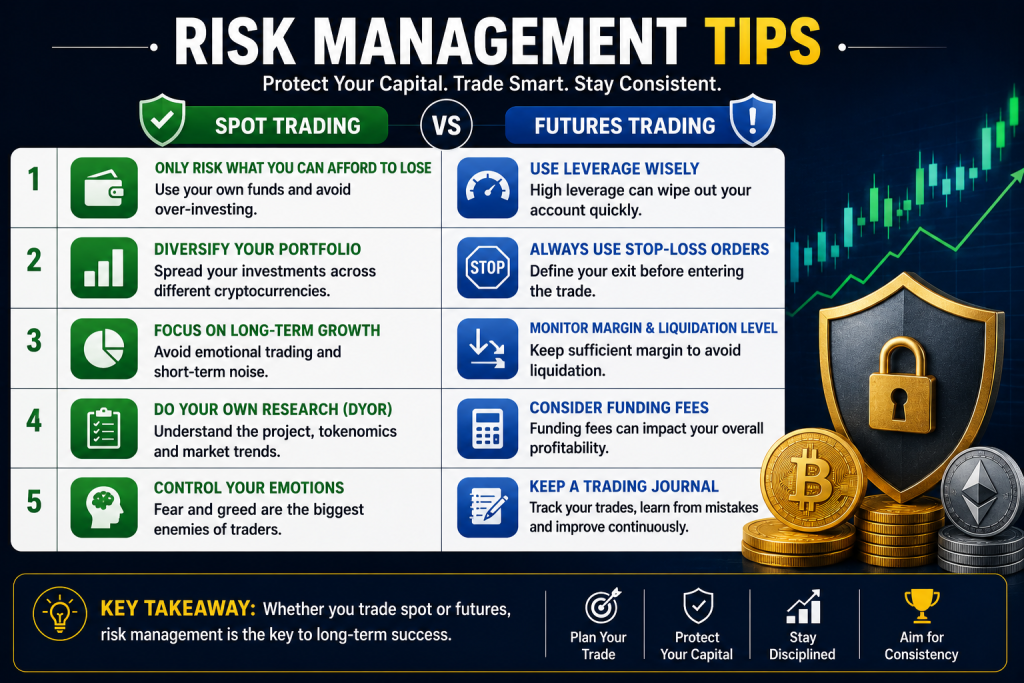
No matter whether you trade in the spot market or use futures contracts, risk management is the foundation of long-term success. A profitable strategy can still fail if you take oversized positions, ignore stop-loss levels, or trade emotionally. The most important lesson in spot vs futures trading in crypto is that protecting capital matters more than chasing returns.
In my experience, consistent traders focus first on protecting capital. Once risk is under control, profitability becomes much easier to achieve.
Use Stop-Loss Orders
A stop-loss order automatically closes your position if the market reaches a predefined price level.
This helps you:
- Limit losses on individual trades
- Remove emotional decision-making
- Protect your capital during unexpected market moves
For example, if you buy Bitcoin at $100,000 and set a stop-loss at $97,000, your maximum planned loss is approximately 3%, excluding fees and slippage.
A stop-loss should be placed at a level that invalidates your trade idea, not at a random percentage.
Avoid Excessive Leverage
Leverage can increase returns, but it also magnifies losses.
Many beginners use 20x, 50x, or even 100x leverage without understanding how quickly a small market move can trigger liquidation.
A more conservative approach is to:
- Use low leverage (for example, 1x to 3x)
- Reduce position size during volatile conditions
- Focus on consistency rather than maximizing returns
In many cases, lower leverage improves decision-making and helps preserve capital.
Risk Only a Small Percentage Per Trade
A common rule among professional traders is to risk only a small portion of total account equity on each trade.
Many traders use:
- 1% risk per trade
- 2% risk per trade at most
For example:
- Trading account size: $10,000
- Risk per trade: 1%
- Maximum planned loss: $100
This approach helps protect the account from significant drawdowns during losing streaks.
Keep a Trading Journal
A trading journal is one of the most effective tools for improving performance.
Record details such as:
- Entry and exit prices
- Position size
- Stop-loss and target levels
- Trade setup and reasoning
- Emotional state
- Lessons learned
Reviewing your journal can reveal recurring mistakes and highlight what works best.
Maintain a Favorable Risk-to-Reward Ratio
Before entering a trade, compare the potential reward to the planned risk.
Many traders look for setups offering at least:
- 1:2 risk-to-reward ratio
- 1:3 or higher when possible
This means your average winning trade can outweigh several small losses.
Never Trade with Money You Cannot Afford to Lose
Cryptocurrency markets are highly volatile.
Only use capital that fits your financial situation and that you can afford to risk without affecting essential expenses.
Control Your Emotions
Fear, greed, and frustration can lead to poor decisions.
Helpful practices include:
- Following a written trading plan
- Taking breaks after losses
- Avoiding revenge trading
- Focusing on process rather than short-term results
My Experience with Risk Management
The biggest improvement in my trading results came from refining risk management rather than changing strategies. Limiting risk per trade, using stop-loss orders, and maintaining a detailed journal helped me become more disciplined and consistent.
Summary
Essential risk management principles include:
- Use stop-loss orders
- Avoid excessive leverage
- Risk only a small percentage of your account per trade
- Keep a detailed trading journal
- Maintain favorable risk-to-reward ratios
- Trade only with capital you can afford to lose
Whether you trade spot or futures, protecting capital should always be your highest priority.
Common Mistakes Beginners Make
Many new traders enter the crypto market attracted by the possibility of quick profits. However, without a solid understanding of how spot and futures trading work, beginners often make avoidable mistakes that can lead to unnecessary losses.
Below are some of the most common mistakes I have seen—and experienced myself—when learning to trade cryptocurrencies such as Bitcoin and Ethereum.
Starting with High Leverage
One of the biggest mistakes beginners make is using excessive leverage.
Many exchanges offer leverage levels of 20x, 50x, or even 100x. While these numbers can appear attractive, they leave very little room for error.
For example:
- A 1% adverse move with 50x leverage can have a substantial impact on your margin.
- Small market fluctuations may trigger liquidation.
A more conservative approach is to begin with spot trading or use very low leverage while gaining experience.
Ignoring Funding Fees
Perpetual futures contracts often involve recurring funding payments between long and short traders.
Beginners may focus solely on price direction and overlook these costs.
If you hold positions for an extended period, funding fees can materially affect overall profitability, especially during highly bullish or bearish market conditions.
Overtrading
Overtrading occurs when traders take too many positions without a clear edge.
This often happens because of:
- Fear of missing out (FOMO)
- Boredom
- Attempting to recover losses quickly
- Lack of a written trading plan
More trades do not necessarily lead to better results. In many cases, patience and selectivity improve performance.
Confusing Margin with Free Money
Margin is collateral that allows you to control a larger position, but it does not eliminate risk.
Some beginners assume that because they are using borrowed exposure, losses are somehow limited or less significant.
In reality:
- Losses are calculated on the full position size.
- Margin can be lost quickly if the trade moves against you.
Understanding this concept is essential before using leverage.
Trading Without a Stop-Loss
Entering a trade without a predefined exit plan can lead to larger-than-expected losses.
A stop-loss helps define risk before the trade is placed.
Risking Too Much on a Single Trade
Some beginners allocate a large portion of their account to one idea.
A single unexpected move can cause a significant drawdown.
Risking a small percentage of capital per trade helps preserve the account over time.
Following Social Media Blindly
Trading decisions based solely on influencers or viral posts can be risky.
Every trader has different goals, timeframes, and risk tolerance.
Independent analysis and a written plan are more reliable than hype-driven decisions.
Letting Emotions Drive Decisions
Fear, greed, and frustration can lead to:
- Revenge trading
- Moving stop-loss levels
- Closing winners too early
- Holding losers too long
Emotional discipline is a critical component of consistent trading.
My Experience with Beginner Mistakes
Early in my trading journey, I used too much leverage and took trades without fully understanding the risk. Those mistakes taught me that sustainable success comes from discipline, patience, and protecting capital rather than chasing fast profits.
Summary
Common mistakes beginners make include:
- Starting with high leverage
- Ignoring funding fees
- Overtrading
- Confusing margin with free money
- Trading without a stop-loss
- Risking too much on a single position
- Following hype instead of a plan
- Letting emotions dictate decisions
Avoiding these mistakes can significantly improve your learning curve and help you build a more consistent trading process.
My Personal Experience with Spot and Futures Trading
My journey in the cryptocurrency market began with spot trading. Like many beginners, I started by buying assets such as Bitcoin and Ethereum to understand how prices move and how emotions influence decision-making.
Spot trading allowed me to learn at a manageable pace. Because there was no leverage or liquidation risk, I could focus on core concepts such as market structure, support and resistance, trend analysis, and risk management. It taught me patience and helped me understand that successful trading is not about constant action, but about making thoughtful decisions and managing risk consistently.
As I gained experience, I began exploring futures trading. This introduced new concepts such as leverage, margin, funding fees, and liquidation. Futures trading offered greater flexibility, including the ability to short the market and hedge existing positions. It also showed me how quickly both profits and losses can increase when leverage is involved.
Lessons I Learned from Spot Trading
Spot trading taught me several foundational lessons:
- Simplicity is a strength.
- Patience often produces better results than overtrading.
- Owning the underlying asset reduces emotional pressure.
- Risk management matters even without leverage.
Most importantly, spot trading helped me build confidence and discipline before moving to more advanced instruments.
Lessons I Learned from Futures Trading
Futures trading taught me a different set of lessons:
- Leverage amplifies both gains and losses.
- Small mistakes can become expensive quickly.
- Stop-loss orders are essential.
- Emotional control is critical.
Some of my largest gains came from well-executed futures trades, but some of my most valuable lessons came from trades where I underestimated the risks.
How Futures Magnify Gains and Losses
One of the most important realizations I had was that leverage does not improve a trading strategy. It only increases the impact of whatever edge—or lack of edge—you already have.
If your analysis is correct, leverage can boost returns.
If your analysis is wrong, leverage can magnify losses just as quickly.
This is why many traders lose money when they focus on position size rather than process.
Why Discipline Matters More Than Leverage
Over time, I learned that consistent profitability comes from discipline, not from using high leverage.
The habits that had the greatest impact on my results were:
- Following a written trading plan
- Limiting risk per trade
- Using stop-loss orders
- Keeping a detailed trading journal
- Reviewing mistakes objectively
Leverage is simply a tool. Without discipline and a tested strategy, it can do more harm than good.
My Core Takeaway
If I could offer one lesson to new traders, it would be this:
Focus on protecting your capital and building a repeatable process. Once discipline is in place, profitability becomes a byproduct of consistent execution.
Spot trading helped me develop the fundamentals. Futures trading expanded my opportunities, but also demanded greater responsibility.
Final Thoughts
Both spot and futures trading can be valuable, depending on your goals and experience level.
- Spot trading is ideal for learning and long-term investing.
- Futures trading offers more flexibility, but requires stronger risk management and emotional control.
In my experience, traders who prioritize discipline, patience, and capital preservation are far more likely to succeed than those who rely on leverage alone.
Frequently Asked Questions (FAQs)
One of the most common beginner questions about spot vs futures trading in crypto is which method is safer.
Is Spot Trading Safer Than Futures Trading?
Yes, spot trading is generally considered safer than futures trading.
When you trade in the spot market, you buy and own the actual cryptocurrency, such as Bitcoin. There is no leverage by default, which means your position cannot be liquidated by the exchange.
In futures trading, leverage magnifies both profits and losses. A relatively small move against your position can lead to liquidation and the loss of your margin.
For beginners and risk-conscious investors, spot trading is usually the more conservative option.
Can Beginners Trade Futures?
Technically, yes. Most major exchanges allow new users to access futures trading after completing the required verification steps.
However, futures trading is generally not the best starting point for beginners because it introduces:
- Leverage
- Margin requirements
- Funding fees
- Liquidation risk
- Greater emotional pressure
A practical approach is to first build experience in the spot market, learn risk management, and develop a tested trading plan before considering futures.
Do You Own Crypto in Futures Trading?
No. In futures trading, you do not own the underlying cryptocurrency.
Instead, you trade a contract whose value is linked to the price of the asset. For example, if you trade a Bitcoin futures contract, your profit or loss depends on how the price of Bitcoin changes, but you do not take ownership of the actual coins.
If your goal is to hold and transfer crypto to a private wallet, spot trading is the appropriate choice.
What Is Liquidation?
Liquidation occurs when a leveraged position is automatically closed by the exchange because your losses exceed the margin available to support the trade.
For example:
- You open a futures position using leverage.
- The market moves against you.
- Your account equity falls below the required maintenance margin.
- The exchange closes the position.
Liquidation is one of the most significant risks in futures trading.
Which Is More Profitable: Spot or Futures?
Both can be profitable, but they differ in risk and return characteristics.
- Spot Trading: Returns generally match the percentage move in the asset. It is simpler and lower risk.
- Futures Trading: Leverage can amplify returns, but it also amplifies losses.
A disciplined trader with a proven strategy may use futures effectively. However, for most beginners, spot trading offers a more sustainable learning environment.
In my experience, long-term success depends more on risk management and consistency than on the trading instrument itself.
Final FAQ Takeaway
If you are new to cryptocurrency trading:
- Spot trading is generally safer and easier to understand.
- Futures trading offers more flexibility but carries significantly higher risk.
- You do not own the asset in futures trading.
- Liquidation is a key risk when using leverage.
- Profitability depends more on discipline and risk control than on whether you choose spot or futures.
Final Verdict
When comparing spot vs futures trading in crypto, there is no universal answer that fits every trader. The best choice depends on your experience level, financial goals, and tolerance for risk. The right choice between spot vs futures trading in crypto depends on your experience, risk tolerance, and trading goals.
Spot Trading: Simpler and Safer
For most beginners, spot trading is the more practical starting point.
When you buy cryptocurrencies such as Bitcoin or Ethereum in the spot market:
- You own the actual asset.
- There is no liquidation risk in standard spot markets.
- The trading process is easier to understand.
- Emotional pressure is generally lower.
- Positions can be held for the long term.
Spot trading is well suited to:
- Beginners
- Long-term investors
- Low-risk traders
- Dollar-cost averaging investors
Futures Trading: Flexible but Higher Risk
Futures trading provides advanced features such as:
- Leverage
- Short selling
- Hedging
- Capital efficiency
These tools can create additional opportunities, but they also introduce:
- Liquidation risk
- Funding costs
- Greater complexity
- Increased psychological pressure
Futures trading is generally more appropriate for experienced traders who have a tested strategy and strong risk-management skills.
Choose Based on Your Goals
Here is a simple way to think about the decision:
Choose spot trading if you want to:
- Build a long-term crypto portfolio
- Learn the basics of trading
- Avoid leverage and liquidation
- Reduce stress
Choose futures trading if you want to:
- Trade both bullish and bearish markets
- Use leverage responsibly
- Hedge existing positions
- Execute short-term strategies
My Personal Recommendation
If you are new to cryptocurrency trading, start with spot trading.
Use it to learn:
- Market structure
- Technical analysis
- Position sizing
- Trading psychology
- Risk management
Once you have developed consistency and a tested trading plan, you can explore futures trading with conservative leverage and strict risk controls.
Bottom Line
Spot trading is simpler, more transparent, and generally safer.
Futures trading offers greater flexibility and profit potential, but it carries significantly higher risk.
In my experience, long-term success depends less on whether you choose spot or futures and more on how well you manage risk, control emotions, and follow a disciplined process.
Remember: The goal is not to make money quickly. The goal is to protect capital, develop consistency, and build a sustainable trading approach over time.
Beginner Education Resources
- Binance Academy – Spot vs Futures Trading Explained
- Coinbase Learn – What Is Crypto Futures Trading?
- Kraken Learn – Crypto Futures Trading Guide
Independent Financial Education
- Investopedia – Best Crypto Exchanges and Educational Resources
- Investopedia – How Futures Trading Works