This Content Is Only For Subscribers
Table of Contents
Master the 3 Essential Types of Orders in Trading
By Shiva Naresh | Zyqorr Insights
Trading in financial markets requires more than just identifying the right setups—it demands precise execution and disciplined risk management. As a market analyst and platform developer, I’ve seen firsthand how execution mechanics dictate profitability.
Trading in financial markets is not only about choosing the right stock, forex pair, or commodity. One of the most critical, yet frequently overlooked, skills every trader must master is how to choose the right types of orders. Choosing the wrong order type can lead to unnecessary losses, severe slippage, poor execution prices, or entirely missed opportunities.
Whether you are trading equities, forex, crypto, futures, or commodities, understanding the mechanics behind different types of orders is the foundation of effective risk management and superior trade execution.
In this comprehensive guide, we will break down the most commonly used types of orders in the financial markets:
- Market Orders
- Limit Orders
- Stop-Loss Orders
We will explore the underlying mechanics of how these orders interact with market liquidity, provide practical examples using actual price action scenarios, outline the advantages and disadvantages of each, and show you exactly when to use them.
What Are the Main Types of Orders?
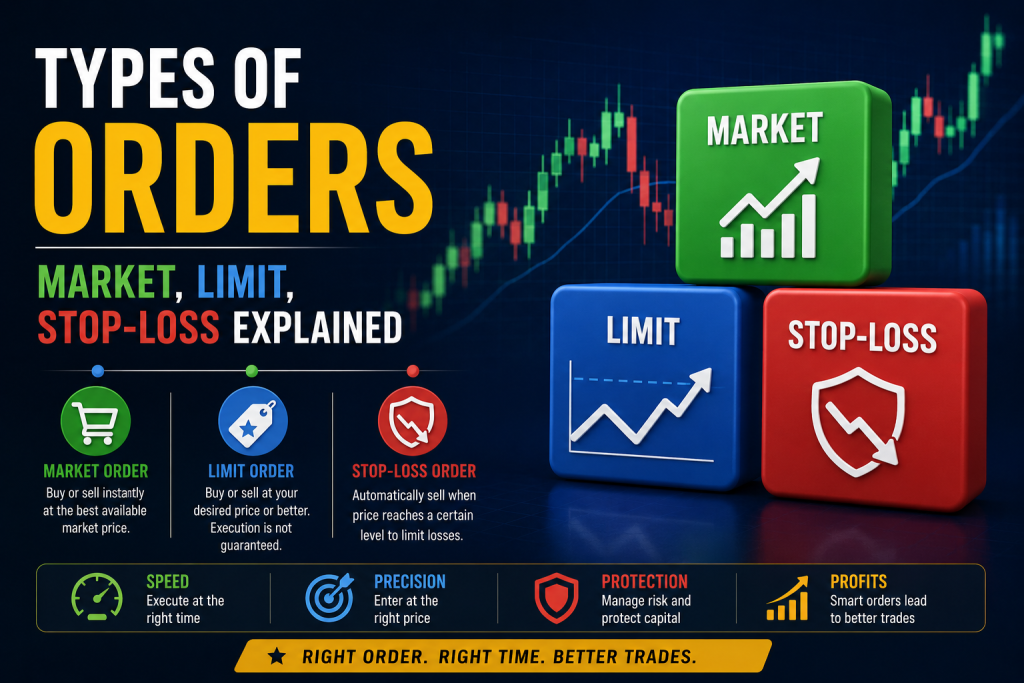
A trading order is a precise instruction given to a broker or a trading exchange to buy or sell a financial asset under specific, predetermined conditions.
According to the U.S. Securities and Exchange Commission (SEC), understanding how these types of orders work is critical because “the type of order you place can affect the price you pay.” Orders are the actual mechanisms that allow traders to:
- Enter new positions based on technical setups.
- Exit active trades to secure profits.
- Control and limit financial risk.
- Automate trade execution without constantly monitoring screens.
Without a structured approach to order management, traders are left exposed to emotional decision-making, erratic trade execution, and unpredictable market volatility.
Also Read: How to Open a Demat Account in India?
Why Understanding Types of Orders Matters
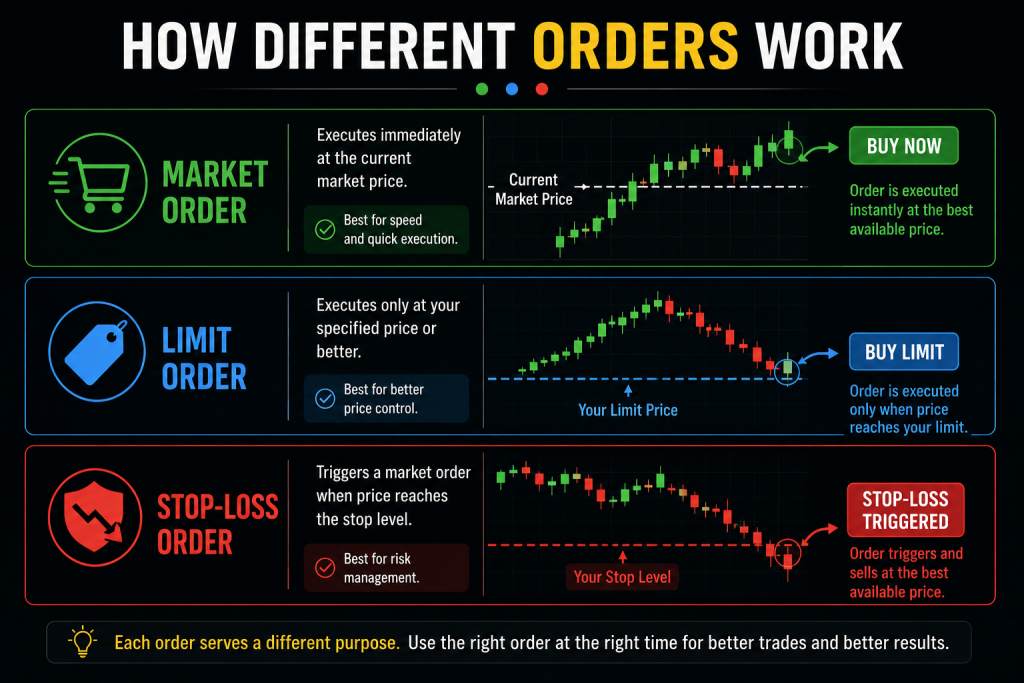
Different market conditions—ranging from tight consolidation phases to explosive, news-driven volatility—require vastly different types of orders to execute successfully. Professional traders do not just click “buy” or “sell”; they combine order types to construct structured, logical trading systems.
- Fast-moving markets (e.g., during major economic data releases) may necessitate Market Orders to guarantee entry, though at a cost to price precision.
- Precise entry points (e.g., entering on a pullback to a key support zone) require Limit Orders to capture specific price levels.
- Risk protection absolutely mandates the use of Stop-Loss Orders to prevent catastrophic drawdowns.
Mastering these distinctions results in better execution control, lowered transaction costs (via understanding maker vs. taker fees), and improved trading psychology.
What Is a Market Order?
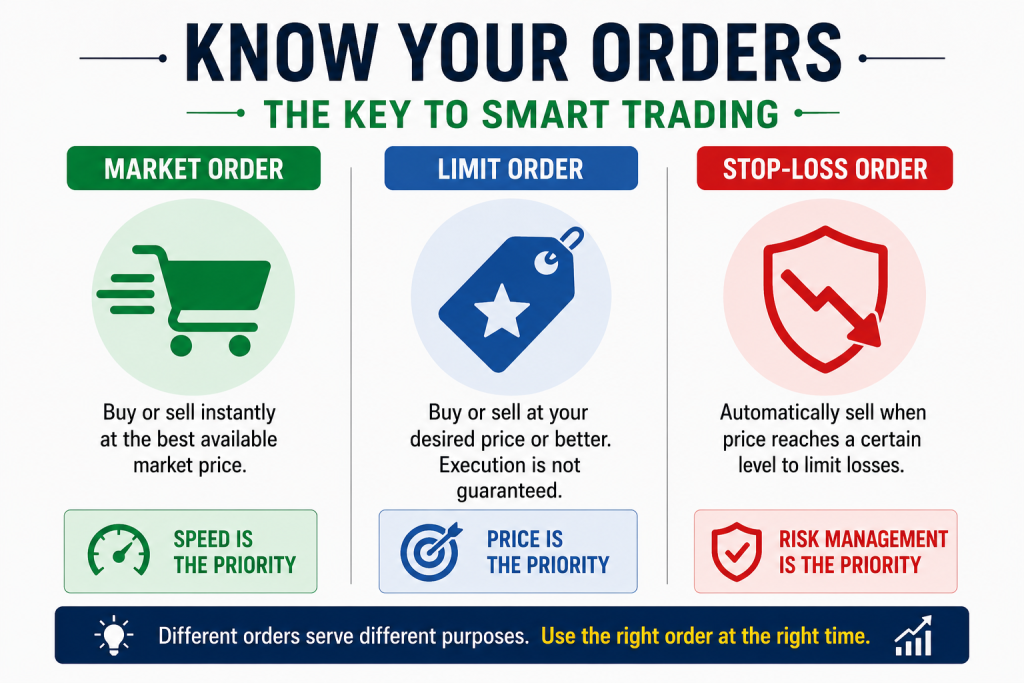
When exploring different types of orders, the Market Order is the most basic. It is an instruction to buy or sell an asset immediately at the best available current market price. When you use a market order, you are prioritizing speed of execution over price certainty.
When you place a market order, you are acting as a “taker” of liquidity, meaning your order is matched with the existing limit orders on the exchange’s order book.
Example of a Market Order
Suppose Gold (XAU/USD) is highly volatile during a New York session open and is currently trading around $2,350.50. You see an aggressive breakout on your chart and want to enter a long position instantly.
If you place a Market Buy Order, your broker will execute the trade immediately. However, because price is moving rapidly, your order might get filled at $2,350.50, $2,350.75, or even $2,351.00. This discrepancy is known as slippage.
Pros and Cons of Market Orders
Advantages:
- Instant Execution: Orders are executed almost instantly, ensuring you do not miss a fast-moving trend.
- Simplicity: Highly intuitive and ideal for beginners who just want to get into a position without calculating exact entry limits.
- High Probability of Fill: In heavily traded, highly liquid markets (like major forex pairs or blue-chip stocks), these orders are filled immediately.
Disadvantages:
- Slippage Risk: Your actual execution price may differ significantly from the quoted price you saw on your screen, particularly during high-impact news events.
- Poor Control Over Entry: You sacrifice precision, which can skew your risk-to-reward ratio.
- Dangerous in Low Liquidity: In “thin” markets, a large market order can sweep the order book, resulting in an incredibly poor average entry price.
What Is a Limit Order?
Among the various types of orders, a Limit Order allows traders to buy or sell an asset at a specific price or better. Unlike Market Orders, execution is strictly conditional; the trade will not execute unless the market reaches your exact specified price.
By using limit orders, you act as a “maker” of liquidity, adding your order to the exchange’s book. Because of this, many cryptocurrency and stock exchanges offer lower trading fees for limit orders compared to market orders.
Example of a Limit Order
Imagine you are conducting technical analysis on a chart and notice a strong institutional support block for a stock at ₹1,200. The current market price is ₹1,225.
You do not want to pay ₹1,225. Instead, you place a Limit Buy Order at ₹1,200.
- If the price drops to ₹1,200, your order is triggered and filled at that price (or lower).
- If the price rallies from ₹1,225 and never drops to ₹1,200, your order remains unfilled, and you miss the trade.
Pros and Cons of Limit Orders
Advantages:
- Total Price Control: You dictate the exact price you are willing to pay, allowing for precise risk-to-reward calculations.
- No Negative Slippage: You are protected from sudden, unfavorable price spikes.
- Strategic Entries: Perfect for price action traders who trade pullbacks, retracements, and specific supply/demand zones.
Disadvantages:
- No Guaranteed Execution: The market may miss your limit order by a single pip or tick and reverse in your forecasted direction, leaving you on the sidelines.
- Requires Patience: You must wait for the market to come to your levels, which requires strong psychological discipline.
What Is a Stop-Loss Order?
Of all the types of orders, a Stop-Loss is arguably the most important. It is an automated risk management tool designed to limit potential losses by exiting a trade once the price reaches a predefined invalidation level. According to FINRA’s Investor Insights, stop orders are vital for protecting profits and limiting downside risk without having to watch the market continuously.
Once the asset hits the “stop price,” the Stop-Loss order typically converts into a Market Order, selling (or buying back) the position immediately to stop the bleeding.
Example of a Stop-Loss Order
You enter a swing trade on a currency pair at 1.1050, expecting the price to rise. You analyze the chart and determine that if the price drops below 1.1000, your trade idea is completely invalidated.
You place a Stop-Loss at 1.1000.
- If the market trends against you and hits 1.1000, the broker automatically closes the trade, capping your loss at 50 pips.
Pros and Cons of Stop-Loss Orders
Advantages:
- Capital Protection: Prevents a manageable loss from turning into a blown account.
- Removes Emotion: Once set, it forces discipline, stopping the trader from hopelessly holding onto a losing position in denial.
- Automation: Allows you to step away from your trading desk safely.
Disadvantages:
- Stop Hunting / Liquidity Grabs: Temporary spikes in volatility can trigger your stop prematurely. Institutional algorithms often push prices just past obvious support levels to trigger retail stop-loss orders before reversing in the original direction.
- Slippage During Market Gaps: Because standard stop-losses convert to market orders, if a stock closes on Friday at ₹500 and opens on Monday at ₹450 due to bad news, a stop-loss set at ₹480 will be triggered at the new market price of ₹450, resulting in a larger loss than anticipated.
Comparing the 3 Types of Orders: Market vs. Limit vs. Stop-Loss
| Feature | Market Order | Limit Order | Stop-Loss Order |
| Primary Goal | Speed of execution | Price precision | Risk mitigation |
| Execution Speed | Immediate | Conditional (must hit price) | Conditional (triggers at price) |
| Price Control | Low (subject to slippage) | High (exact price or better) | Medium (converts to market) |
| Guaranteed Fill | Usually Yes (if liquid) | No | Usually Yes (after triggered) |
| Best Use Case | Breakouts, news trading | Buying pullbacks, selling at resistance | Protecting capital, trailing profits |
Advanced Best Practices for Order Execution
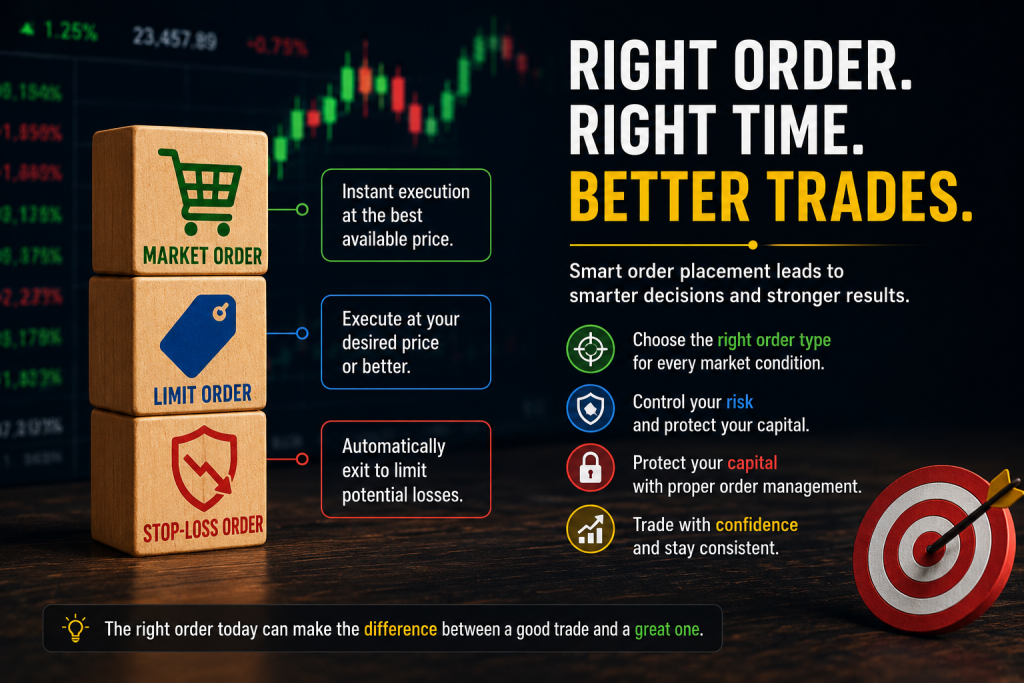
- Always Use a Hard Stop-Loss: Mental stops do not work. Professional traders prioritize capital preservation above all else. Every trade should have a defined exit point before it is executed.
- Understand Maker vs. Taker Dynamics: Frequent day traders should lean toward Limit Orders. By providing liquidity to the order book (Maker), you can drastically reduce the commission fees charged by exchanges over time compared to hitting Market Orders (Taker).
- Use Limit Orders for Take-Profits: When targeting a specific exit for profit, use a Limit Sell order. This ensures you get your exact target price without slippage eating into your gains.
- Beware of “Gapping” Markets: If you are holding positions over the weekend in traditional markets (stocks, forex), be aware that weekend news can cause the market to “gap” past your stop-loss on Monday morning.
Also Read: Intraday vs Swing vs Long-Term Trading: Complete Guide for Beginners
Conclusion
Understanding the diverse types of orders is a foundational skill for every trader and investor. Market Orders provide necessary speed, Limit Orders offer required precision, and Stop-Loss Orders are the ultimate shield for your trading capital.
There is no single perfect choice among these types of orders. Successful trading requires dynamic adaptation. You must choose your execution method based on current market volatility, your personal risk tolerance, your specific price action strategy, and the liquidity of the asset you are trading.
By mastering how and when to deploy these types of orders, you will instantly improve your trading discipline, drastically reduce emotional mistakes, and build a highly structured, professional approach to the financial markets.
Disclaimer: This article is for educational and informational purposes only and should not be construed as financial, investment, or trading advice. Financial markets involve substantial risk, and past performance does not guarantee future results. Always conduct your own independent research, test strategies on a demo account, and consult a qualified financial advisor before making live investment decisions.