Table of Contents
Introduction
Stock trading is one of the most popular ways to participate in financial markets. Every day, millions of traders buy and sell shares of companies listed on exchanges like the National Stock Exchange of India (NSE) and the Bombay Stock Exchange (BSE).
If you’ve ever wondered:
- What is stock trading?
- How does the stock market work?
- Can beginners start trading in India?
- Is stock trading profitable?
This comprehensive guide will answer all of these questions in simple language.
By the end of this article, you’ll understand how stock trading works, the different types of trading, practical examples, risks involved, and how to start your trading journey in India in 2026.
What Is Stock Trading?

What is stock trading? Stock trading is the process of buying and selling shares of publicly listed companies to profit from price movements. In this ultimate beginner’s guide, you’ll learn what stock trading is, how stock trading works, the major trading styles, and how to start stock trading successfully in India in 2026.
Stock trading is the process of buying and selling shares of publicly listed companies to profit from price movements.
When you buy a stock, you become a partial owner of that company. If the price rises, you can sell the stock at a profit. If the price falls, you may incur a loss.
Simple Definition
Stock trading means purchasing and selling company shares in the stock market to generate short-term or medium-term profits.
Real-Life Example
Suppose you buy 10 shares of Infosys at ₹1,500 each.
- Total investment = ₹15,000
- Price rises to ₹1,650
- Sell value = ₹16,500
- Profit = ₹1,500 (excluding brokerage and taxes)
If the price falls to ₹1,400:
- Sell value = ₹14,000
- Loss = ₹1,000
How Does Stock Trading Work?
Why Understanding What Is Stock Trading Matters
Before risking real money, it is essential to understand what is stock trading and how professional traders approach the market. Knowing what is stock trading helps beginners build realistic expectations, manage risk effectively, and develop a disciplined trading plan. Once you understand what is stock trading, you can choose the trading style that best matches your goals, personality, and available time.
Stock trading takes place on regulated stock exchanges where buyers and sellers transact electronically.
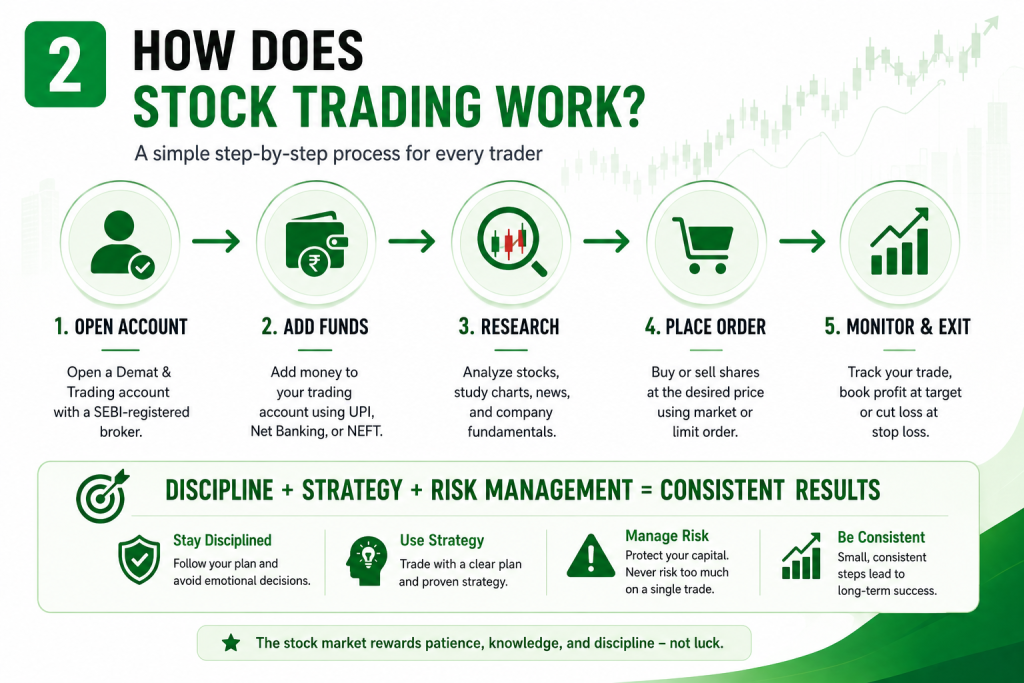
Step-by-Step Process
- Open a trading and Demat account.
- Deposit funds.
- Research stocks.
- Place a buy order.
- Wait for execution.
- Monitor price movement.
- Sell the stock to book profit or cut loss.
Key Participants
- Retail traders
- Institutional investors
- Brokers
- Market makers
- Regulators such as the Securities and Exchange Board of India (SEBI)
What Is Stock Trading and How Does It Work?
Now that you understand what is stock trading, you can begin your journey with confidence. Stock trading offers significant opportunities, but success depends on education, discipline, and risk management. By mastering the fundamentals of what is stock trading and following a structured plan, beginners in India can build the skills needed for long-term success.
Stock Trading vs Investing
| Feature | Trading | Investing |
| Holding Period | Minutes to months | Years |
| Goal | Profit from price movement | Long-term wealth creation |
| Frequency | High | Low |
| Risk | Higher | Moderate |
| Analysis Style | Technical and price action | Fundamental analysis |
Trading focuses on shorter-term opportunities, while investing focuses on long-term business growth.
Types of Stock Trading
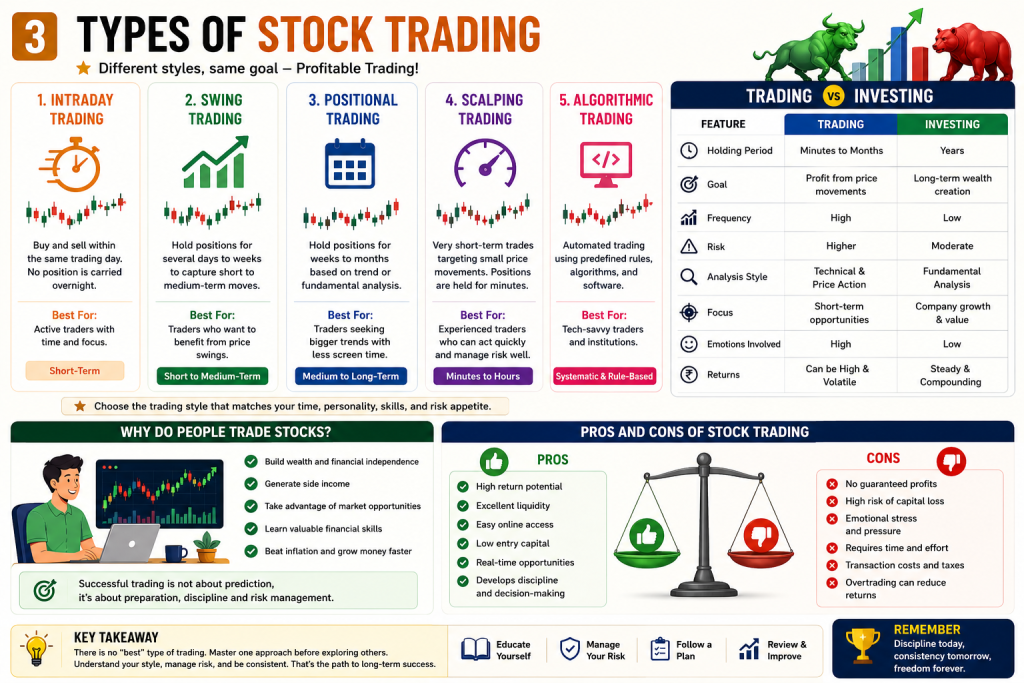
1. Intraday Trading
Buy and sell on the same day.
2. Swing Trading
Hold positions for several days to weeks.
3. Positional Trading
Hold trades for weeks to months.
4. Scalping
Very short-term trading targeting small price movements.
5. Algorithmic Trading
Automated trading using predefined rules and software.
Example of a Stock Trade
Imagine you identify a breakout in Reliance Industries.
- Entry Price: ₹2,800
- Stop Loss: ₹2,760
- Target Price: ₹2,920
- Risk per Share: ₹40
- Reward per Share: ₹120
- Risk-Reward Ratio: 1:3
If you buy 100 shares:
- Total Risk = ₹4,000
- Potential Reward = ₹12,000
This structured approach helps traders manage risk.
Why Do People Trade Stocks?
People trade stocks to:
- Build wealth
- Generate side income
- Achieve financial independence
- Take advantage of market opportunities
- Learn valuable financial skills
Benefits of Stock Trading
Potential Advantages
- High return potential
- Excellent liquidity
- Easy online access
- Low entry capital
- Real-time execution
- Wide educational resources
Risks of Stock Trading
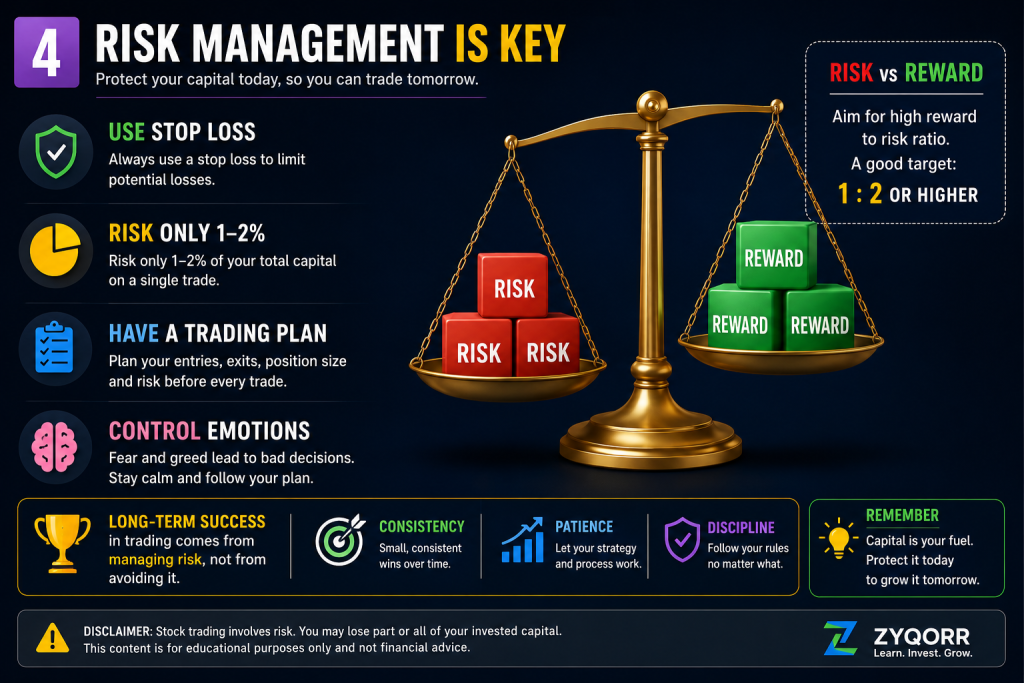
Key Risks
- Capital loss
- Emotional decision-making
- Overtrading
- Use of leverage
- Market volatility
- News-driven gaps
Important Reality
Most beginners lose money initially due to poor risk management, lack of discipline, and unrealistic expectations.
Pros and Cons of Stock Trading
Pros
- Flexible and accessible
- Can be started with modest capital
- Opportunity for consistent returns with discipline
- Strong learning potential
Cons
- No guaranteed profits
- Requires time and effort
- Emotional pressure
- Transaction costs and taxes
- Significant risk of losses
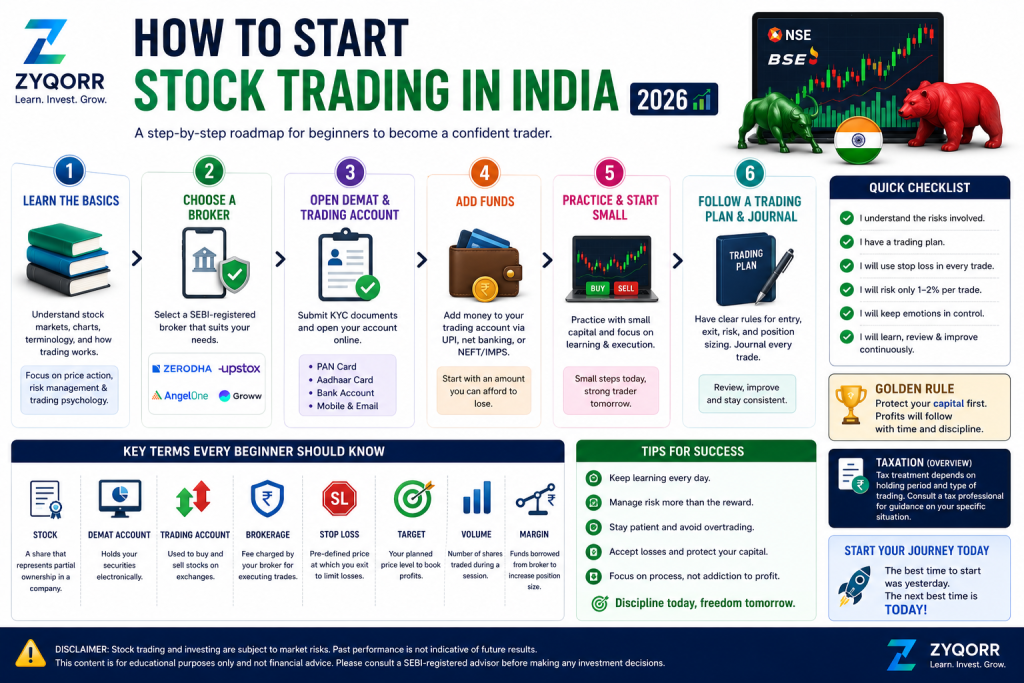
How to Start Stock Trading in India (2026)
Step 1: Learn the Basics
Understand:
- Candlestick charts
- Support and resistance
- Risk management
- Trading psychology
Step 2: Choose a SEBI-Registered Broker
Popular brokers include:
- Zerodha
- Angel One
- Upstox
- Groww
Step 3: Open a Demat and Trading Account
You’ll need:
- PAN card
- Aadhaar card
- Bank account
- Mobile number
- Email ID
Step 4: Practice With Small Capital
Start with small position sizes while focusing on execution quality.
Step 5: Maintain a Trading Journal
Record:
- Entry and exit
- Stop loss
- Target
- Trade rationale
- Emotions
- Lessons learned
Step 6: Follow a Trading Plan
Define:
- Setup rules
- Position sizing
- Risk limits
- Daily routine
Essential Terms Every Beginner Should Know
Stock
A share representing ownership in a company.
Demat Account
Electronic account that holds securities.
Trading Account
Used to buy and sell securities.
Brokerage
Fee charged by your broker.
Stop Loss
Predefined exit to limit losses.
Target Price
Planned exit point for profits.
Volume
Number of shares traded.
Margin
Borrowed funds provided by a broker.
Taxation of Stock Trading in India (Overview)
Tax treatment depends on holding period and transaction type.
- Intraday equity trading profits are generally treated as speculative business income.
- Delivery-based gains may be taxed as capital gains.
- Securities Transaction Tax (STT), stamp duty, and brokerage also apply.
Tax rules can change, and your specific situation matters. Consult a qualified chartered accountant or tax professional before making decisions.
Common Mistakes Beginners Should Avoid
- Trading without a plan
- Risking too much on one trade
- Ignoring stop losses
- Following tips blindly
- Overtrading
- Revenge trading
- Using excessive leverage
- Neglecting a trading journal
Is Stock Trading Profitable?
Yes, stock trading can be profitable, but profitability depends on:
- Education
- Risk management
- Consistency
- Emotional discipline
- Realistic expectations
Successful trading is a skill developed over time, not a guaranteed shortcut to wealth.
Frequently Asked Questions (FAQs)
Is stock trading legal in India?
Yes. Stock trading is legal when conducted through SEBI-registered brokers and regulated exchanges.
How much money do I need to start trading?
Many brokers allow beginners to start with relatively small amounts. The appropriate capital depends on your strategy and risk tolerance.
Can I trade using my mobile phone?
Yes. Most brokers provide mobile apps for order placement and portfolio tracking.
Is stock trading gambling?
No. Trading based on analysis, risk management, and a structured plan differs from gambling. However, undisciplined trading can resemble speculative behavior.
Which is better: trading or investing?
It depends on your goals, time commitment, and temperament.
Can beginners become profitable?
Yes, but it typically requires education, practice, and discipline over a sustained period.
Practical Beginner Checklist
Before placing your first trade, ask yourself:
- Do I understand why I am entering this trade?
- What is my stop loss?
- What is my target?
- Is the risk-reward ratio favorable?
- How much capital am I risking?
- Have I accepted the possibility of loss?
If you cannot answer these questions clearly, it may be better to wait.
Authoritative References
- SEBI Investor Education
- NSE India Learn Section
- BSE India Investor Education
- Income Tax Department of India
Final Thoughts
Stock trading offers exciting opportunities, but it also carries meaningful risk.
The most successful traders treat trading as a business rather than a shortcut to quick riches. They focus on education, disciplined execution, and protecting capital.
If you are a beginner in India, start small, learn continuously, and prioritize risk management above everything else.
Remember:
Your first goal in trading is not to make money. Your first goal is to survive long enough to develop a profitable edge.
Financial Disclaimer
This article is for educational and informational purposes only and should not be considered financial, investment, legal, or tax advice. Stock trading involves risk, including the potential loss of principal. Past performance does not guarantee future results. Always conduct your own research and consult a SEBI-registered investment adviser or qualified professional before making investment decisions.
Also Read: How Crypto Trading Works (Simple Explanation): A Beginner’s Guide
About Zyqorr
Zyqorr.com provides educational content on stock trading, investing, cryptocurrency, cybersecurity, and personal finance to help readers make informed decisions with confidence.